


Coexistence is not unity. Geography is not belonging. Until we face that, we are not building a nation. We are only maintaining a ceasefire.
By Themba Khumalo
The goals and desires of South Africans are still racially divided. Stop whispering it. Stop coating it with rainbow-coloured euphemisms and the soft soap of diplomatic cowardice.
This truth — uncomfortable, unvarnished, stubborn as winter smoke — sits at the dead centre of our public life. It exposes us not as a nation united in purpose, but as a country sharing a flag, a passport, and a brittle myth we have the nerve to call “unity”.
For all the speeches, slogans, and ceremonial doves released into an indifferent sky, South Africans do not want the same things—for or from this land. Not even close. We do not fear the same dangers. We do not dream the same dreams. We live in parallel emotional universes, carved long before 1994, still fenced off by history and habit — and we have the audacity to act surprised when they surface.
We are not building a nation—we are only maintaining a ceasefire.
We live together. But not with each other. There is a difference, and our refusal to face it is killing us.
Look at sport — our supposed balm for old wounds, the great national anaesthetic. Rugby, we are told, unites us. The Springboks’ victories have coaxed new supporters into the fold, and the crowds are more mixed than they were. Peel back the green and gold, and the bones of the past still protrude, sharp as ever.
Rugby’s heartbeat beats strongest in white Afrikaner spaces. Support is growing across races, but it is not yet symmetrical, and pretending otherwise is a comfort for people who cannot stomach the full picture.
Meanwhile, football stays overwhelmingly Black — vibrant, beloved, and yet treated by many white South Africans as though it were an import rather than the nation’s most popular sport.
The bones of the past still protrude, sharp as ever.
It is the country’s clearest cultural X-ray: we cheer from different stadiums because we come from different worlds, and no amount of Springbok euphoria changes that by morning.
Sport is not a mirror that shows us a family portrait. It is a mosaic of strangers who occasionally embrace across a fence and mistake that embrace for a sense of belonging.
Our public holidays reveal the same fracture, running deep and clean as a fault line. Take Heritage Day: for some, it is little more than an excuse to braai — a pleasant afternoon of meat and cold beer, stripped of any meaning that might cause discomfort. For others, it is a moment of cultural remembrance, a reclaiming of identity that has been beaten out of people for generations.
Then there is Freedom Day: for millions, it is a celebration of redemption — hard-won, blood-soaked, real. For others, it is a day of bitterness, nostalgia, or political resentment dressed up as concern for the country.
We all mark the same dates on the calendar. The emotional meaning is scattered, contradictory, and flatly incompatible. We do not celebrate together. We perform togetherness with each other, and then go home.
Even our fears betray us. Crime, the great national obsession, does not strike us in the same shape or with the same urgency. Behind high walls and electric gates, it is a policing failure, a management problem, a dinner-table topic. In a township, it is an economic tragedy — a symptom of unemployment, hunger, and a state that abandoned the poor long before rolling blackouts became a personality trait.
Same country. Same crisis. Different realities — and the chasm between them is not a misunderstanding. It is a structure.
You cannot build a national agenda when nightmares are colour-coded. When the thing that terrifies you depends on which side of a wall you were born on, you are not one people. You are two people sharing a postal code and calling it a country.
This division is not an accident, nor the result of bad manners or poor political taste. It is the legacy of a centuries-long social engineering project executed with surgical cruelty and the full backing of the state.
Apartheid did not simply separate bodies; it separated imaginations. It built different worlds — different schools, different suburbs, different histories, different expectations of what life was allowed to look like. It erected fences inside minds, and those fences do not come down because a constitution was signed and Mandela smiled for the cameras.
The rainbow was always a mirage, painted over the scars we refused to name.
We pretend, with cautious self-serving optimism, that thirty-two years is enough to undo centuries.
It never was. Anyone who told you otherwise was selling something you should not have bought.
Race remains the strongest predictor of daily life in this country: whether you live behind a fence or in a shack, whether your school has a library, whether you have a working toilet, whether you worry about property tax or your next meal.
These circumstances forge different desires, different politics, different definitions of what the country is. A person fighting for survival does not dream like a person fighting for a tax cut. They are not the same animal. No amount of nation-building rhetoric will paper over that canyon.
The Rainbow Nation never collapsed. It simply never existed. It was always a slogan looking for a country to inhabit.
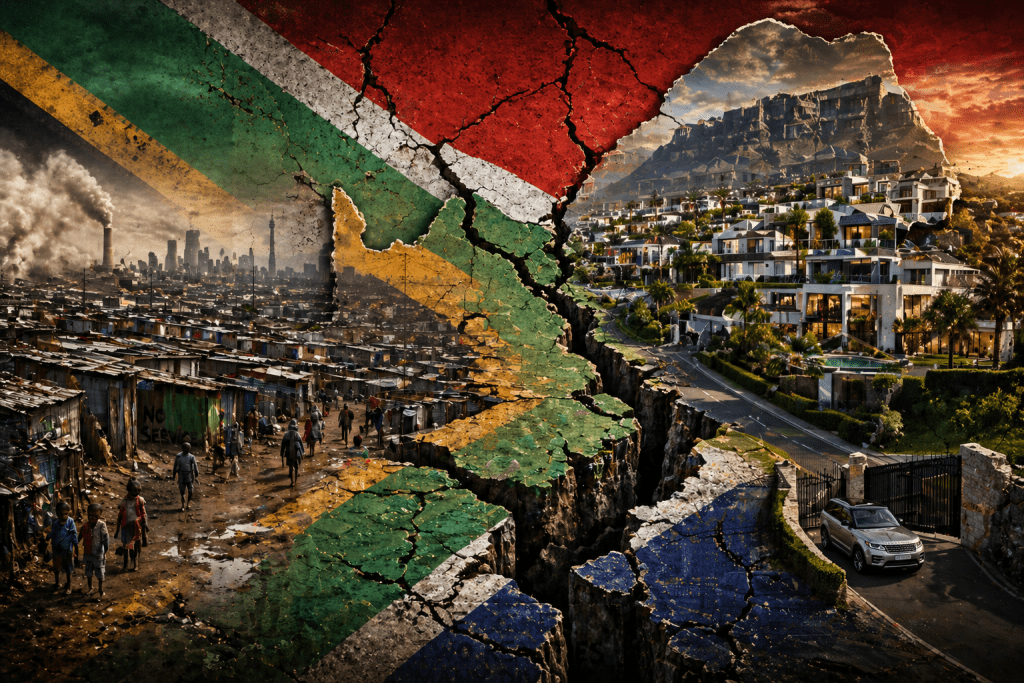
South Africa is, by every technical measure, a country. We have borders, laws, elections, and a flag. But a nation? A nation is held together by a shared sense of destiny — a gut-level belief that we sink or swim together, that your suffering diminishes me and your flourishing lifts me, that your child’s school matters to me even if mine does not.
We do not have that. We have never had that. We have islands of identity floating in a single ocean — sometimes colliding, often drifting apart, occasionally pretending the water between them does not exist.
Until we face this truth without sentimentality or spin — without reaching for the Mandela quote or the 1995 World Cup photograph — we will keep mistaking coexistence for unity and geography for belonging. That mistake is not innocent. It is a choice. A convenient one.
The gap between what we are and what we tell ourselves we are—that is where the rot festers.
Admitting that we are a country without a nation is not defeat. It is the first honest thing we will have said in years. Honesty — the kind our politics, our public rhetoric, and our dinner-table conversations have spent thirty-two years avoiding — is the only foundation on which anything real can be built.
We can become a nation. We are not one yet. The gap between what we are and what we tell ourselves we are — that is where the rot festers. We have been feeding it for three decades.
Nationhood will not be built by hashtags, nor by performative speeches about “unity”, nor by plastering over cracks with a World Cup victory and a week of flag-waving. It will be built the hard, slow, painful way — and that way has a specific shape.
It means integrated public schools, not the fee-based segregation we dress up as choice. It means land and housing policy that stops shuffling poverty around and starts dissolving the spatial apartheid we still inhabit. It means a political class willing to lose an election over the truth rather than win one on a lie.
None of this is happening. All of it is possible. The distance between those two sentences is a political choice — and to understand who is making it, you have to understand what was done to this country, and who, since then, has chosen to leave it undone.
Coexistence is not unity; geography is not belonging.
Apartheid built the wound. That is its crime, and history has recorded it. Nobody serious expects a wound centuries in the making to heal in thirty-two years. What history is recording — quietly, patiently, damningly — is something narrower and more damning: the failure to seriously begin. The schools were not integrated. The land was not redistributed. The spatial apartheid was not touched.
Those are not the failures of time. They are the failures of political will. The wound was inherited. The neglect was chosen. The people responsible for that neglect know exactly what they are doing.
Until then, we remain what we are: not one nation but many, each pulling the blanket towards its own cold feet, each certain it is the other one doing the pulling.
That is the truth. And the longer we take to say it plainly, the longer we spend mistaking a ceasefire for peace.