

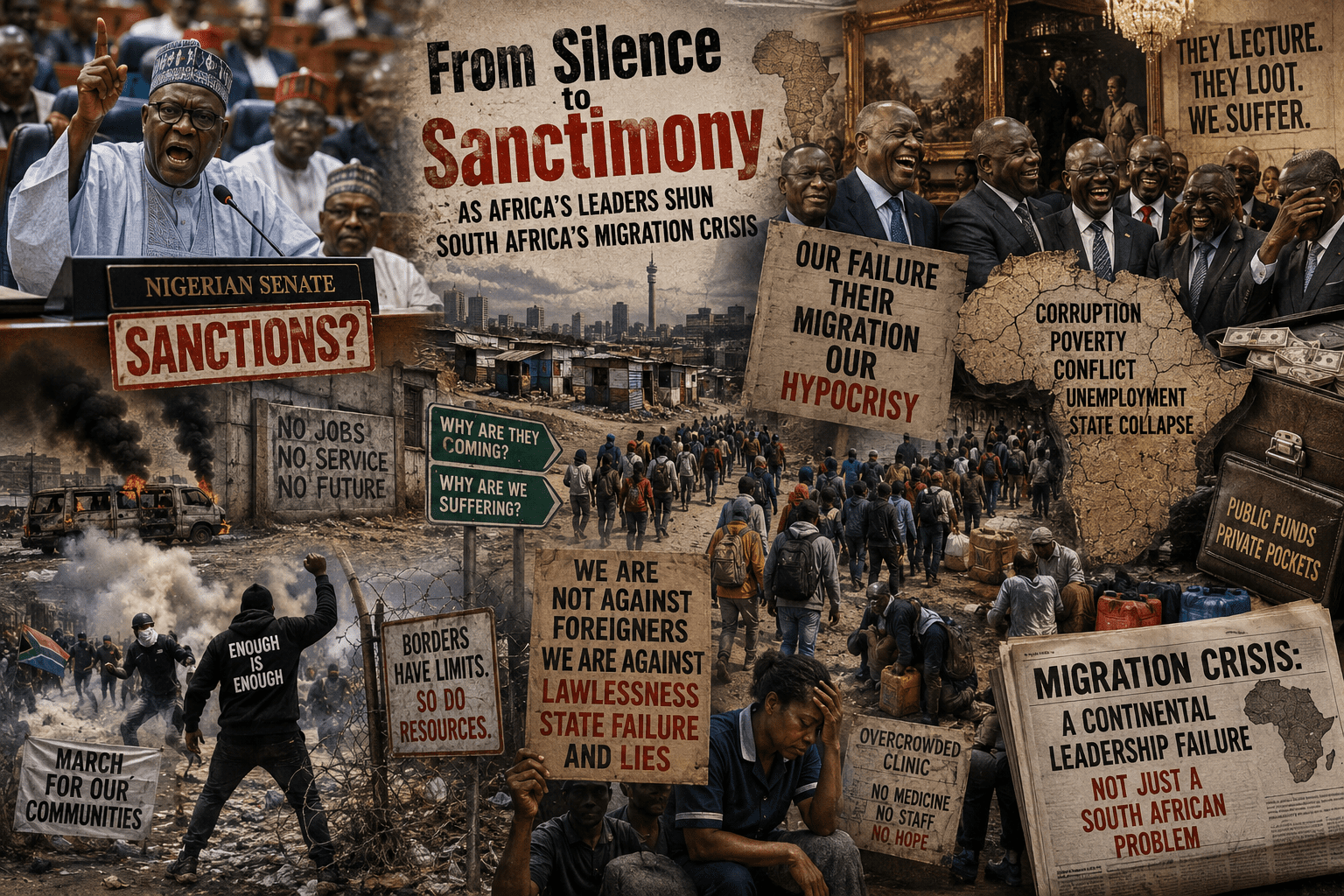
While politicians trade blame and rewrite history, ordinary people navigate the rubble of broken systems and empty outrage. South Africa’s migration pressures are woven into the failures of leadership across the continent. As those in charge look away, the wounds of denial and neglect continue to deepen, crossing every border.
By Themba Khumalo
There is an especially nauseating arrogance that creeps into political discourse when outrage becomes theatre and memory becomes currency.
The latest performance from sections of the Nigerian senate belongs firmly in that category: loud, sanctimonious, selective and dripping with moral vanity. South Africa has many crises. It has a violent crime epidemic, collapsing municipalities, catastrophic unemployment, porous borders and a political class that governs with the energy of exhausted undertakers. But what it does not need is a lecture from politicians presiding over one of the most spectacular governance failures on the African continent.
The sheer audacity of Nigerian lawmakers threatening sanctions against South Africa over alleged xenophobia would be comic if it were not so grotesquely dishonest. It is like watching an arsonist condemn smoke damage.
Of course, criminal attacks against foreign nationals are wrong. Mob intimidation is wrong. Lawlessness is wrong. Any South African who assaults another human being because of nationality disgraces both the Constitution and basic civilisation. That truth is non-negotiable. But what is equally non-negotiable is the truth Nigerian politicians desperately want buried beneath the emotional fog of apartheid nostalgia and diplomatic guilt manipulation.
South Africans are not hallucinating the pressure on public services, informal economies, policing and labour markets. They are living it daily. In overcrowded clinics. In hijacked buildings. In criminal syndicates. In undocumented labour networks. In communities where the state has collapsed so thoroughly that citizens are left competing for scraps beneath a government banquet of corruption.
Yet every time ordinary South Africans raise these realities, the political and media priesthood reaches for the same lazy incantation: xenophobia. That word has become the political equivalent of tear gas — deployed not to clarify, but to blind.
This is not to deny that xenophobia exists or to excuse it, but rather to insist that not all anger is rooted in hatred of ‘outsiders’.
The Nigerian Senate debate was drenched in the usual emotional blackmail. South Africa must “remember apartheid”. South Africa must “respect Nigeria’s support”. South Africa owes eternal diplomatic obedience because Nigeria stood against white minority rule decades ago.
But solidarity during apartheid was not an investment portfolio accruing permanent moral interest.
Nigeria did not support the anti-apartheid struggle as an act of charity to future generations of South Africans personally. It was part of a continental struggle against racial tyranny. To now weaponise that history as a shield against criticism of migration realities or criminality is intellectually fraudulent. Liberation history is not a diplomatic protection racket.
The real obscenity lies elsewhere: in the hypocrisy of African political elites who manufacture refugees with one hand and demand moral applause with the other.
Millions of Africans do not leave functioning, prosperous, safe societies for the thrill of crossing borders. They leave because political elites have vandalised their own states with the appetite of locusts. Corruption has eaten through institutions across large parts of the continent like acid through cheap metal. Youth unemployment festers. Infrastructure collapses. Electricity grids fail. Universities decay. Criminal syndicates flourish where governments retreat. Politicians loot public funds while citizens queue for visas and survival.
Then, when those citizens migrate southward in enormous numbers toward Africa’s most industrialised economy — itself deeply unstable and economically wounded — South Africans are expected to absorb the pressure silently, indefinitely and gratefully.
Any resistance—even when it is clumsy or ill-expressed—is immediately packaged as barbarism, regardless of its underlying causes.
This is the central dishonesty poisoning the debate.
South Africa’s immigration crisis did not emerge in a vacuum. It emerged because the African continent is governed too often by elites who treat state coffers like casino chips and national planning like an optional hobby.
The surge of anger in South Africa over migration is not simply about “hatred of foreigners”. It is the visible scar tissue of continental governance failure.
And that truth terrifies politicians.
Because once the emotional smoke clears, uncomfortable questions begin to surface.
Why are so many young Africans fleeing their own countries in the first place?
Why are African governments so incapable of creating stable economies that their citizens risk illegality, exploitation and hostility elsewhere?
Why must South African townships absorb the consequences of failures manufactured thousands of kilometres away by ruling elites insulated behind convoys and palace gates?
What often deepens South African frustration is the perception that outrage becomes loudest and most organised when tensions erupt inside South Africa, while broader continental failures driving migration — corruption, economic collapse, conflict, institutional decay and political mismanagement — rarely provoke the same sustained fury from African political elites. Parliamentary chambers suddenly thunder with moral condemnation, yet the deeper crises pushing millions to leave their own countries are too often discussed in whispers, excuses and diplomatic euphemisms.
This selective outrage reeks of opportunism.
South Africa is expected to carry the emotional burden of Pan-African solidarity while simultaneously being denied the sovereign right to debate immigration, border control, criminal infiltration or economic strain without immediate accusations of fascism.
No serious country on earth operates like that.
Even Europe — which endlessly lectures Africa about tolerance — has tightened borders, expanded deportations and hardened migration policy under pressure from its own citizens. The United States militarises sections of its border. Britain debates immigration obsessively. Yet when South Africans raise similar concerns amid 32% unemployment and social collapse, they are portrayed as uniquely primitive.
The hypocrisy could choke a furnace.
This does not absolve South Africa’s government. Far from it. The ANC has governed immigration with the competence of a leaking bucket. Border management is weak. Documentation systems are chaotic. Enforcement is inconsistent. Public communication is cowardly. Into that vacuum marches populism, vigilantism and rage.
When governments fail to regulate migration lawfully and transparently, extremists inevitably rush in to perform the state’s abandoned duties theatrically and violently.
March and March and other similar formations did not emerge from nowhere. It emerged from a vacuum created by state paralysis. That does not legitimise excesses or intimidation. But pretending such movements are born purely from irrational hatred is political dishonesty of the highest order.
The Nigerian Senate can scream about sanctions if it wishes. It can wrap itself in anti-apartheid nostalgia and perform outrage for television cameras. But none of that changes the harder continental truth pounding beneath the noise:
Africa’s migration crisis is, first and foremost, a leadership crisis.
Not a South African crisis alone.
A continental one.
Until African leaders confront corruption, economic collapse, elite theft, insecurity and governance failure inside their own borders, migration tensions will intensify everywhere. No amount of sanctimony in parliamentary chambers will erase that reality.
And South Africans are increasingly tired of being told to apologise for noticing it.