

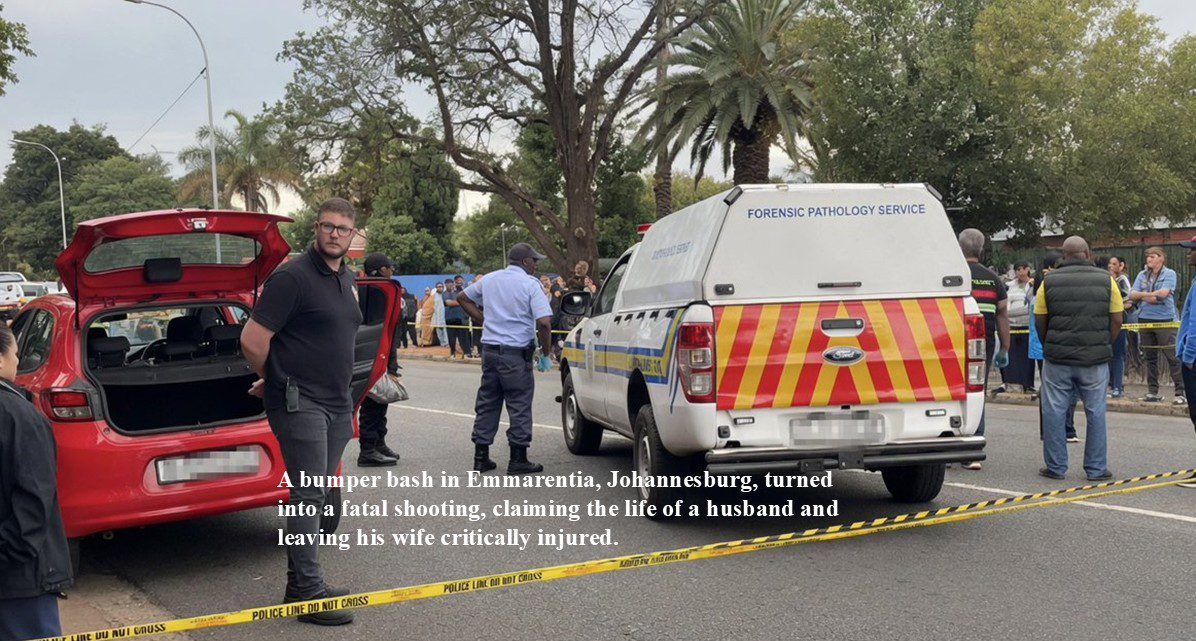
What began as a minor bumper bash in a suburb north of Joburg turned into unimaginable tragedy—gunfire cutting through the moment, a husband killed, and his wife left fighting for her life, all unfolding in full view of children who should never have witnessed such horror.
By Themba Khumalo
In Emmarentia, Johannesburg, last Saturday did not begin like a day destined for horror. It began the way most days do in a suburb like this—quietly, almost innocently, with a family in a car moving through the ordinary rhythms of life.
There probably were errands to run, or perhaps no destination at all beyond the simple fact of being together; sharing space, sharing breath, sharing the unremarkable continuity that families rarely question until it is gone.
Nothing in that moment gave a warning. Not the sunlight, not the traffic, not the passing streets that carried on indifferent to what was about to unfold. There was no omen in the air, no fracture in the surface of things. Only the fragile illusion that the day would remain what it was.
What unfolded was a rupture—instant, violent, and absolute. The kind no human mind is ever truly prepared for, when a passing moment splits into something final and irreversible, searing itself into memory long after the sirens have faded.
A bumper bashing. The kind of scrape that happens on South African roads every single day and is usually forgotten by lunchtime. But on this particular Saturday, two drivers got out of their cars, and the ordinary world cracked open…and was captured on video.
In it, you see a physical altercation between two men—voices rising, bodies closing the distance, that familiar South African choreography of anger teetering on the edge of control. You see a woman—a wife, a mother—rush to her car, return with a firearm, and she hands it to her husband.
He fires a shot into the ground, a gesture meant to intimidate. And then you see the moment everything goes irreversibly wrong, because the man standing opposite him was also armed, and his response was not a warning shot fired into the tarmac. The husband was shot dead. His wife was shot and critically wounded. And then you see the children — small, bewildered, devastated children, crouched over their father’s lifeless body, reaching for their mother who could not reach back.
I watched that video only once. Once was, in truth, far too many times. There are certain things that, once seen, take up permanent residence behind your eyes — they move in quietly, uninvited, and they never quite leave. It has settled into me like a stone dropped into still water, and the ripples have not stopped.
I have been confronted with road rage many times. I have felt that hot, irrational surge of fury rise in my chest when someone cut me off, when someone hooted at me as though I were an inconvenience. I have gripped a steering wheel so tightly that my knuckles have forgotten their colour.
In those moments, I have made a choice that I now wear not as a badge of shame, but as one of quiet, deliberate survival. I have chosen to be a coward. I have chosen to breathe, to swallow the indignity, to look away, to drive on. I have chosen my life over my pride, and I would make that same cowardly, beautiful choice a thousand times over.
Because pride, as it turns out, is a terribly poor exchange for everything that matters.
South Africa, we need to speak plainly to one another — without softness, without diplomatic distance. We are a wounded, exhausted, deeply traumatised people, and that trauma has not been healed; it has been compressed beneath the surface of our daily lives until the smallest spark — a hooting car, a rude gesture, a scraped bumper — causes it to detonate with consequences that are disproportionate to their origins.
We carry our pain into our cars with us. We carry our financial stress, our unemployment anxiety, our grief, our sense of injustice, our accumulated humiliations. And then someone cuts us off in traffic, and suddenly all of that compressed suffering has a face and a target, and we unleash upon a stranger the full weight of everything we have been quietly carrying for years.
This is not an excuse. It is an explanation. Understanding why we are this way is the first step towards choosing to be otherwise. Because we can choose otherwise. We must.
As a citizen who drives on these roads, who has felt that same volcanic anger and understands the seductive pull of refusing to back down — there is something in us, something ancient and stubborn and deeply human, that resists retreat.
We have been conditioned to believe that walking away is weakness, that absorbing an insult without retaliation is a kind of defeat. What does winning actually mean when both parties are standing in the middle of a public road, hearts hammering, adrenaline flooding their systems, rationality entirely abandoned?
Winning, in that context, is nothing more than surviving. Winning is driving home. Winning is sitting down to dinner with your family that evening. Winning is being alive.
You may be furious. You may be entirely in the right. The other driver may have been reckless, inconsiderate, and dangerous. None of that matters, not even slightly, in the face of this one immovable truth: you do not know who is in that other car. You do not know what they are carrying — not in their hearts, and not in their glove compartments.
This country has made it heartbreakingly clear that there is always someone angrier than you, always someone with less to lose — someone who has crossed over into a place where consequences have ceased to register.
No argument is worth entering that territory. No dented bumper, no rude gesture, no perceived slight is worth the price of your presence in the lives of the people who love you.
And if you will not do it for yourself — if your pride is still whispering that retreat is beneath you — then I am asking you to do it for the children in your back seat. Do it for the small faces that are watching you, learning from you in ways that you will never fully be able to measure. Children do not learn from what we tell them; they learn from what we show them.
When you step out of that car with your jaw set and your fists ready, you are teaching them something. When you reach into the cubbyhole for a weapon, you are teaching them something. And when the worst happens — as it did last Saturday, as it does with devastating regularity on South African roads — they are left to carry the lesson of that teaching for the rest of their lives, in the most unbearable way imaginable.
Those two children who knelt over their father’s body and reached for their unresponsive mother did not choose to be there. They were brought there by the choices of the adults who loved them and were supposed to protect them. I do not write this to condemn a woman who has already paid an unimaginable price. I write it because the rest of us still have the chance to choose differently.
Guns are instruments of last resort. They exist for the moment when your life or the life of someone you love is in genuine, immediate danger, and there is no other way out. They are not props in a confrontation. They are not tools for making a point.
The moment you introduce a firearm into an argument, you have not raised the stakes — you have removed the ceiling entirely. There is no coming back from a gun drawn in anger.
The other driver has been arrested. But none of this will restore a father to his children. None of it will reach into those children’s dreams and remove what they have seen. Justice, in this instance, is cold comfort. Justice is what you reach for when prevention has already failed. Prevention is what I am pleading for today.
South Africa, we are better than this. I believe that with the whole of my heart, even on the days when the evidence makes belief difficult. We are a people who have survived things that would have broken other nations, not through violence but through an extraordinary, hard-won capacity for grace. We have it in us. But grace does not arrive automatically; it must be chosen, actively, in the moments when everything in us is screaming for something else.
Choose it in the car. Choose it on the road. Choose it when your blood is up, and your hands are shaking, and the other driver is saying things that make you want to climb out and respond in kind. Choose the deep breath. Choose the turned cheek. Choose the undignified, life-preserving, family-protecting decision to simply drive away.
Call yourself a coward if you must. I have made my peace with that word. I call myself alive. I call myself present. I call myself someone who will be home tonight, and tomorrow, and the day after that.
To the soul who departed on that Johannesburg road last Saturday — may you find the peace that the living so desperately need to find for themselves. And to the two children left behind, carrying something no child should ever have to carry: I am so profoundly, achingly sorry. You deserved better from the world that day.