

A Joburg mother of two faces possible bankruptcy over a water bill that has climbed to nearly R3 million. This number alone should trigger Joburg City’s alarm bells. Instead, it appears to have triggered nothing but bureaucratic deflection.
By Themba Khumalo
I was reading a news report by GroundUp when my jaw dropped. It was not a gentle, theatrical slow-motion drop for show, but a reaction so forceful and disbelieving it felt as though my jaw struck the floor with a violent, bone-shaking thud.
This was not a passing shock. It was the kind that leaves you momentarily winded, mouth dry, mind racing.
What followed was not confusion or disbelief, but fury—the kind that burns in your chest and makes your hands shake.
The more I read, the angrier I became. This was not some minor clerical mistake. It was something much darker: a system so unmoored from reality, so coldly indifferent, that it can drive an ordinary resident to the brink of financial ruin—and then have the gall to insist it is right.
Let me emphasise that what is contained in the report is not just a mistake. It is something far worse: a system that refuses to correct itself even when reality is screaming in its face.
The report tells the story of Jenny-Lee Bot, a Joburg mother of two who now faces possible bankruptcy over a water bill that has climbed to nearly R3 million. That figure alone should have triggered urgency, scrutiny, and perhaps correction. Instead, it has been met with denial and bureaucratic deflection.
Her ordeal began with a sudden, inexplicable surge — from R1,334 to R454,192 in a single month. No gradual increase. No credible explanation. Just a number so massive it borders on the absurd…a figure that makes no practical sense.
And then it kept going.
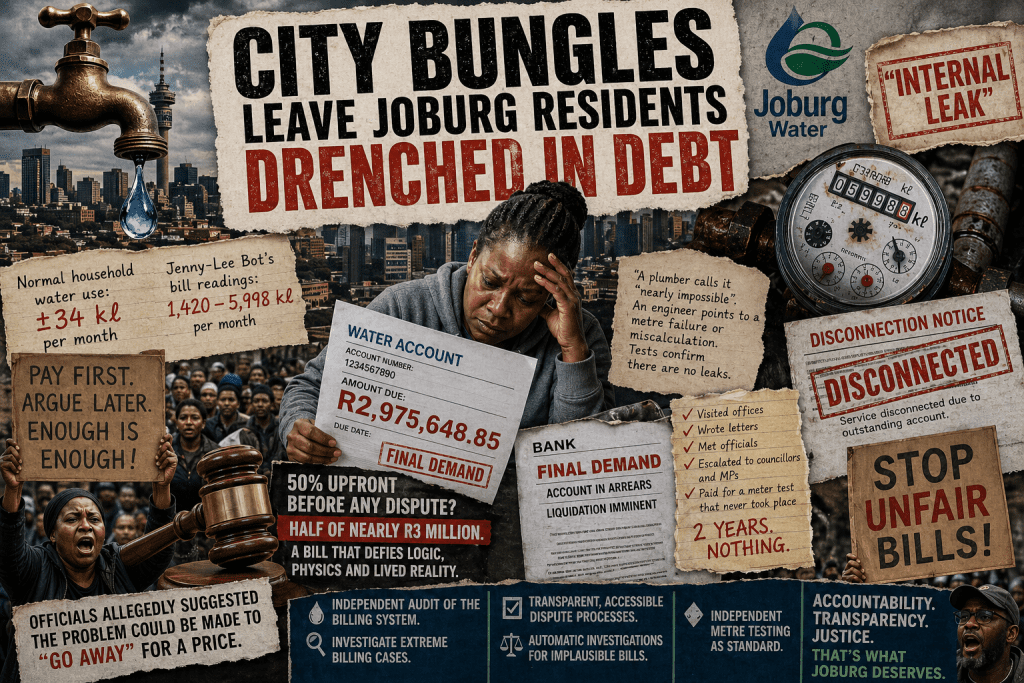
For months, the readings suggested water usage between 1,420 and nearly 6,000 kilolitres. To put that plainly, a normal household uses around 34 kilolitres a month. What Bot was billed for would require millions of litres — the kind of volume that does not hide. It floods. It destroys. It leaves evidence everywhere.
Yet there was nothing.
No swamp where a garden should be. No collapsing ground. No water tearing through walls. Nothing to suggest that even a fraction of that water had ever existed on the property. Experts have said so clearly. A plumber calls it “nearly impossible”. An engineer points to a metre failure or miscalculation. Tests confirm there are no leaks.
Reality is not ambiguous here.
What is ambiguous — or rather, wilfully ignored — is how Joburg Water and the City of Joburg continue to respond. Their answer has been as predictable as it is inadequate: “internal leak”.
It is a convenient phrase. It shifts blame. It closes the conversation. It allows the institution to stand untouched while the individual carries the burden. The problem is that it does not withstand even the most basic scrutiny.
And still, they persist.
Worse, before any proper dispute can even begin, Bot is expected to pay 50% upfront. Half of nearly R3 million. Half of a bill that defies logic, physics, and lived reality. That is not a process designed to resolve disputes. It is one designed to force submission.
Meanwhile, the consequences are real and immediate. Repeated disconnections — even in defiance of a court interdict — have driven away tenants. The rental income she depended on has disappeared. The bank has issued a final demand. Liquidation is no longer hypothetical.
All of this over a number that should never have existed.
And this is where the story of erratic billing becomes even more disturbing — because this is not an isolated case. Across Joburg, residents have been quietly battling bills that make no sense: inflated readings, erratic spikes, accounts that seem to invent consumption out of thin air.
People are exhausted. They queue, they call, they write, they plead — and more often than not, they are met with the same cold response. Pay first. Argue later. Many simply cannot keep up. They are pushed to the edge, not by drought or waste, but by a billing system that appears untethered from reality and an institution that refuses to acknowledge it.
Bot has done everything that is asked of a citizen. She has visited offices, written letters, met officials, escalated the matter to councillors and Members of Parliament. She even paid for a meter test that, by her account, never took place. For two years, she has been moved from pillar to post.
And still, nothing.
Here is where the human cost comes to the fore. As Bot told GroundUp, “I lose sleep over this matter, and it is insane that such a huge mistake can put me in liquidation if I cannot find a remedy.”
Her anxiety and the real threat of financial ruin underscore just how devastating municipal incompetence can be for ordinary citizens.
Then come the most disturbing details of all — allegations that officials suggested the problem could be made to “go away” for a price. Whether proven or not, the fact that such claims sound believable tells you everything about the environment in which this is happening.
Joburg’s billing system has long been dogged by errors — estimated readings, faulty meters, accounts that spiral out of control. But this case exposes something deeper: a refusal to admit fault, even when the evidence is overwhelming.
Because when a city can present an impossible bill, ignore expert findings, demand payment before review, and push a resident to the brink of financial ruin — all while insisting it is correct — then the problem is no longer technical.
It is institutional.
There is something deeply troubling about a municipality that struggles to provide reliable services, yet shows unwavering confidence when billing for them — even when the numbers make no sense. It speaks to a culture where the system is protected at all costs, and the individual is left to absorb the damage.
“I honestly feel like I’m in a nightmare…It’s too much stress,” Bot told GroundUp.
Jenny-Lee Bot is living in a nightmare, and the uncomfortable truth is that this nightmare is entirely predictable in a system that refuses to admit when it is wrong.
And that should unsettle every single resident of Joburg.
Unchecked failures like this don’t just harm individuals—they steadily erode trust in all public institutions. Every resident, homeowner, and ratepayer is at risk when accountability and transparency are absent.
It is time for the City’s leadership to launch an independent audit of the municipal billing system, investigate extreme billing cases, and implement transparent, accessible dispute processes. Automatic investigations for implausible bills and the use of independent metre testing should become standard, not exceptions.
Residents must demand better: a city government that is as rigorous about correcting errors as it is about collecting payment. Only then can trust—and justice—be restored.