
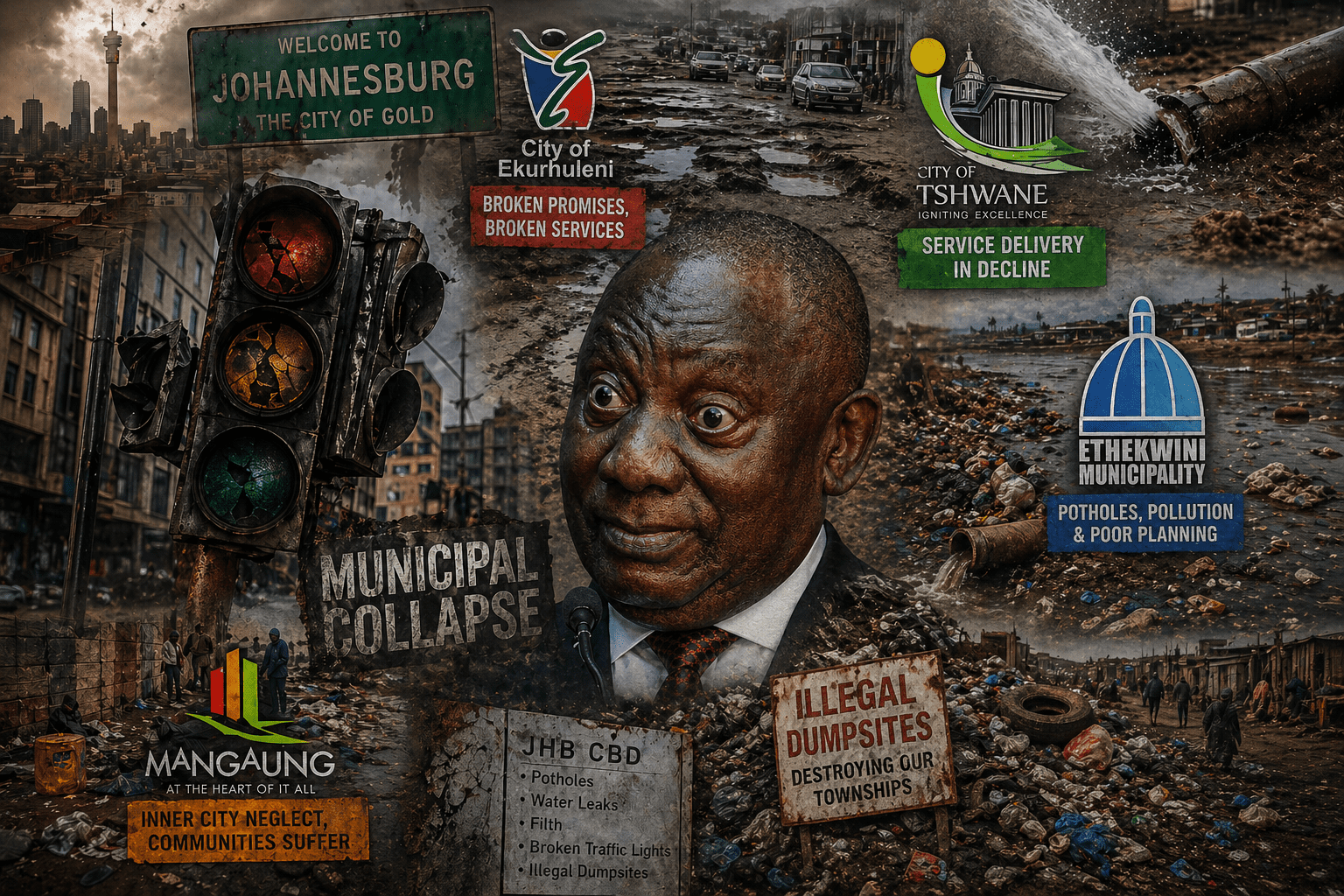
Speeches grow sharper, promises grander, but in the end, it is just another round of thunder with no rain. The only thing tougher than talk is the wait that follows it—days that blur into weeks, while ordinary lives carry on beneath a sky full of noise but empty of change.
By Themba Khumalo
Well, hold onto your leaky taps and brace yourself for a deluge of déjà vu: President Cyril Ramaphosa has once more sounded the clarion call to South Africa’s municipalities, that most reliable source of national embarrassment.
In a moment of almost Shakespearean self-awareness, Ramaphosa has urged local governments to stop acting like a Monty Python sketch or a rerun of Emzini Wezinsizwa and start, well, governing.
One imagines the collective eye-rolling from mayors, premiers, and officials forced to endure this spectacle in Boksburg—the city that proves, if nothing else, that mediocrity can be achieved at scale.
Ramaphosa, ever the statesman, declared with a straight face that national progress on load shedding and logistics must now be “felt at local level.”
The implication, of course, is that someone, somewhere, has actually felt national progress—a claim that would no doubt amuse any South African who has spent the last decade navigating potholes the size of moon craters or staring longingly at the thin trickle of water emerging from their kitchen tap.
“We must take steps also to focus on another important area of governance, which is to professionalise the public service also at the local level. Appointments must be made on merit, not on whether somebody is popular in a political party.”
President Cyril Ramaphosa
However, let me not be too cynical (heaven forbid). Ramaphosa’s demands are bold, almost revolutionary: cut the red tape, appoint officials on merit, and—this is the real zinger—ensure local government workers are actually trained to do their jobs.
“Lifelong training,” he intoned, as though the average municipal employee is itching for a spot of continuing professional development between power outages and plumbing disasters.
The President’s newfound zeal for municipal competence comes hot on the heels of another minor apocalypse: the water crisis.
South Africa, a land where taps are mostly ornamental and water pressure is measured in hopeful sighs, now faces “deepening” interruptions.
Yet behind the jokes and jabs, it is ordinary residents who wait, day after day, for basic services that never arrive.
Metros lose a third of their water before it can even be billed, which is rather fitting in a country where the only thing more reliable than the infrastructure’s decline is the creative accounting that follows it.
Some metros are pushing a 50 percent loss, which is less a margin of error and more a masterclass in collective negligence.
Waiting for municipal repairs is like watching a desert for rain—there is always hope, but rarely a downpour.
Why is this happening, you ask? The president, with the clinical precision of a man diagnosing a corpse, cited ageing infrastructure, illegal connections, poor maintenance, and “institutional instability.”
You would be forgiven for thinking these issues might have been addressed at some point during the past three decades of democracy. But in South Africa, institutional memory is as short-lived and fleeting as running water—here one moment, gone the next.
In other words, lessons from the past seem to wash away quickly, lost before they can take root.
It is comforting to know, though, that the President has at least managed to name the problems. Now, if only someone could show him where the solutions are kept.
However, fear not, solutions are on the agenda. Ramaphosa assured the assembled bureaucrats that this was not just another meeting for the sake of appearances: they would be “addressing it from a diagnostic point of view and the solutions point of view, as well as how best that all should be fed.”
“Our eight metropolitan municipalities are collectively losing an average of 34% of all water purchased before it can be billed; some metros are approaching almost 50%. Municipal debts to water boards have tripled between 2018 and 2025. Now, this crisis did not emerge overnight and will not be resolved by any single intervention. We need a range of actions addressing critical areas of failure.”
President Cyril Ramaphosa
The country waits with bated breath and unquenched thirst for the next committee to be formed, the next action plan to be drafted, the next consultant to bank a tidy sum for stating the obvious.
And what of the actual numbers? According to the last census, over 82 percent of households have piped water in their homes or yards, up from 61 percent in 1990.
A triumph! Just ignore the small detail that a growing number of those households experience water interruptions lasting more than a week—a figure that has jumped from 24 percent in 2012 to 34 percent in 2024. Progress, like plumbing, is apparently a matter of interpretation.
Municipal debts to water boards have tripled since 2018. One wonders how many more red warning letters will be required before someone realises that “financial sustainability” is not a synonym for “let us see how long we can get away with this.”
But then, why worry about debts when you can simply convene another summit, issue another sternly worded statement, and move on to the next crisis?
To his credit, Ramaphosa did attempt a rallying cry for professionalism in local government: “Appointments must be made on merit, not on whether somebody is popular in a political party.”
This, in the South African context, is about as likely as Prasa running trains uninterrupted for a fortnight, but one admires the optimism. Perhaps next week, the President will propose that rain falls upwards and that pigs, when properly motivated, can indeed fly.
Or perhaps the answer lies in appointing a Minister of Hopeful Announcements—or, at the very least, someone who knows where the stopcock is.
“Municipalities must be at the frontline of delivery, ensuring that industrial parks have power, township streets are lit, and businesses can operate with confidence. We must therefore also focus on cutting the red tape to enable businesses to operate so that our tax base and our rate base can also increase.”
President Cyril Ramaphosa
In his most stirring moment, the president reminded his audience that economic growth happens at the local level, not in the Union Buildings. A revelation, no doubt, to the mayors nodding along while mentally tallying up their own procurement contracts.
The President hopes that municipalities will become “effective drivers of growth and development.” The rest of us hope they will become effective drivers of anything at all.
So, to recap: the water is running out, the pipes are crumbling, the debts are mounting, and the red tape is choking the last vestiges of enterprise out of local economies.
The solution? Another meeting, more promises, and a heartfelt plea to do things correctly, just this once.
But take heart, South Africa. Ramaphosa is on it. He has convened the councils, issued the warnings, and delivered the speeches.
Is it too much to ask for a tap that works and a pothole-free street—or is that just another punchline in the South African comedy of errors?
In the meantime, keep a bucket handy—you will need it.