

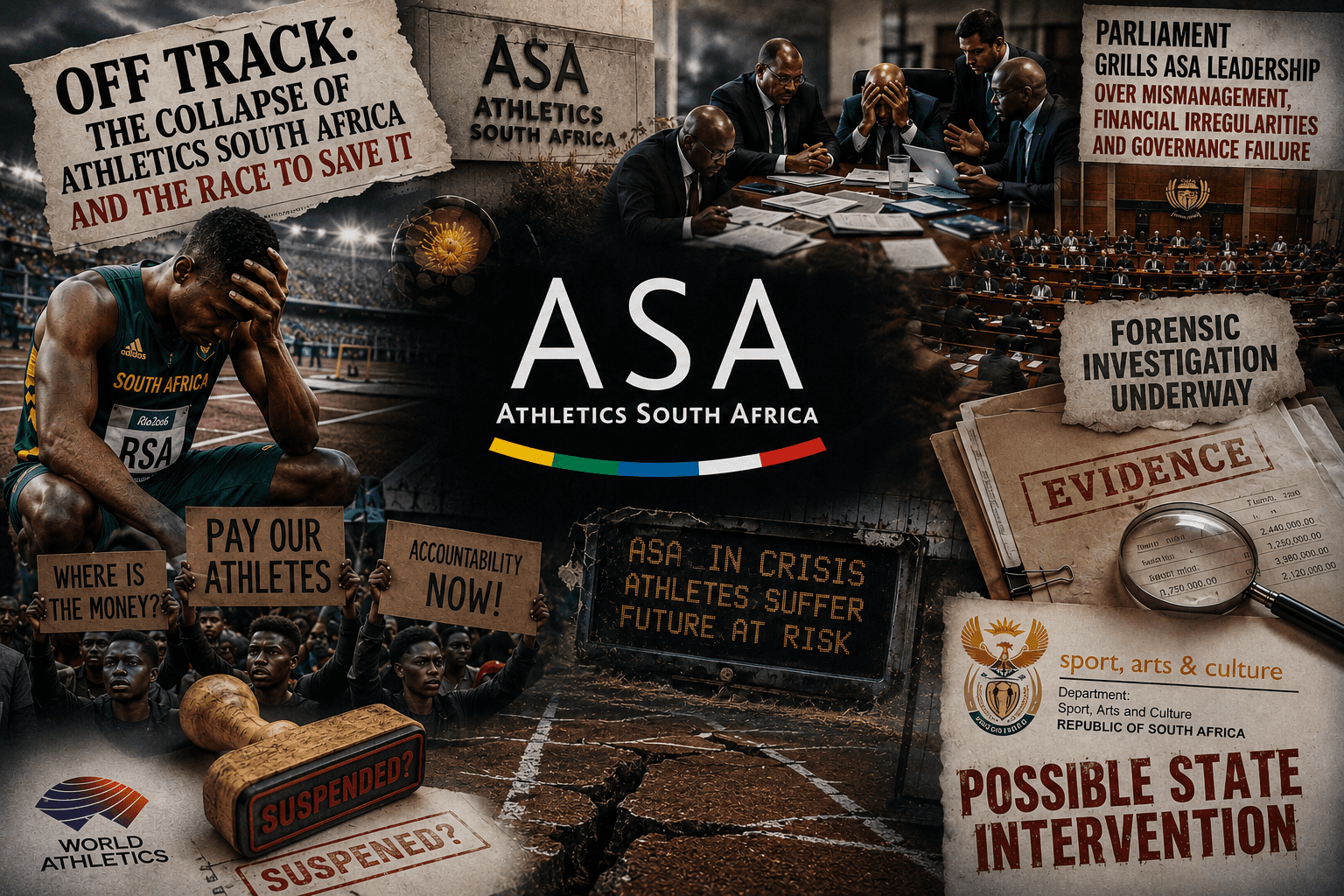
South African athletics is in crisis. Explosive allegations of financial abuse, internal warfare and governance failure have left Athletics South Africa under pressure from Parliament, government and World Athletics. Meanwhile, athletes remain unpaid, and one of the country’s most iconic marathons faces an uncertain future.
SA Telegraph Reporters
There was a time when Athletics South Africa stood as one of the country’s proudest sporting institutions — a body that carried the dreams of Olympic sprinters, township runners, school athletes and marathon hopefuls onto the world stage.
Today, it is an organisation consumed by allegations of financial abuse, boardroom warfare, institutional paralysis and mounting political humiliation.
By May 2026, the federation appears to be fighting for its survival.
What has unfolded over the past several months is no longer simply an administrative dispute inside a sports body. It has become a full-scale governance crisis involving Parliament, forensic investigators, government ministers, global athletics authorities, unpaid athletes and now the looming possibility of direct state intervention in one of the country’s most iconic races.
At the centre of the collapse lies a devastating question: how did one of South Africa’s most important sporting federations descend into what lawmakers now openly describe as chaos?
The Forensic Report That Blew the Lid Off
The moment the crisis exploded into the national spotlight came in March 2026, when auditing firm Mazars presented its forensic findings to Parliament’s Portfolio Committee on Sport, Arts and Culture.
What MPs heard was staggering.
The report painted a picture of an organisation where financial controls had effectively broken down and where senior leadership allegedly operated with extraordinary impunity.
Most damaging were the findings linked to suspended ASA president James Moloi.
According to the forensic investigation, Moloi spent R300,406 using a corporate credit card between May 2023 and April 2024 — exceeding the approved budget allocation by roughly R120,000.
But the raw figure alone was not what alarmed Parliament.
Auditors reportedly identified 46 transactions worth approximately R23,000 that could not be properly classified or accounted for. MPs were also told of allegations that Moloi continued drawing a monthly allowance while simultaneously using the federation’s corporate card for expenses that raised serious governance concerns.
Among the transactions scrutinised was the purchase of a mobile phone, which investigators reportedly linked to what auditors later described as misleading explanations.
The atmosphere inside the parliamentary hearing reportedly shifted from concern to outright fury.
Committee members questioned how a federation already struggling financially could allow such spending patterns while athletes and events faced financial distress.
When Moloi later reimbursed ASA R25,000 after the audit findings emerged, the gesture did little to calm the outrage.
For many MPs, the repayment was seen not as accountability, but as confirmation that the spending concerns were real.
The issue became symbolic of something larger: a sporting body accused of losing sight of its core purpose while ordinary athletes carried the consequences.
The Moloi Disciplinary Process and the Fight for Legitimacy
The crisis surrounding Moloi has now entered what ASA leadership says will be its decisive phase.
Acting ASA president John Mathane has confirmed that the federation is appointing external senior counsel to preside over disciplinary proceedings involving Moloi — a move designed to lend credibility to a process already under intense scrutiny from Parliament and SASCOC.
Mathane insisted this week that Moloi remains suspended despite reports suggesting otherwise.
“We are still sitting with what we have; the president was served with a letter to say that until the internal processes are being done,” said Mathane.
“We are in the process of appointing the external senior counsel to sit in a disciplinary hearing because, for this issue of Moloi, we are engaging SASCOC, and they gave us the processes that need to be done.”
“By the end of May, we should have done with the issue because it is something that will take a day or two, and it will be done. So, currently the status quo of Mr Moloi still stands.”
The emphasis on external oversight is significant.
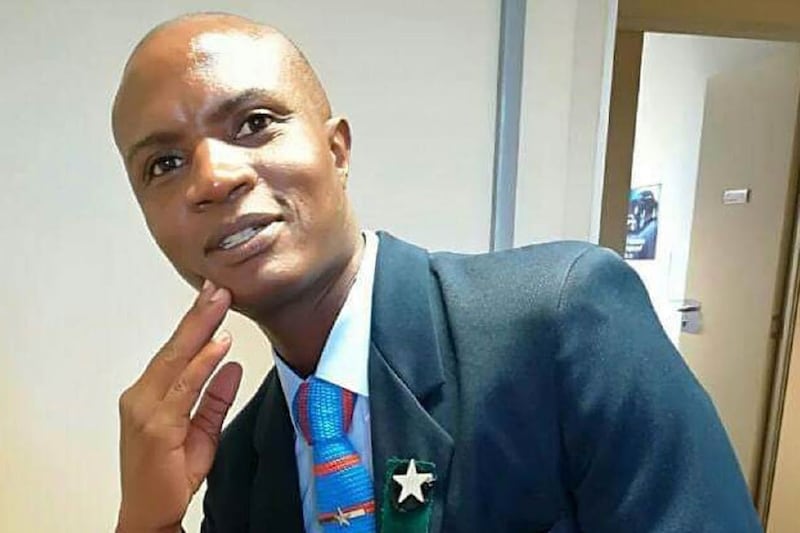
For months, ASA has been accused of handling internal governance matters through factional manoeuvring rather than a transparent process. By bringing in senior external legal counsel, the federation appears to be attempting to restore at least some institutional legitimacy.
But scepticism remains widespread.
Many within athletics believe the credibility crisis now extends far beyond Moloi himself. The disciplinary process has become a test of whether ASA still possesses the institutional integrity to hold its own leadership accountable.
A Federation at War With Itself
Behind the financial allegations lies an even deeper institutional fracture.
For months, ASA has been locked in internal conflict involving whistleblowers, suspensions, counter-suspensions and competing factions inside the federation.
At the centre of this struggle is a group informally referred to as the “Big Five” — individuals within the organisation who allegedly raised concerns about corruption and governance failures.
Rather than stabilising the federation, the fallout triggered what critics describe as a cycle of retaliation and administrative warfare.
One of the most controversial figures in the ongoing crisis is acting CEO Terrence Magogodela.
Magogodela has faced sustained criticism over allegations linked to the misappropriation of National Lottery funding — allegations that continue to shadow his leadership. Critics inside and outside the federation have questioned how an executive implicated in governance controversies remained in a senior leadership position during a period of organisational meltdown.
The controversy deepened when Magogodela was accused of signing suspension letters against board members challenging his authority, despite his being linked to ongoing probes.
The result has been paralysis.
Meetings have reportedly descended into infighting. Governance decisions have stalled. Leadership disputes have consumed the federation’s energy while operational failures mounted around it.
Inside Parliament, frustration boiled over publicly.
Portfolio Committee member Marlon Daniels delivered one of the most damning rebukes during the March 31 hearing: “The problem lies in the lies you are peddling to us. We were told a new board would be presented, and their first task was the appointment of a CEO. It did not happen.”
ASA has now finally advertised the CEO position — an acknowledgement, perhaps, of how damaging the leadership vacuum has become.
Yet the timing has also raised difficult questions about why the federation moved only after sustained public and parliamentary pressure.
The Soweto Marathon Crisis and the Threat of Government Intervention
Nothing has exposed ASA’s governance failures more publicly than the crisis surrounding the Soweto Marathon.
Months after the 2025 edition of the race, athletes who finished in the top positions were still waiting for prize money owed to them. Reports suggest the unpaid amount could total close to R2 million.
For many runners, the delays have become more than a contractual dispute. They have become a symbol of how athletes have been abandoned while administrators fight internal battles.
The outrage escalated dramatically when Minister of Sport, Arts and Culture Gayton McKenzie announced that government would intervene directly.
McKenzie said government would step in to pay athletes their outstanding prize money, take over the race and even open a criminal case against organisers linked to the 2025 event.
“We are going to take over the Soweto Marathon,” McKenzie warned, adding that athletes would be paid and organisers who disappeared after the event would face consequences.
The declaration represented one of the most extraordinary moments in South African sport administration in recent years: a Cabinet minister publicly threatening to intervene in the operations of a major race amid allegations of financial collapse and organisational failure.
Yet Mathane’s response revealed the precarious balancing act now confronting ASA.
While welcoming government assistance, he also warned that any intervention would need to comply with international sporting governance frameworks.
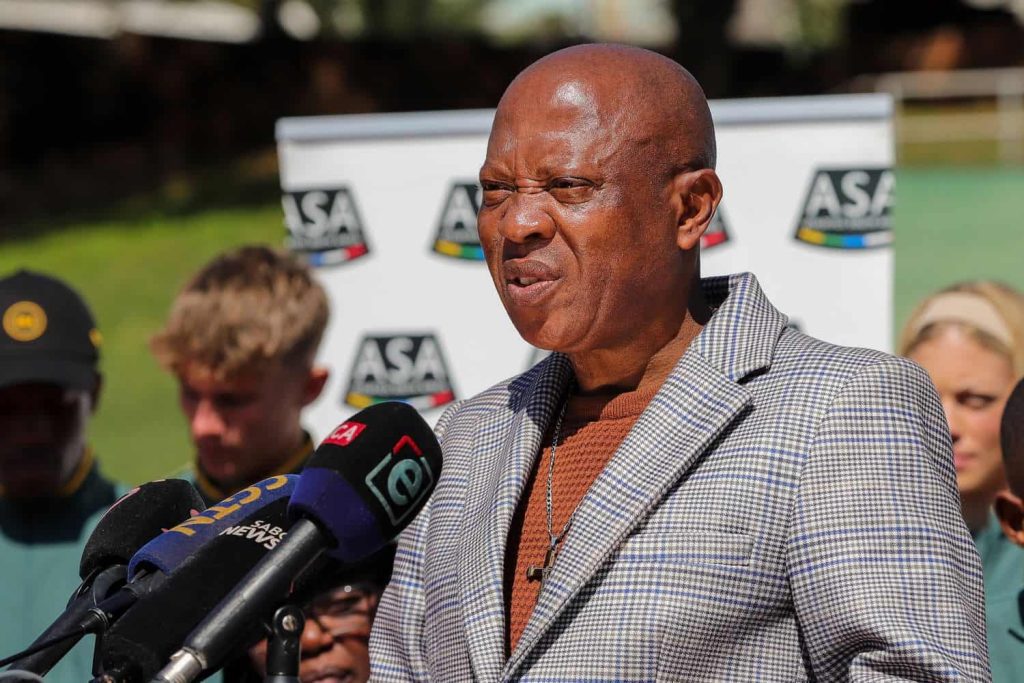
“We are going to engage with the government to give them the guidance,” said Mathane during a press briefing in Rosebank.
“It’s a good initiative, [but] what needs to happen are federation processes and procedures that need to be followed.”
“CGA knows the rules and regulations.”
His remarks underscored a sensitive reality within global sport.
International federations such as World Athletics are historically wary of direct government interference in member federations. Excessive state intervention can trigger sanctions or create tensions with international governance rules.
Mathane stressed repeatedly that the Soweto Marathon falls under the jurisdiction of Central Gauteng Athletics and that ASA could not simply override provincial structures.
“What we are going to do is sit the government down to say what they are coming up with,” he said.
The comments reveal the increasingly fragile political terrain ASA is attempting to navigate: too little intervention risks further collapse, while too much could invite conflict with international athletics authorities.
Meanwhile, the immediate future of the marathon itself remains uncertain.
Mathane acknowledged that the race may not take place this year unless athletes are paid what they are owed.
“This is a heritage event; we need to rescue that,” he said.
“We, as ASA, want to see it happening, but it must come up with the right direction.”
For many South Africans, the Soweto Marathon is far more than a sporting event. It is woven into the country’s democratic and township sporting history — often referred to as “The People’s Race”.
The possibility that it could collapse under the weight of financial dysfunction has become one of the starkest illustrations yet of ASA’s broader institutional crisis.
The Rise of “Illegal” Road Running
As if ASA’s leadership crisis were not severe enough, the federation is now confronting another threat: the apparent growth of unsanctioned races operating outside official structures.
At a recent press conference, Mathane issued a stern warning against what he described as illegally organised runs taking place outside ASA’s approved fixtures calendar.
According to the federation, some organisers have allegedly been charging registration fees for events that are not sanctioned by provincial or national athletics structures.
The issue has become especially contentious in Gauteng, where provincial athletics bodies have reportedly circulated warnings about events being staged in direct conflict with officially approved races.
Mathane insisted the federation would act aggressively against organisers and athletes participating in such events.
“We are so worried with all the unsanctioned and illegal events that are taking place,” Mathane said.
“This conduct is unacceptable. It’s undermined the authority of ASA, it undermines the welfare of the athletes, it undermines the event safety standards.”
“They will face immediate disciplinary action, including suspension and the withdrawal of their running licences.”
But the rise of alternative races also reflects something deeper: the erosion of confidence in official structures.
As ASA’s governance crisis has intensified, some runners and organisers appear increasingly willing to operate outside the federation’s authority altogether.
In that sense, the emergence of “illegal” races may be less a separate problem than another symptom of institutional breakdown.
International Alarm Bells
The crisis has now spread far beyond South Africa’s borders.
Global governing body World Athletics has formally placed ASA under active scrutiny — an alarming development for any national federation.
World Athletics reportedly demanded a formal roadmap from ASA outlining how it intends to restore governance stability and operational credibility.
The concerns raised by the international body cut to the heart of the federation’s failures:
- Weak and inadequate financial controls.
- Lack of independent decision-making.
- Serious leadership capacity deficiencies.
For South African athletics, the implications are severe.
International governing bodies rarely intervene unless they believe institutional failure threatens the integrity or functioning of the sport itself. The fact that World Athletics has now escalated oversight signals how deeply confidence in ASA has eroded.
Portfolio Committee chairperson Joe McGluwa summarised the situation in stark terms:
“ASA is on the verge of collapse with no financial controls, an inability to prioritise critical issues, and infighting… We are managing chaos instead of running successful athletics programmes.”
It was not merely criticism. It sounded like a warning of institutional failure.
Parliament’s Nuclear Option
By April 23, 2026, Parliament had seemingly lost faith in ASA’s ability to repair itself.
The Portfolio Committee formally recommended that Minister McKenzie dissolve the ASA board entirely.
It was the strongest possible intervention short of direct state administration.
The recommendation effectively acknowledged that lawmakers believed the federation’s internal governance mechanisms had failed beyond recovery.
At the centre of the current standoff are several embattled figures.
James Moloi remains suspended pending disciplinary proceedings.
Acting president John Mathane now presides over what critics describe as a fractured and broken board struggling to maintain authority while simultaneously attempting to reassure sponsors, government and athletes that the federation remains functional.
Board member Jean Verster has also faced parliamentary criticism for failing to attend oversight meetings despite overseeing major governance concerns, including the loss of broadcast sponsor SuperSport.
The withdrawal of SuperSport carried symbolic and financial consequences.
Broadcast deals are critical revenue streams for sporting federations. Losing such support during a governance crisis further deepened perceptions that ASA’s institutional credibility was collapsing in real time.
Can ASA Still Be Saved?
Despite the turmoil, ASA leadership insists reform is underway.
Mathane has declared there will be “no tolerance” for poor governance, financial misconduct or administrative failure going forward.
But confidence inside athletics circles remains deeply fragile.
Years of infighting, allegations of financial abuse and public political embarrassment have left many questioning whether the federation can still rebuild itself.
The tragedy is that South African athletics itself remains rich with talent.
The country continues to produce world-class runners, sprinters and middle-distance athletes capable of competing on the global stage. Yet many athletes operate within systems marked by administrative instability and chronic uncertainty.
The ASA crisis has exposed how vulnerable athletes become when governance fails.
Sponsors retreat. Prize money stalls. Development programmes weaken. Trust collapses.
And once confidence disappears, rebuilding it becomes extraordinarily difficult.
For many observers, the most disturbing aspect of the scandal is not any single allegation, but the sense that institutional dysfunction became normalised over time.
Warning signs reportedly existed long before the crisis reached Parliament. But corrective action either failed or came too late.
Now the federation faces a credibility battle on multiple fronts simultaneously — legal, political, financial and international.
And hanging over everything is a painful irony.
At the exact moment South African athletes continue delivering remarkable performances on tracks and roads around the world, the institution meant to support them appears trapped in one of the deepest crises in its history.
The runners keep running.
The administrators keep fighting.
And Athletics South Africa — once a symbol of sporting aspiration — now stands dangerously close to institutional ruin.