

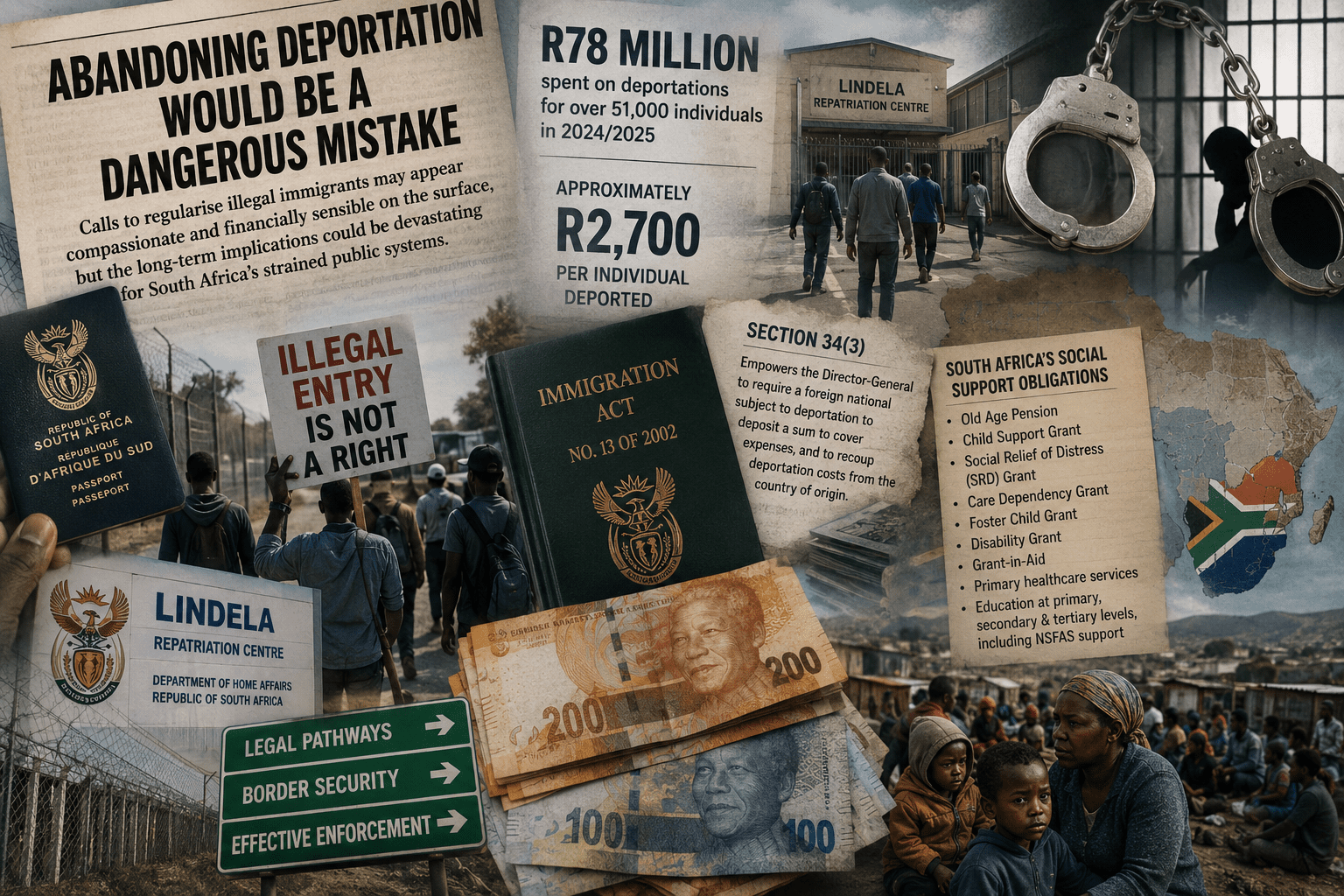
Calls to regularise illegal immigrants may appear compassionate and financially sensible on the surface, but the long-term implications could be devastating for South Africa’s strained public systems. Beneath the debate lies a far bigger question about law, accountability and the future sustainability of an already pressured state.

By Teboho Mokoena
South Africa’s immigration debate has once again returned to the centre of public discourse, largely driven by rising deportation costs and growing frustration with border management. Yet amid the noise, there is a dangerous temptation to embrace simplistic solutions to a deeply complex issue.
Research indicates that South Africa spent R78 million on deportation costs for just over 51,000 individuals during the 2024/2025 financial year. This translates to approximately R2,700 per individual deported. That figure alone is substantial, but it tells only part of the story.
It does not account for the roughly R6 million per month operational costs incurred at the Lindela Repatriation Centre during the same period. Nor does it include the additional burden carried by the Department of Correctional Services in housing undocumented immigrants who have committed further offences while in the country.
The department has rightly proposed that convicted foreign nationals should serve their prison sentences in their home countries after the deportation process is concluded.
Against this backdrop, a growing number of voices have argued — rather bizarrely, in my view — that South Africa should abandon deportation efforts altogether and instead regularise the presence of illegal immigrants already in the country.
Their argument rests largely on two points.
Firstly, they point to the high financial cost of deportations and the maintenance of facilities such as the Lindela Repatriation Centre.
Secondly, they argue that many of those deported eventually find their way back into South Africa, making the exercise appear futile.
At first glance, these arguments may sound practical, even compassionate. However, they ignore several critical realities that cannot simply be wished away.
The first and most important point is that deportation exists primarily as a deterrent. A sovereign state cannot simply suspend the enforcement of its immigration laws because enforcement carries a financial cost. Doing away with deportation would not only undermine the provisions of the Immigration Act 2002, but it would also send a dangerous message across the region and beyond: that illegal entry into South Africa carries no meaningful consequences.
Such a move would inevitably encourage even more illegal immigration from individuals who may otherwise have respected lawful immigration processes. In simple terms, it would reward illegality while penalising compliance.
It is akin to someone repeatedly stealing your car and, after observing the time, stress and resources you spend recovering it, suggesting that you simply allow them to co-own the vehicle with you instead.
The second point often ignored in this debate is that South African law already provides mechanisms to recover deportation-related costs.
Section 34(3) of the Immigration Act [No. 13 of 2002] empowers the Director-General to order a foreign national subject to deportation to deposit a sum of money to cover expenses linked to their detention, maintenance and deportation.
In addition, the same section empowers the Department of Home Affairs to recoup deportation costs from the countries whose nationals are being returned.
The real challenge, therefore, is not the absence of legal instruments, but rather the effective enforcement and implementation of those instruments.
Thirdly — and perhaps most critically — those advocating for blanket regularisation appear unwilling to confront the long-term financial implications for South Africa’s already overstretched social support systems.
South Africa is a constitutional democracy with extensive social welfare obligations. These include:
- Old Age Pension
- Child Support Grant
- Social Relief of Distress (SRD) Grant
- Care Dependency Grant
- Foster Child Grant
- Disability Grant
- Grant-in-Aid
- Primary healthcare services
- Education at primary, secondary and tertiary levels, including NSFAS support
These services are already under immense strain due to unemployment, poverty and slow economic growth. Expanding access without sustainable planning would place even greater pressure on a fiscus that is already struggling to meet existing obligations to citizens and lawful residents.
This is not an argument against immigration itself. South Africa has long benefited from legal migration, regional trade, skilled foreign professionals and cultural diversity. Many immigrants contribute positively to the economy, create jobs and strengthen communities.
However, there is a profound difference between legal immigration governed by clear laws and uncontrolled illegal immigration that bypasses national systems entirely.
A serious country cannot abandon border management simply because enforcement is expensive. Every functioning state in the world incurs costs in protecting its borders, administering immigration systems and enforcing its laws. South Africa cannot become the exception.
The real conversation South Africa should be having is not whether deportation should exist, but rather how to improve border security, strengthen immigration administration, accelerate legal immigration pathways where appropriate, and ensure that deportation systems operate more effectively and efficiently.
Reducing corruption at ports of entry, improving regional cooperation, strengthening documentation systems and ensuring stricter accountability within immigration structures would go further in addressing the root causes of illegal immigration than surrendering enforcement altogether.
Ultimately, compassion and legality are not mutually exclusive. A country can uphold human dignity while still enforcing its laws. But no nation can sustainably function if it signals that its immigration laws are optional.
That is the danger hidden beneath the seemingly simple call for blanket regularisation.