

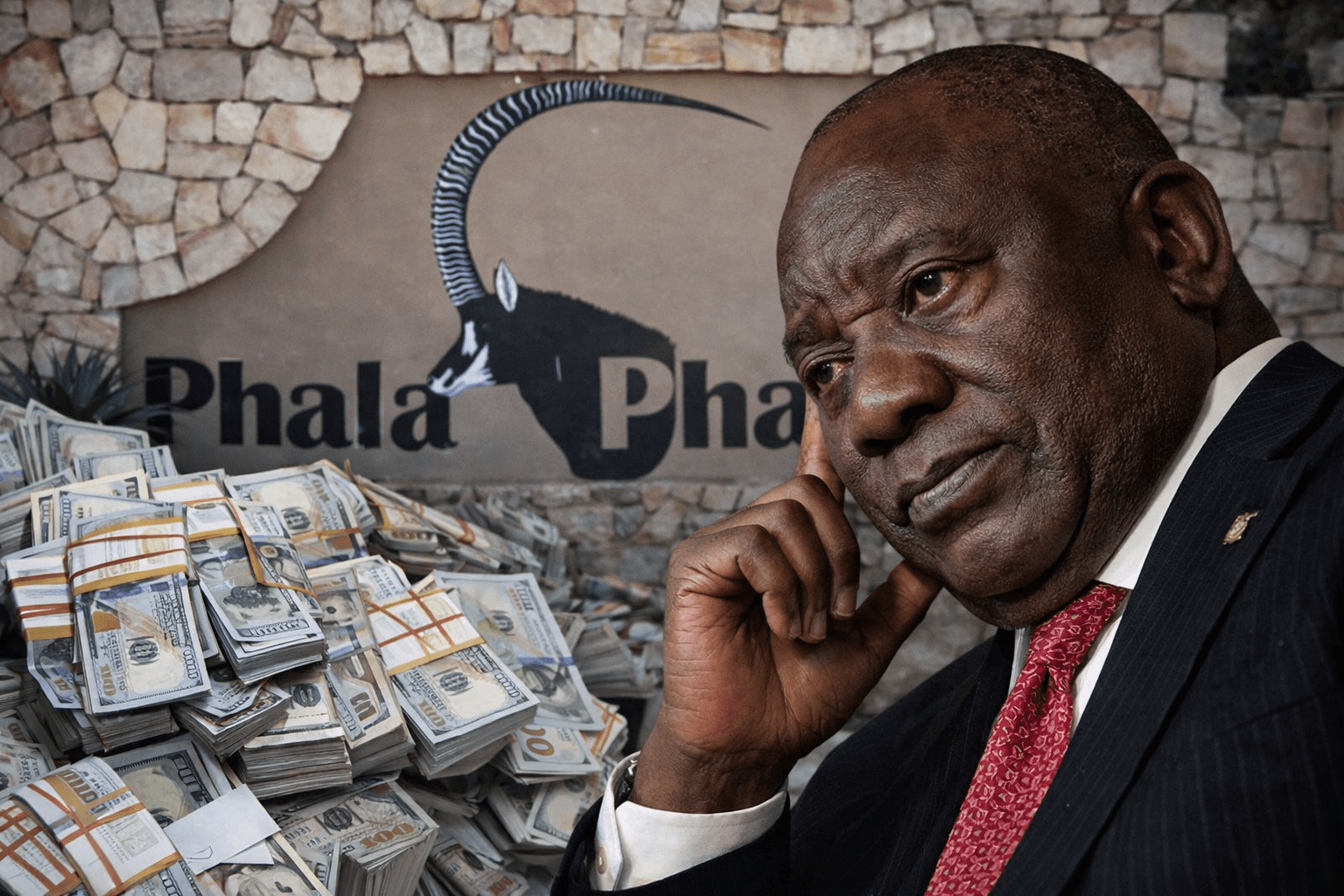
The IPID report does not prove presidential guilt. It does something more damaging: it makes innocence increasingly difficult to believe. It shifts the burden from proof to perception — and in politics, perception has a way of hardening into reality. The longer doubts linger unanswered, the more corrosive they become.
By Themba Khumalo
Some scandals flare and fade. Others refuse to die because the people responsible for burying them keep providing reasons to dig. The Phala Phala saga belongs firmly to the latter.
What began as a burglary on a private game farm in Limpopo has become something more corrosive: a sustained test of whether this president is willing to be held to the same standards he built his political identity around.
The latest instalment — a declassified report by the Independent Police Investigative Directorate (IPID) — does not just revive a story that the presidency would prefer to be forgotten. It makes denial harder to sustain. In careful but damning detail, the watchdog sketches a picture of a presidential protection unit that appears to have stepped outside the law it is sworn to uphold.
At the centre of the report are allegations that senior officers tasked with protecting President Cyril Ramaphosa concealed a crime, bypassed formal investigative channels, and deployed state resources in what reads more like a private recovery mission than a policing operation.
The theft itself — reportedly involving huge amounts of US dollars hidden in furniture — was serious enough. But it is the alleged response that should disturb every South African who still believes the law applies equally to everyone, including the people paid to enforce it.
According to IPID, no official case of housebreaking was registered. Instead, members of the Presidential Protection Unit allegedly pursued suspects across provincial and even national borders without a warrant, using public funds under questionable pretences. There are further claims of unlawful detention, coercive interrogations, falsified travel records, and even attempts to suppress information through inducements.
Taken together, the report describes not a lapse in judgement, but a pattern of conduct designed to place the president above the law.
IPID’s conclusion is unambiguous: the officers in question effectively acted as a “private enforcement unit”, in breach of the very statutes governing the South African Police Service. It has recommended disciplinary action. But recommendations are not enforcement. And so far, no one has been held to account for anything.
This is where the legal process ends, and the political reckoning begins.
Opposition parties have seized on the report as confirmation of what they have long alleged — that Phala Phala was not merely mishandled, but deliberately obscured. Herman Mashaba has argued that the findings make it impossible for the president to claim ignorance. The African Transformation Movement has gone further, describing the president as compromised and renewing calls for impeachment.
Such responses are predictable in a polarised political environment. But predictability does not make them wrong. The report raises more than uncomfortable questions — it describes, in documented detail, state machinery apparently bent towards private ends. In a country where the abuse of public institutions has left deep scars, that is not a question to be managed. It is a reckoning to be faced.
The IPID report is not a criminal verdict on the president — its mandate is to assess police conduct, and it does not cross that line. Legal caution is warranted. Political caution is not. What the report documents is damning enough: a protection unit that behaved like a private militia, answerable not to the law but apparently to the man they were paid to protect.
For his part, Ramaphosa has maintained a consistent line. He denies wrongdoing, insists the funds were legitimate proceeds from a buffalo sale, and distances himself from the actions of his security detail. That position may be legally defensible. But it defies belief. The president’s own protection unit allegedly ran an off-book operation to recover cash from his farm — and he knew nothing? The question does not require a court to feel unanswered. Perception matters. Credibility matters more. Right now, both are bleeding.
What makes the IPID report particularly corrosive is not that it proves presidential misconduct, but that it confirms what too many South Africans already suspect: that power operates in the shadows of its own rules. State officials allegedly mobilised to recover private cash — quietly, informally, without oversight. South Africans recognise this. They have seen it before. They are tired of seeing it.
This is compounded by the absence of visible consequences. One of the key figures named in the report has reportedly been cleared — on technical grounds — and remains in position. That is not an outcome. That is an insult to the process. It feeds a familiar suspicion — that accountability is uneven, and that proximity to power offers a measure of insulation.
The timing makes this worse, not better. The loss of the ANC’s parliamentary majority in 2024 was supposed to mark a new era — coalition governance anchored in transparency and reform. Ramaphosa sold that vision personally. Phala Phala is now the first real test of whether he meant what he said. So far, he is failing it.
Institutions have moved slowly. Recommendations have stalled. The political leadership has shown more appetite for managing the story than confronting it. The danger for Ramaphosa is not immediate legal jeopardy but cumulative erosion — and he is running out of time to stop it.
Each unresolved question, each delayed decision, chips away at the reformist image that has defined his presidency. This is one of those moments that will be remembered — not for what was said, but for what was done.
Silence is not a strategy. It is a calculation. And it is failing.
The Phala Phala affair will not go away because it is, at its core, a simple story that powerful people have worked hard to make complicated. A large sum of cash was hidden on a president’s private farm. When it was stolen, the state — by IPID’s account — went looking for it quietly, unofficially, and outside the law. That is not a governance failure. That is a betrayal of the office.
The IPID report does not close the chapter. It opens a door that Ramaphosa must now choose to walk through or barricade. Following through — publicly, and without exception — is where credibility is either rebuilt or forfeited.
South Africans have heard too many promises. What they are waiting for, with diminishing patience, is a president who proves that the rules apply to the people around him, too.