

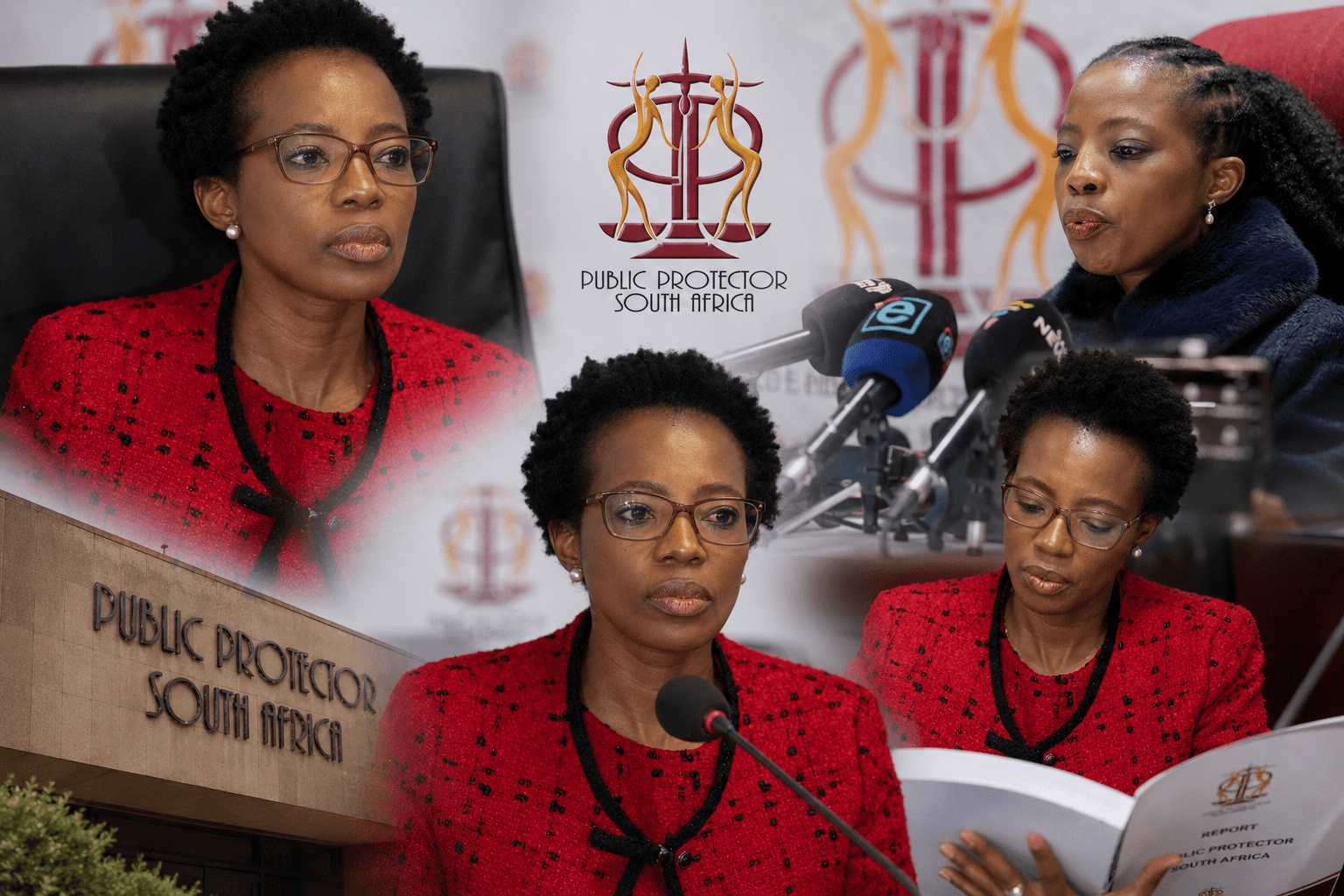
A democracy’s health is measured not by its ceremonies, but by its tolerance for anger, mockery and dissent. When the guardians of the Constitution reach for punitive threats, the stakes become less about law and more about the air that democracy breathes.
By Themba Khumalo
Five days have crawled by since the Office of the Public Protector went completely feral and issued a statement so steeped in institutional hostility, so heavy with the stale perfume of state arrogance, that it veered dangerously close to sounding like a warning to South Africans about what they may or may not say regarding a constitutionally protected office.
Five days later, I still find myself walking around with the uneasy sensation that I have inadvertently wandered into a constitutional nightmare, stitched together by people who have spent far too long inhaling the intoxicating fumes of unchecked authority.
Because surely—surely—we have not yet descended to the point where a democratic institution, born from the ashes of censorship, repression, and state intimidation, now finds itself toying with the language of fear and punishment whenever public criticism cuts too deeply.
And yet, there it was.
Cold. Official. Menacing in its undertone.
A press statement that did not merely defend the dignity of the institution, but seemed to carry the unmistakable growl of authority irritated by free expression itself. A statement that hovered ominously between constitutional caution and something far uglier: the suggestion that citizens should watch their tongues when speaking about the Public Protector or Deputy Public Protector.
That is the sort of language that should send a shiver down the spine of any democracy serious about freedom.
It is both worrying and infuriating that somewhere within the polished machinery of state bureaucracy, those entrusted with upholding constitutional accountability apparently convinced themselves it was perfectly acceptable to publicly remind South Africans that mocking, insulting, or verbally tearing into the Public Protector could earn them a R40,000 fine or twelve months behind bars.
Not for corruption. Not for theft. Not for looting public money in a collapsing republic. For insults.
A year in prison. For insults.
One almost admires the breathtaking audacity of it. It takes a special kind of institutional arrogance to survey a country drowning in corruption, collapsing municipalities, rotting infrastructure, rampant unemployment, political gangsterism, and rolling public despair—and then decide the emergency requiring immediate national attention is hurt feelings at the Public Protector’s office.
South Africans cannot get water from their taps. They cannot trust the police. They cannot keep the lights on. But heaven forbid someone bruises the emotional upholstery of a public institution.
This is not merely tone-deaf. It is sinister.
Because beneath all the legal jargon and carefully polished constitutional language lies the unmistakable stench of intimidation. The statement may wear a suit and carry legal citations, but its message is as blunt as a truncheon slammed against a prison cell: Watch what you say.
And that should terrify every South African who still possesses the faintest pulse for liberty.
The Public Protector’s office says freedom of expression “is not unlimited”. Fine. Nobody disputes that rights have limitations. One cannot incite violence, spread defamation recklessly, or threaten lives. But there is something deeply rotten—almost authoritarian in flavour—about a state institution responding to public criticism by rattling off prison sentences like an angry headmaster threatening detention.
It reeks of a democracy developing a rash of intolerance.
Worse still, it exposes a leadership so catastrophically out of its depth that it mistakes public scrutiny for sacrilege and accountability for insult. The Public Protector is not a medieval monarchy. It is not a sacred cow floating above reproach in some holy constitutional cloud. It is a public office, funded by taxpayers, empowered by the Constitution, and wholly subject to criticism, ridicule, anger—even contempt—from the public it serves.
That is how democracies work.
Citizens are not required to whisper politely when speaking about power. They are not obliged to powder their language with rose petals before criticising state officials. Democracy is noisy. Democracy is rude. Democracy is often furious. And thank God for that, because history shows that the moment governments begin policing tone instead of conduct, freedom starts suffocating quietly in the corner.
One can already hear the slippery defence forming: “No, no, this is merely a reminder of the law.” Spare us the legal cosmetics.
When a constitutional institution publicly warns citizens about fines and imprisonment in direct response to criticism following a politically explosive judgment, it is not engaging in civic education. It is flexing its muscles. It is puffing out its chest. It is trying to chill speech through fear.
And the timing is impossible to ignore.
The Constitutional Court judgment triggered public commentary, mockery, anger, and fierce debate. Instead of absorbing criticism with the thick skin expected of democratic institutions, the response from the Public Protector’s office was effectively to mutter: Careful now. We can arrest you.
What astonishing fragility.
What paper-thin skin.
What a catastrophic misunderstanding of constitutional democracy.
Institutions that truly command public respect do not need to threaten citizens into silence. They earn credibility through integrity, competence, and consistency. The moment an office begins reaching for punitive language against critics, it advertises weakness, not strength. It tells the country that criticism has pierced somewhere painfully deep.
And South Africans have every right to be alarmed by this creeping appetite for suppressing expression through legal intimidation. Today, it is “insulting the Public Protector”. Tomorrow it becomes “undermining confidence in institutions”. The day after that, some opportunistic political hyena decides journalists, activists, and ordinary citizens are “destabilising democracy” simply because they speak too loudly.
This is how democratic erosion begins—not always with tanks in the streets, but with bureaucrats developing an unhealthy affection for punishing dissent.
There is a seismic absurdity, too, in a state institution demanding “respectful engagement” from a population that has spent years being brutalised by disrespect from the political class itself. Respect cannot be extracted by threat. It must be earned. South Africans have watched scandal after scandal vomited into public life, while institutions stumble, fumble, and sometimes collapse under political pressure.
The public is angry because people are exhausted.
And exhausted people do not speak in gentle poetry. They rage. They mock. They swear. They insult.
That is not criminality. That is democracy breathing through cracked ribs.
The Public Protector’s office should have responded to criticism with transparency, clarity, and confidence in its own work. Instead, it reached for the language of punishment. It chose intimidation over persuasion. It chose legal menace over democratic maturity.
And in doing so, it exposed something ugly festering beneath the polished constitutional branding: a dangerous temptation to confuse accountability with obedience.
South Africans must reject that temptation with absolute ferocity.
Because freedom of expression does not exist to protect polite compliments. It exists precisely to protect uncomfortable speech, angry speech, mocking speech, and speech that powerful people detest hearing. The true test of democratic commitment is not whether institutions tolerate praise, but whether they can withstand fury without reaching for handcuffs.
Right now, the Public Protector’s office looks less like a guardian of constitutional accountability and more like an irritated aristocrat threatening peasants for insolence.
That should jolt every citizen awake—a grave warning that when dread begins to eclipse dissent, the fragile promise of our democracy stands in peril.