

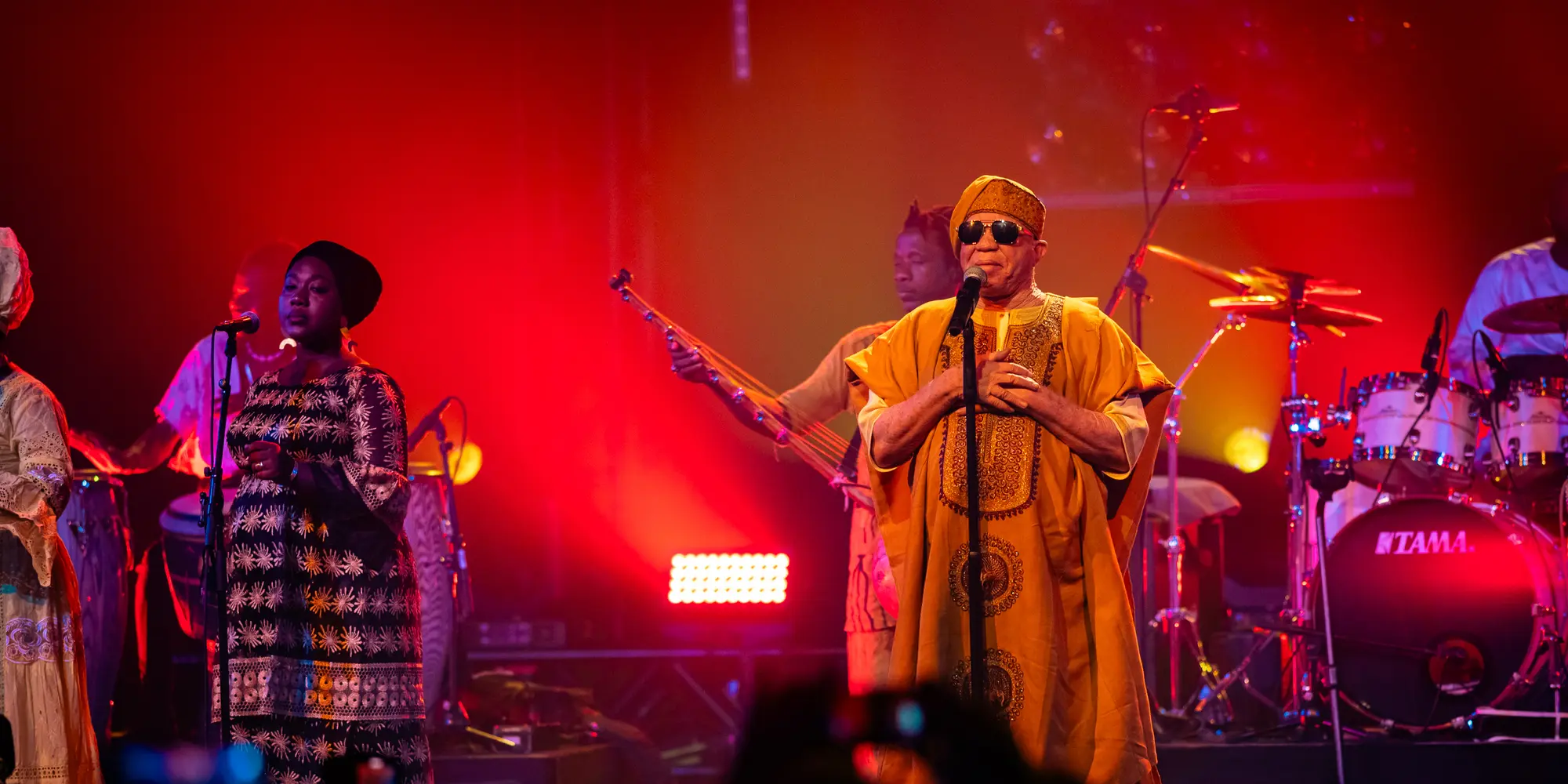
Salif Keita has closed the door on South Africa over what he sees as xenophobic violence. But before judging a country he once stood beside, Sandile Memela says he should listen to ordinary South Africans confronting illegal immigration, criminality, unemployment and state failure.

By Sandile Memela
Salif, we need to talk to you as brothers. We do so with love, deep respect and, yes, pain.
For more than fifty years, you have been the Golden Voice of Africa. You sang for Mandela when it was dangerous to sing for Mandela.
You have given Mali and Africa dignity at times when the world called us albinos and outcasts. You are not just an artist to us; you are a brother and an elder.
That is why your statement, “I Close the Door on Hate, Not on the People”, has hurt us so much. And that is why we must respectfully tell you that you have been misled.
You have been misled by nefarious and non-objective reports that portray what is happening in South Africa as simple xenophobia. It is not. To call it that is to insult ordinary South Africans who are suffering 33 years after democracy.
What You Call Xenophobic Violence Is an Anti-Illegality March
Salif, we have to make a distinction that international media, especially African parachute journalism, refuses to make. There is xenophobia, which we condemn, and there is a legitimate, lawful protest against illegal immigration and lawlessness, which is what you are seeing now.
No South African in their right mind hates Africans. We are Africans. Our homes are full of Malawians, Zimbabweans, Mozambicans, and Basotho who came legally, who work, and who are our neighbours, our comrades, and our family. My own cousin is married to a Zimbabwean. We live together.
What South Africans are marching against is not legal migrants. They are marching against illegal migration, undocumented criminality and the complete collapse of border control.
The anti-illegal migration marches you have seen on television, including those organised by Operation Dudula, March and March, and community forums, are not designed to attack fellow Africans. They are driven by a desire to restore law and order in the face of state failure.
For more than 20 years, our state has failed to secure the border. It has failed to issue proper visas. It has failed to deport criminals. It has failed to stop human trafficking.
When the state fails, people take to the streets. That is not hate. That is desperation.
The Borders Are Porous, The Police Are Corrupt
You said you see people looking for work, safety and dignity. And you are right, many are. But you must also see what ordinary South Africans see in Diepsloot, Hillbrow, Isipingo and Marabastad.
We see porous borders. The fences between South Africa and Mozambique, Zimbabwe and Lesotho were cut years ago and never repaired. People cross with goods, drugs, guns and children. The army and police on both sides are corrupt and allow things to fall apart.
A bribe of R1,500 or less at Beitbridge can get a truckload through. This is not a secret. Even our own Border Management Authority has acknowledged serious corruption and weaknesses at the borders.
We see hijacked buildings in Johannesburg where 30 people sleep in one room, owned by criminal syndicates, some involving undocumented foreign nationals and protected by corrupt local police. We saw 77 people burn to death in the Usindiso building because of the conditions created by this criminality.
We see spaza shops in townships selling expired food and poison to our children, run by people with no papers, no health certificates and no tax compliance, while South African shop owners who follow the law go bankrupt.
We see our clinics under enormous pressure because they must serve far more people than they were designed and budgeted for, without the necessary additional resources.
Is it xenophobic to ask for papers? Is it hate to ask for law and order?
If a Malian came to South Africa without papers, took over a building and sold fake medicines to South African children, would the Malian government say nothing in the name of African unity?
Of course not. We must establish clear boundaries if peace is to prevail.
Keita, Please Examine the Failure of African Political Leadership
This is the deeper issue you must examine, brother. This crisis is not exclusively South African. It is African. It is a failure of African political leadership and governance.
Why are millions of young Africans leaving their countries in the first place? Why is a young man from your beloved Mali, from Zimbabwe, Malawi or the DRC risking his life to cross the Limpopo?
Because his own government has failed him. Because there are no jobs. Because there is corruption. Because there is war. Because African leaders steal elections and resources and then drive their youth into exile.
And then those leaders have the luxury of calling South Africans xenophobic from comfortable offices in Addis Ababa.
The AU, SADC and ECOWAS have never held a summit to ask: Why are our people fleeing? What are we doing to create conditions for them to stay? Instead, they allow South Africa to carry the burden of the entire continent’s failures and then shame South Africa when ordinary people complain that the burden has become too heavy.
This is dishonest. African unity cannot mean that South Africa must collapse so that Africa can feel united.
You, Salif, know this. You have criticised leaders in Mali for their corruption. You know that governance matters.
Come and Listen Before You Boycott
You said: “If there is a stage in a township, I will sing there. If a community needs to be heard, I will listen.”
We invite you to do exactly that. But do not cancel first and listen later. Listen first.
You are most welcome to engage in frank talks with people who understand the background to this, including activists such as Jacinta Ngobese Zuma and community leaders in Alexandra, Soweto, Durban and Cape Town who are leading these marches. Not politicians. Ordinary mothers who have buried children who ate poisoned snacks. Ordinary workers who lost jobs because employers prefer cheap, undocumented and exploitable labour. Families who have been held hostage and robbed in their own homes.
Sit with them. They will not show you hate. They will show you shacks where South Africans and legal migrants live together, both suffering because illegal criminal networks control housing and electricity.
You sang at Wembley in 1988 for Mandela because apartheid was our shared struggle. Today, our shared struggle is against corrupt African elites who have betrayed Mandela’s dream of a functional, law-governed Africa.
Boycotting South Africa punishes the wrong people. It punishes helpless ordinary South Africans who are having a tough time 33 years after democracy, who still live in poverty, who still have no jobs and who still drink water contaminated with cholera. It tells them that their pain does not matter; only the pain of those who crossed the border matters.
African unity should not come at the expense of helpless ordinary South Africans. We deserve to be treated as a priority in our own country.
We appreciate the African support during the days of the struggle. But the real fight was inside the country, waged by ordinary people.
Keep The Door Open
Dear brother, you said, “I am closing the door on violence.” We challenge and request you: do not close the door on dialogue.
Violence is wrong. If any South African attacks a fellow African because of their nationality alone, we condemn it with you. They must be arrested. But demanding documents, demanding law and order, demanding that our state do its job and secure the border is not violence. It is citizenship.
We love you. We need your voice here, not away from here. Come and sing on that township stage. But also come and march with those mothers who want clean spaza shops.
Come and advise undocumented migrants to return home and obtain the proper documents. Come and see both sides.
Do not allow nefarious NGOs and sensationalist international media outlets, which have never lived in a township, to tell you who we are. Do not read or listen to African journalists who write stories after spending less than two days in the country.
We are not xenophobic. We are exhausted. We are a people who opened our arms to the continent after 1994, and now our arms are tired because our own state has left us to carry what should be carried by 54 states.
Your music taught us that difference is not disdain. Please do not disdain our struggle for law and order.
With love and Ubuntu,
Your brothers and sisters in South Africa
Sandile Memela is a writer and cultural critic.