


Traditional leadership remains one of South Africa’s most enduring governance systems, yet it has long operated at the margins of formal economic structures. A new initiative seeks to change that by introducing enforceable governance, professional oversight and investment readiness into a sector that serves millions but has historically lacked access to institutional capital.
By Noko Mashilo
A new governance framework seeks to connect South Africa’s traditional leadership institutions to investment, accountability and formal economic participation, bridging the longstanding divide between traditional governance and modern economic systems.
The establishment of the Royal Authority for Commerce and Charters (RACC) represents the institutional response to this gap, providing a structured mechanism through which traditional leadership structures can engage with formal investment and governance systems.
RACC will be officially launched on 20 April 2026 at Regenesys Business School, Sandton, as part of an initiative hosted by the Chartered Institute for Business Accountants (CIBA) and Royal Leaders of South Africa (ROLESA).
The framework introduces a formal governance and funding structure aimed at supporting project preparation and unlocking investment aligned with corporate standards under traditional leadership structures.
Speaking ahead of the launch, Nicolaas van Wyk, Chief Executive Officer of CIBA and vice-chairman of RACC, said the organisation’s involvement is rooted in the scale and significance of traditional leadership in South Africa.
“South Africa’s traditional leadership sector governs the daily lives of an estimated 18 million people. These are constitutionally recognised institutions, kings, chiefs and headmen who resolve disputes, manage land, preserve culture and hold communities together. Yet there has never been a formal, professionally governed framework that connects this sector to the resources, accountability frameworks and investment infrastructure it needs to function effectively,” said van Wyk.
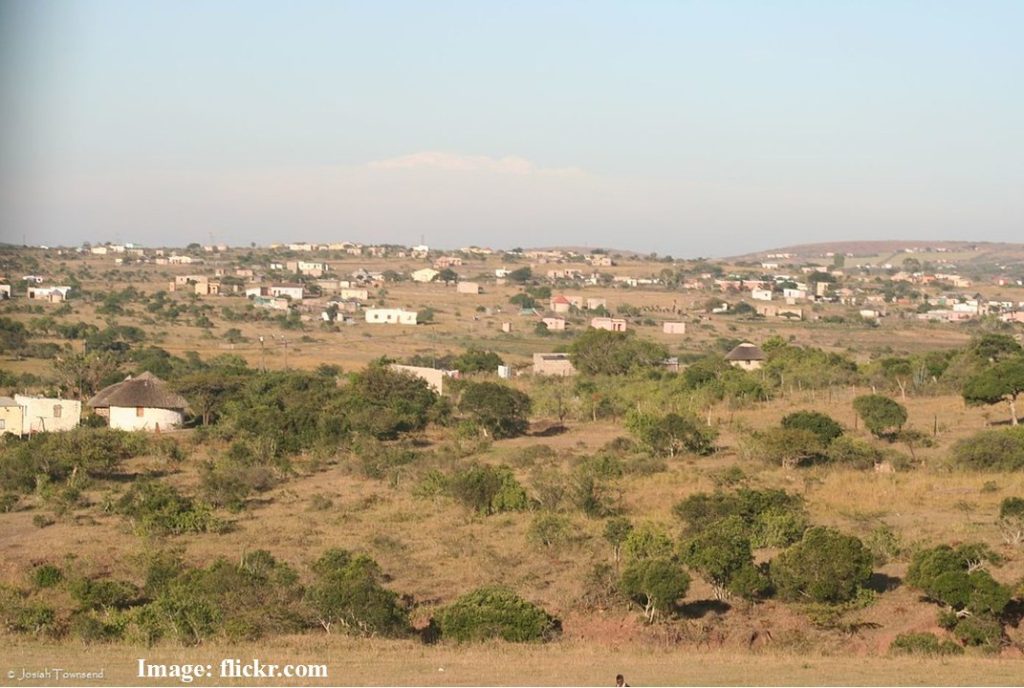
He stressed that this gap has had far-reaching consequences. “This is not a minor administrative oversight. This is why royal community projects struggle to access development funding. It is why headmen often serve without pay or transport. And it is why, when unrest occurs, the institutional vacuum becomes visible to the entire country,” he said.
Van Wyk said the implications extend beyond administration.
He explained that CIBA’s mandate is to extend professional financial governance beyond corporate environments into underserved sectors. Partnering with ROLESA to establish RACC is the most direct expression of that mandate. We are not providing charity; we are providing the professional infrastructure that makes sustainable development possible.”
At the core of RACC’s model is enforceable governance and compliance. Van Wyk said every project processed through the framework will meet corporate, audit and investment standards through oversight by CIBA-accredited professionals.
“Each project is handled by Chartered Business Accountants in Practice, professionals bound by CIBA’s code of conduct and disciplinary framework. This ensures that every initiative is credible, compliant and investment-ready,” he said.
He added that RACC’s financial administration will be independently managed to ensure full accountability. “All funds, including community contributions, are overseen by an independent registered auditor responsible for bookkeeping, statutory compliance and audit coordination. This is not self-certification; it is independent professional accountability aligned with the standards required of any entity seeking funding.”

For companies seeking RACC’s Royal Charter, its cultural verification seal, the process is equally rigorous. “Each application is assigned to accredited professionals who produce a verified and defensible record of compliance. This is not a branding exercise; it is a credible signal to investors, donors and government that standards have been met,” said van Wyk.
Addressing the persistent challenge of funding rural and community-led projects, van Wyk pointed to a critical structural issue. “The biggest barrier is not a lack of good ideas; it is a lack of documentation. Funders require governance structures, audited financials, procurement systems and reporting frameworks. Most traditional communities have never had access to the institutional support needed to develop these.”
He said RACC directly addresses this gap. “We deploy CIBA’s professional network into the preparation of projects, transforming them from concept-stage ideas into bankable opportunities. We move initiatives from being endorsed by a king to being evaluated with confidence by investors. This is substantive, technical work; it is the bridge between traditional authority and modern capital.”
Van Wyk emphasised that the partnership between CIBA and ROLESA represents a deep structural commitment rather than a symbolic gesture.
“When a nationally accredited professional body co-founds and governs a framework alongside recognised royal leadership, it signals a serious commitment to accountability. Governance standards are built into the foundation, not added later,” he said.
He added that for the business sector, RACC offers a unique value proposition. “The Royal Charter provides something no conventional corporate social investment programme can replicate: a professionally verified signal of genuine alignment with South Africa’s traditional leadership institutions.”
At a national level, van Wyk said the initiative represents a necessary convergence. “South Africa needs both its professional sector and its traditional leadership institutions to function effectively. RACC is the framework that connects them, transparently, constitutionally and for the long term.”
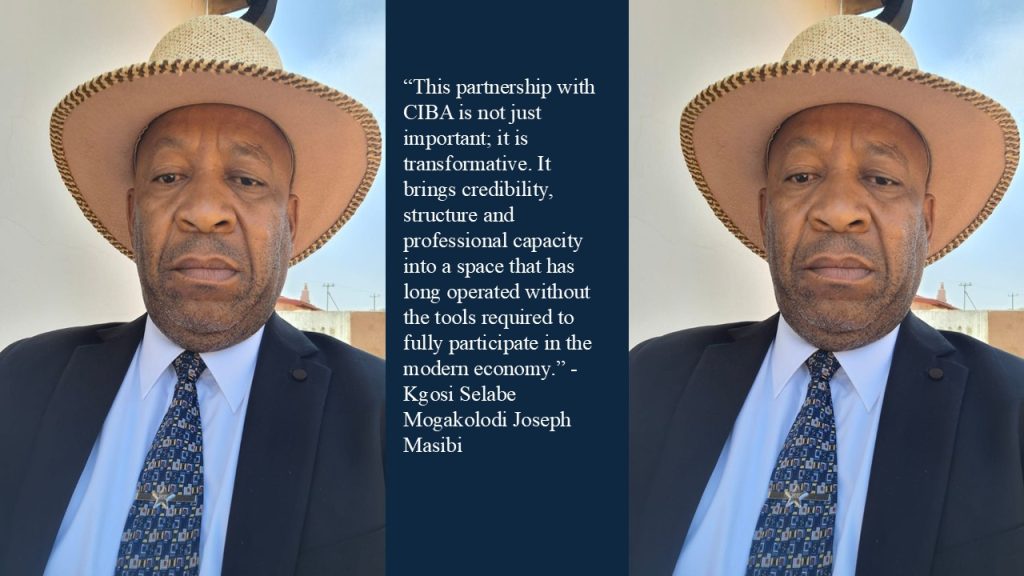
According to Kgosi Selabe Masibi, who is the president of ROLESA and chairman of RACC, traditional leaders have carried the responsibility of their communities for generations, often with very limited institutional support. “This partnership with CIBA is not just important; it is transformative. It brings credibility, structure and professional capacity into a space that has long operated without the tools required to fully participate in the modern economy,” said Masibi.
He further said this partnership represents a long-awaited breakthrough. “It affirms that traditional leadership is not separate from development, but central to it. We have always had the authority, the land and the trust of our people; what has been missing is the bridge to funding, compliance and investment. RACC provides that bridge,” he said.
Kgoshi Letsiri Phaahla, Ngwato a Phogole, deputy president of ROLESA, said this is indeed something they have been seeking for many years. “Our communities have ideas, initiatives and opportunities, but they have remained locked out of the mainstream economy because they were not packaged in a way that funders and investors could recognise. With the launch of RACC, that changes fundamentally,” he said.
He also said that what RACC does is bring professionalism into development efforts without taking away identity or authority. “It allows traditional leaders to remain custodians of their communities while working with qualified professionals to ensure that projects meet the standards required by government, investors and development institutions.”
“For our communities, the impact will be even more significant. This framework will unlock development, particularly in sectors such as agriculture, local enterprise, infrastructure and community services. It will create opportunities for young people, improve livelihoods and restore dignity to rural economies that have long been overlooked,” he said.

He added that RACC is not just a launch; it is the beginning of a new chapter where traditional leadership and the professional sector walk together to build sustainable, accountable and inclusive development for our people,” he concluded.