


She promised not to disappoint anyone. For a city that had been let down so many times, those were bold words. But Mayor Babalwa Lobishe is quietly making good — one repaired bridge, one secured substation, one sealed pipe at a time.
By Lonwabo Mirha
When Babalwa Lobishe stood before a jubilant council chamber in October 2024, newly elected and uncontested, she made a promise that few of her predecessors had dared to keep: “We promise not to disappoint anyone.”
After nearly a dozen mayors in five years, a city haemorrhaging water, power and public trust, and factories quietly losing orders to a world that wasn’t waiting — Nelson Mandela Bay had heard it all before. This time, something may be different.
The city she inherited is no small prize. Nelson Mandela Bay is one of South Africa’s economic powerhouses — anchored by two deep-water ports and a legacy of manufacturing, home to major car plants and component factories that account for about 40% of the nation’s auto-sector jobs and roughly 70% of its locally assembled vehicles.
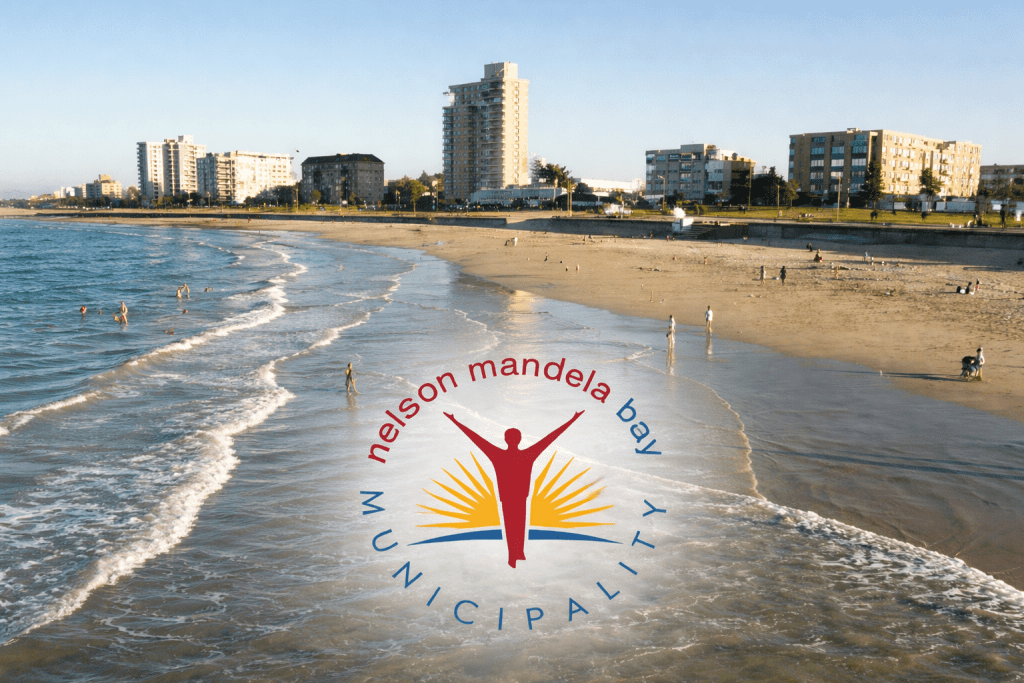
Known as the ‘Bay of Opportunity’, the metro also boasts breweries, food and textile plants, a pharmaceuticals cluster, and 300 days of sunshine that fuel a thriving tourism sector of golden beaches and flower-filled reserves.
However, that competitive edge has been badly eroded by global headwinds, including US tariffs, cheap imports, and the EV shift, and by years of failing local infrastructure that no previous mayor had managed to fix.
The scale of what she walked into was staggering. After a decade of political instability — nearly a dozen mayors in five years — Nelson Mandela Bay’s services had crumbled to a critical point.
Audit reports revealed that almost half of all treated water was being lost through leaks; electricity losses ran into the billions, with the metro haemorrhaging more than R1 billion in unbilled power in 2024 alone, and forecasting a further R1.7 billion gap in 2025.
Streetlights and traffic signals lay dark across entire suburbs, and storm-damaged roads and bridges went unrepaired for lack of funding and oversight. The business community had reached breaking point.
In late 2024, the NMB Business Chamber — one of the city’s most influential private-sector voices — warned that “crumbling roads, sewer bursts and Eskom outages [were] paralysing the metro’s productivity.”
From the outset, Lobishe framed her mandate not as a solo act but as a partnership. She moved quickly to activate a ‘master MOU’ with the Nelson Mandela Bay Business Chamber — an agreement first signed under the prior administration but now given real teeth — bringing private engineering and security expertise directly into municipal problem-solving.
Together, they launched a series of adopt-a-street and adopt-a-facility projects that put businesses on the ground in the city’s most neglected corners.
In low-income neighbourhoods, volunteers repaired over 4,200 burst pipes, saving approximately 1.6 million litres of treated water every single day — a 23% reduction in consumption in those areas, and a meaningful reprieve for communities that had long learned to live with dry taps.
The partnership’s reach extended well beyond street repairs. Eighteen companies moved into schools, repairing faulty plumbing and installing rainwater tanks at 76 facilities — shaving a further 10% off the city’s water losses.
Twelve businesses went further still, ‘adopting’ critical electrical substations and funding round-the-clock security guards and alarm systems.
The results were immediate and measurable: in those areas, cable theft stopped entirely, and power flowed uninterrupted. In the industrial suburb of Struandale, an entire two years passed without a single substation outage — a feat that would have seemed unimaginable just years before.

For Denise van Huyssteen, CEO of the Nelson Mandela Bay Business Chamber and one of the driving forces behind the private-sector mobilisation, the momentum was clear. Businesses, she said, were “fully committed to working with government… to help resurge the Bay and unlock the potential of the Bay of Opportunity as a two-port city.”
Words at a summit were quickly backed by money. In April 2025, Lobishe stood alongside Premier Oscar Mabuyane and the city’s top business leaders at a city-province summit, where Mabuyane captured the spirit of the moment: “Our strength lies in our collective action.”
The summit identified water, sanitation, electricity and port operations as urgent priorities — and Lobishe returned to the council chamber determined to put real rands behind the rhetoric.
The March 2026 adjustment budget earmarked R679.6 million for infrastructure upgrades — R482.4 million directed at water projects alone, covering new pipelines, boreholes and meter installations, with the remainder allocated to electrification and roadworks.
It was, in Lobishe’s own words to council, a budget that “prioritises sanitation capex projects” and “addresses some of the challenges associated with electricity projects” — the kind of unglamorous, nuts-and-bolts spending that broken cities desperately need.
The promises are beginning to show up in concrete and steel.
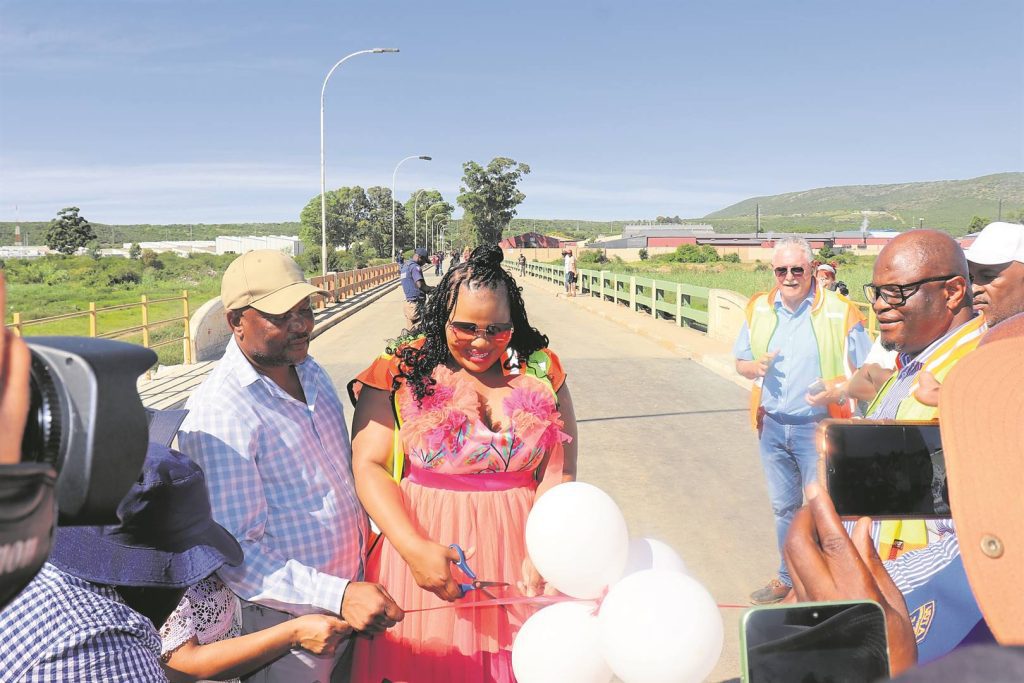
In November 2025, Lobishe stood at the newly rebuilt KwaNobuhle bridges — two crossings that had collapsed in the June 2024 floods, severing isolated townships from schools and clinics — and declared them open, months ahead of schedule and at a cost of R89 million. The moment carried a quiet symbolism: a mayor who said she would deliver, delivering.
At the reopening ceremony, she turned to her critics with characteristic confidence: “We are happy that critics have managed to put us in the spotlight. Today, we are also in the same spotlight for goodness — we’ve done so under tremendous pressure.”
She used the occasion to announce a further R53 million for roads and pipes, making clear that no disaster-damaged infrastructure would be left to rot.
And to ensure the public could see the progress for themselves, she launched a series of open “progress tours” — personally leading inspections of restored power supply in formerly blackout-prone suburbs, making accountability visible rather than merely promised.
On the ground, the transformation was becoming visible in unexpected ways. Chamber task teams on water, electricity and sanitation were now embedded directly in the municipality’s planning processes, while local business clusters went further — installing backup generators at traffic lights and donating CCTV cameras for community patrols.
Van Huyssteen noted that by choosing collaboration over confrontation, companies had been able to offer “consulting and advice” on technical fixes, effectively freeing up cash-strapped city engineers to focus on implementation rather than diagnosis.
The political environment, meanwhile, had grown more watchful. In March 2026, two opposition councillors filed no-confidence motions against the mayor — a sign that scrutiny was intensifying even as results were beginning to show. Lobishe survived both votes with ease, but rather than treating the moment as a victory, she leaned into it.
“Leadership must lean into accountability, not retreat from it,” she posted on social media — a statement that said as much about her character as it did about her politics.
No honest account of Nelson Mandela Bay’s recovery would be complete without acknowledging how much ground remains to be covered. Into 2026, more than half of the city’s streetlights were still dark, water interruptions continued in several areas, and power theft had resumed in neighbourhoods where private security patrols had not yet reached.
A declaration that has framed scrutiny as an integral part of renewal.
Opposition councillors were quick to point these out — though many of the shortfalls they cited were the direct inheritance of the decade of neglect that preceded Lobishe’s tenure, not its product.
The mayor has never shied away from the scrutiny. When a R25 million transformer lease was flagged for investigation, she pledged full cooperation without hesitation, framing transparency not as a concession but as a governing principle.
“We remain committed to answering difficult questions and providing information,” she declared — a mayor who understood that rebuilding a city and rebuilding public trust were, ultimately, the same task.
Critics, however, remain vigilant. Opposition councillors have pointed out that many services are still falling short: 53% of streetlights were dark well into 2026, water interruptions persist, and power theft has resumed in unguarded areas.
They fault the mayor for inherited debts and the pace of resolving them, and note that some promised projects – such as road resurfacing – remain pending. Lobishe counters that decades of neglect cannot be undone overnight, but insists her administration’s record must speak for itself.

On every legal challenge or audit query – including a R25 million transformer lease currently under investigation – she has pledged full cooperation, maintaining that transparency and accountability will define her tenure.
By early 2026, cautious optimism had taken hold that Nelson Mandela Bay could indeed turn the ship around. Provincial and business leaders alike regard it as perhaps South Africa’s most “fixable” metro, given its compact size and engaged citizenry.
“Our strength lies in our collective action.”
Eastern Cape Premier, Oscar Mabuyane
City Hall in Gqeberha now hosts regular roundtables with unions, churches and NGOs – an inclusive coalition that the mayor credits for the early gains. Rather than blame-shifting, Lobishe consistently speaks of not disappointing anyone in the city, and of serving all wards with equal urgency.
Lobishe’s broader vision extends well beyond fixing potholes or restoring lights. She has spoken of Nelson Mandela Bay becoming a smart city – leveraging technology for traffic management, utility monitoring, and citizen engagement.
Plans are underway for a digital service-delivery platform that will allow residents to report faults and track repairs in real time.
She also envisions the port of Ngqura and the automotive sector – with Volkswagen and other manufacturers based in Kariega – as engines of economic revival, and has pledged to make the metro more investor-friendly through streamlined licensing and land-use approvals.
“We want to be a city that works,” she has said – and for a metro that has known years of dysfunction, even that modest goal carries profound weight.
In the final analysis, Babalwa Lobishe’s mayoralty represents a high-stakes experiment in cooperative governance. She has inherited a city on the brink – financially stressed, service-delivery challenged, and politically fractured – and is attempting to stabilise it through coalition politics, technocratic management, and sheer force of will.
The early indicators are encouraging, but the road ahead remains long.
Whether Nelson Mandela Bay ultimately succeeds or stumbles will depend not only on Lobishe’s leadership, but also on whether the coalition holds, the fiscus recovers, and citizens remain engaged. For now, the city watches, waits – and, cautiously, hopes.