


South Africa’s deepening socio-economic crisis has fuelled an atmosphere of toxic rage. As conditions deteriorate, migrants are caught in an ever-tightening vice: rising local resentment, a faltering state, and a region unwilling—or unable—to confront the forces driving displacement. The result is a slow-burning ordeal, leaving millions exposed and with no credible end in sight. (This article is the first in a two-part series exploring how leadership failures and unfulfilled promises have left migrants vulnerable across Southern Africa.)
By Themba Khumalo
In May 2008, South Africa’s democratic promise did not simply falter under pressure — it split open in full public view, its carefully held ideals giving way to scenes of fire, fear and fury that exposed, with brutal clarity, how thin the line was between hope and collapse.
What began as simmering frustration erupted into a wave of violence that would scar the post-apartheid era. Armed mobs swept through communities with ruthless precision. At least 62 people lost their lives, more than 1,700 were injured, and around 100,000 were forced from their homes.

It began in Alexandra, Johannesburg.
At a community meeting, migrants were accused of fuelling crime and “stealing” jobs. The rhetoric was familiar; the grievances were not new. But something had shifted. Words hardened, suspicion thickened into hostility, and within days, homes were under siege.
The violence spread with alarming speed—township to township, province to province—revealing just how fragile the social fabric had become, and how swiftly it could tear.
The Ramaphosa informal settlement on the East Rand became one of the places where inhumanity unfolded at an unthinkable level. On 18 May, 35-year-old Mozambican national Ernesto Alfabeto Nhamuave was beaten, stabbed, wrapped in his own blankets and set alight.
Halden Krog, a senior photographer for The Times, captured the photograph, which showed Nhamuave on his hands and knees engulfed in flames. It was published on the front pages of several South African newspapers, becoming a symbol of the violence.
The following day, a 16-year-old migrant was hacked, burned and left for dead on a refuse dump. He survived.
Across the country, tens of thousands fled their homes. Community centres filled overnight. Police stations became temporary sanctuaries. Families clutched what they could carry. They waited for buses to take them to makeshift camps set up on the outskirts of cities that had become hostile.
The fires eventually died down. The anger did not. In the years that followed, prosecutions were slow. Socio-economic change was negligible.
For many poor South Africans, the promised fruits of the 1994 liberation have remained distant. Work has become even more scarce. Informal settlements keep expanding. Service delivery is faltering.
The resentment that has been directed at African migrants has been left to simmer.
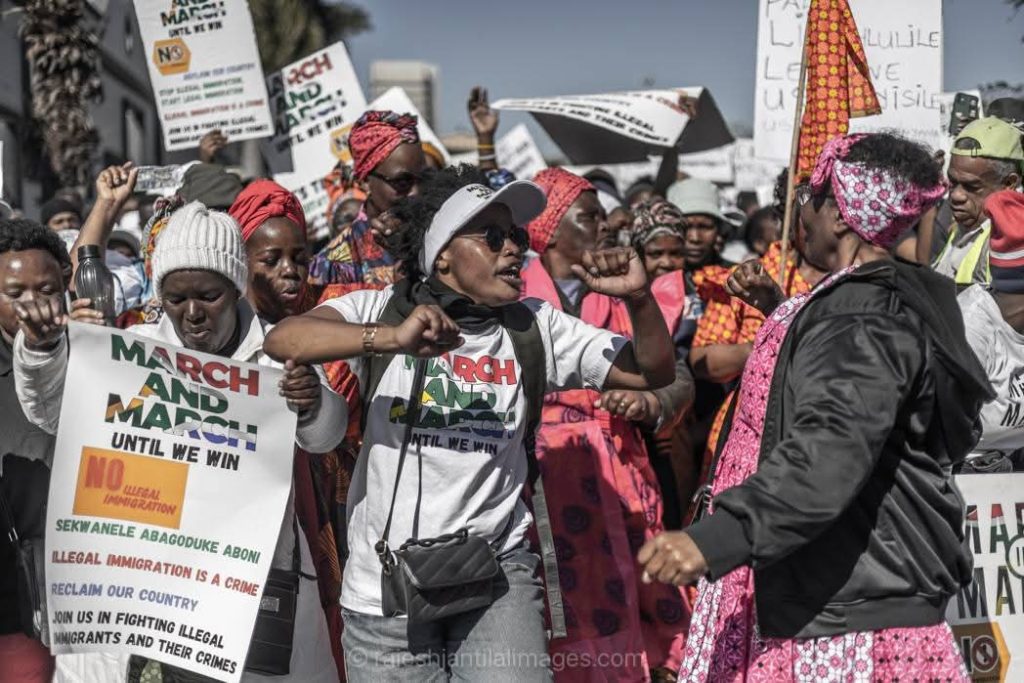
Seven years later, it resurfaced. In April 2015, violence broke out in Durban and soon spread to Johannesburg. African immigrant-owned shops were looted. Families fled again.
The late King of amaZulu, Goodwill Zwelithini, was accused of fuelling tensions when he reportedly said: “Let us pop our head lice. We must remove ticks and place them outside in the sun. We ask foreign nationals to pack their belongings and be sent back.”
King Zwelithini later said his comments had been twisted. But the violence did not wait for clarification. In that month alone, at least eight people were killed. Hundreds were displaced.
Then came another image from Alexandra.

Emmanuel Sithole was attacked in broad daylight. Photographer James Oatway captured the moment Sithole was fatally stabbed. The photograph travelled around the world. It stripped away all abstraction, revealing a man pleading for his life.
Despite official denials that the killing was xenophobic, the army was deployed the day after the images were published. Over the following three years, violence flared intermittently across the country. Some African governments began repatriating their citizens from South Africa — a quiet acknowledgement that safety could no longer be guaranteed.
What we call it matters
For years, South Africa has reached for the catch-all word: xenophobia — fear or hatred of foreigners.
But many South African researchers have argued that this label misses the most important detail: the people most commonly targeted are not “foreigners” in the abstract. They are Africans.
That distinction is why the term Afrophobia has gained ground — not as a fashionable alternative, but as a sharper diagnosis of what repeatedly plays out in townships, inner cities and informal settlements: African outsiders are singled out, accused, hunted, and pushed out.
If the diagnosis changes, the questions change too.
Not only why do South Africans attack foreigners? But why do they attack Africans — and why does the region keep feeding that pressure into South Africa?
The numbers show who “foreign” usually means
South Africa’s migrant population is often spoken about as if it has swallowed the country whole. The evidence does not support that.
According to Statistics South Africa, Census 2022 counted 2,418,197 international migrants living in the country — about 3.9% of the population. – (Statistics South Africa)
The more revealing number is where those migrants come from.
According to the same census-based reporting, Statistics South Africa notes that the SADC region remained the dominant source of international migrants, accounting for 83.7% of the total immigrant population. – (Statistics South Africa)
In ordinary terms, when a South African resident says “foreigner” in daily life, the person they mean is usually African — often Zimbabwean, Mozambican or Malawian.
That demographic truth has consequences.
It means when anger is mobilised, it is mobilised against people who are already nearby, visible, and easy to label — whether or not they are the cause of the hardship being described.
The ordinary South African question is real — and dangerous.
There is a question that surfaces repeatedly in communities where jobs are scarce and services are failing. It is not always shouted. Sometimes it is asked quietly, in frustration: Why must we carry the burden of Pan-Africanism?
The question appears whenever regional solidarity is invoked. It appears when politicians speak about open borders, continental unity or shared African futures. It appears when locals queue at clinics, wait for housing allocations, or search for work without success.
For some, it is a question asked in genuine confusion. For others, it is framed in ways that mobilise anger.
The phrase “Pan-Africanism” carries moral weight in South Africa. The liberation struggle was supported by neighbouring states. Exiles were sheltered. Camps were hosted. Borders were crossed in the name of freedom. That history matters.
But some people argue that history does not automatically settle present-day anxieties.
One reason the question sticks is that public attitudes towards migration have hardened sharply.
In January 2026, Afrobarometer reported that 83% of South Africans said the government should reduce or eliminate entry by foreign job seekers, with a similar majority favouring tighter limits for refugees. (Afrobarometer)
Those numbers matter not because they justify anything, but because they reveal the political ground on which scapegoating thrives. Violence does not need majority approval — it needs enough sympathy, silence, or exhaustion to flourish.

And it flourishes most easily where the state is distrusted: where policing is seen as selective, where housing lists feel like a rigged lottery, where clinics are overwhelmed, and where the promise of 1994 still feels like a rumour.
The missing part of the story is regional.
Here is the part South Africa’s Afrophobia debate often underplays:
The story does not begin at the border. It begins in a region in which accountability is weak, consequences are rare, and power is often protected by power.
South Africa is not the only country in Southern Africa struggling. But it is the largest economic magnet in the neighbourhood, which means regional failures find a way of washing up on its streets.
The migration pressure is not only about people seeking opportunity. It is also about people escaping instability, repression and violence — and doing so in a region where the institutions meant to uphold democratic standards often struggle to enforce them.
Two bodies sit at the centre of that promise:
- The African Union (AU), as the continental umbrella; and
- The Southern African Development Community (SADC) as the regional bloc.
Their founding documents contain strong language. The problem is what happens after the language.
AU: strong words, narrow teeth
The AU’s foundational rule against coups is clear.
In the Constitutive Act of the African Union, Article 30 states: governments that come to power through “unconstitutional means” shall not be allowed to participate in the Union’s activities.
That principle has teeth in classic coup situations because a coup is easy to name.
But many of the crises that drive migration in Southern Africa do not arrive as coups. They arrive as slower erosions: elections that fail credibility tests, public institutions that are captured, civic space that is squeezed, and security forces that act with impunity while the constitutional shell remains standing.
That is harder for continental bodies to punish because it forces leaders to discipline peers, and peers rarely volunteer for precedents that could one day reach their own door.
SADC: consensus that can become paralysis
SADC’s treaty language speaks about democracy and rights. But its decision-making structure can make enforcement fragile.
In SADC’s consolidated treaty, Summit decisions are made by consensus and are binding. However, this reliance on consensus has rendered enforcement slow and often stalled, leaving the region—and its migrants—without decisive recourse or resolution.
Consensus sounds cooperative. In practice, it can mean the strongest action is the action everyone can live with, which is often not very strong at all.
That is one reason Southern Africa has grown familiar with a particular style of regional response: observation, “engagement”, and appeals for calm — but limited consequence.
Zimbabwe is a case study in ‘observation without enforcement’
Zimbabwe is often treated in South African debates as a single sentence: ‘People flee Zimbabwe because the economy is bad’.
That is true — but incomplete.
Zimbabwe’s outward movement has long been tied to political contestation, disputed elections, and an economy repeatedly thrown into turmoil by volatility and policy shocks.
The SADC Electoral Observation Mission to Zimbabwe’s 2023 Harmonised Elections offered unusually blunt language for a regional body. In its preliminary statement, SADC concluded that ‘some aspects’ of the elections fell short of Zimbabwe’s Constitution, the Electoral Act, and SADC’s own election guidelines.
That line mattered because SADC does not often speak that plainly.
And the concerns were not academic. Independent reporting and analysis around the 2023 vote repeatedly pointed to practical issues that ordinary voters felt in their bones: delays, disruption, intimidation allegations, and contested administrative decisions. – (AP News)

Even the politics around monitoring became part of the story. The Associated Press reported the arrest of dozens of election monitors during the vote count, in a climate where observers and civic groups stated that the electoral environment was hostile.
In other words, Zimbabwe’s migration story is not only about hunger or jobs. It is also about whether citizens trust the path between the vote and power.
Economically, the country’s volatility is also documented by the International Monetary Fund, which in its 2025 Article IV reporting described Zimbabwe as having experienced ‘significant macroeconomic volatility’ in recent decades and noted the continuing weight of external financing pressures and arrears constraints. – (IMF)
When a country’s politics feels closed, and its economy feels unstable, people do what people have always done: they move.
South Africa becomes the pressure point — not because it caused Zimbabwe’s crisis, but because geography and gravity do their work.
Part two looks beyond South Africa, uncovering the regional forces that keep migrants on the move.