

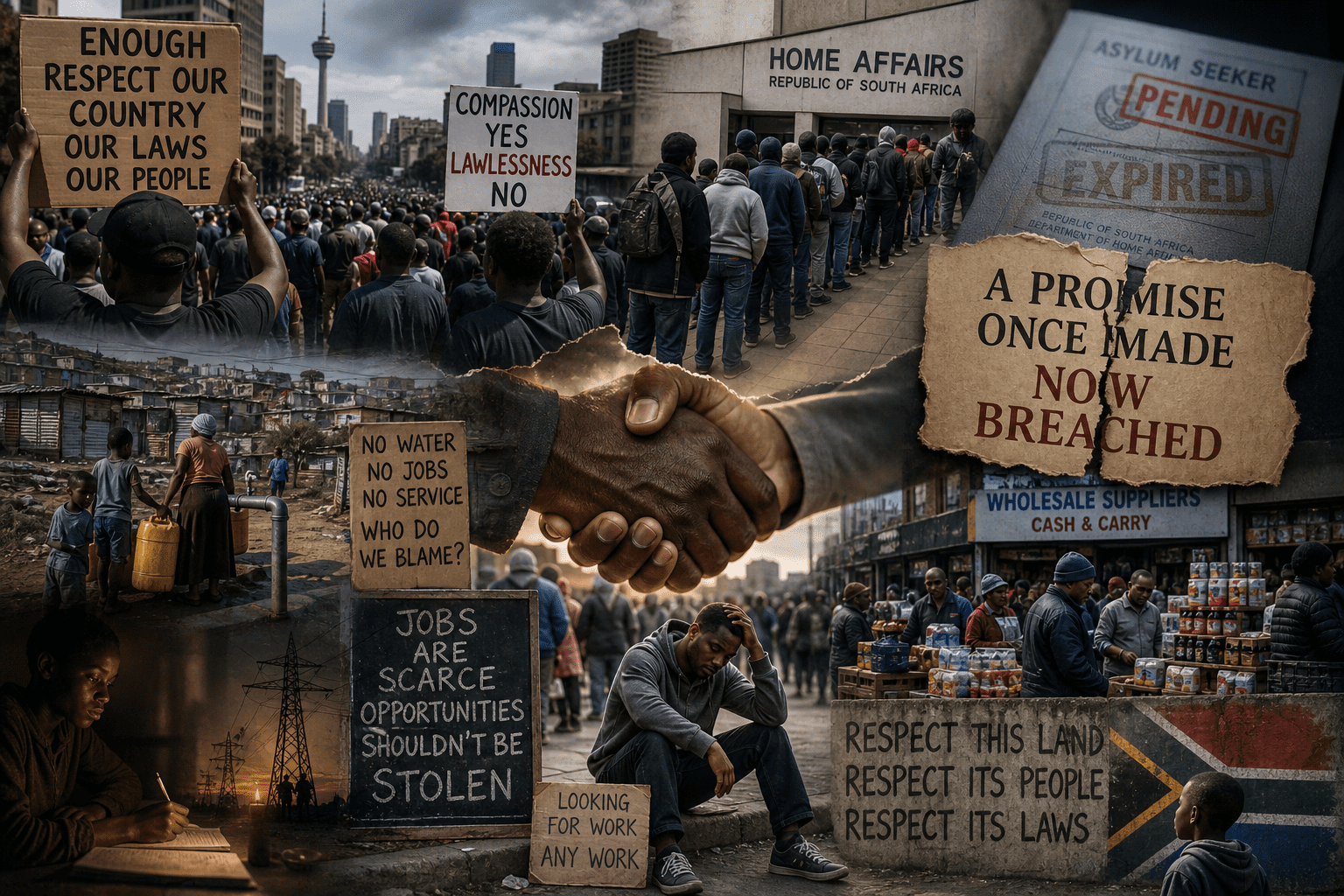
To label all the country’s frustrations with migrants, legal or otherwise, as xenophobic is to oversimplify a complex reality. Xenophobia and prejudice undeniably exist and must be confronted, but not every grievance is born of hate. Many arise from exhaustion, as public systems are worn down and social order begins to fray.
By Themba Khumalo
There is a particular kind of silence that settles over a country before it begins to speak in anger. It is not the silence of peace, but of things endured for too long—frustrations swallowed, explained away, or dismissed as misunderstanding. In South Africa, that silence has been steadily thinning.
For years, the national conversation around migration has been framed in binaries: compassion or cruelty, openness or hostility, solidarity or xenophobia. Yet beneath these simplified lines lies a more complicated and uncomfortable truth—a growing sense among ordinary South Africans that a quiet understanding has been broken.
This unease has not remained confined to private conversations. Instead, it has spilled into the streets—into marches across major cities, led by organisations that have, in turn, been labelled xenophobic by others.
Some commentators have gone further, describing the mood as a strain of chauvinistic nationalism, a hardening of identity in response to perceived encroachment.
There is truth in parts of that critique. Among these organisations are voices that have crossed the line—uttering language that is plainly xenophobic, at times inflammatory, and impossible to defend.
However, to reduce the moment to that alone is to miss what truly drives it. Beneath the slogans and anger, there is a deeper current: a frustration that has been quietly building long before it found expression in protest.
For many, this story does not begin with resentment, but with memory. South Africa, emerging from the long shadow of apartheid, positioned itself not just as a sovereign state, but as a moral idea—a place where those displaced, persecuted, or seeking dignity might find shelter.
There was pride in that role. A belief that suffering, once endured, could be transformed into generosity.
But generosity, when unacknowledged or unreciprocated, becomes vulnerable. It frays and breeds frustration—a quiet pressure that builds until it erupts in the open, often misunderstood as simple hatred.
At the centre of it lies a feeling many South Africans struggle to articulate without being immediately misunderstood: not hatred, but the sense of a promise broken—one shaped by a past in which refuge and solidarity were not abstract ideals, but lived realities.
That legacy set the stage for what was to come next. When South Africa secured its democracy, it opened itself—morally, politically, and historically—as a refuge. During apartheid, many across the continent had offered shelter, support, and solidarity to those forced into exile.
From that history emerged an idea, almost sacred: that freedom brought with it an unspoken obligation—the grace once received should, in turn, be extended. A country that had suffered would not become cruel. A people who had been welcomed would not turn others away lightly.
But over time, that generosity—when stretched without acknowledgement—feels less like virtue and more like risk.
Today, South Africa’s immigration and border management systems are not merely strained—they are approaching collapse. Years of government underfunding, inconsistent policy, and chronic under-enforcement have eroded the basic mechanisms that once regulated entry and presence.
Borders that should provide clarity and security offer little more than a theoretical line on a map. Processes meant to document, monitor, and control movement are riddled with loopholes—easily exploited and overwhelmed by the scale of the challenge.
This failure is not just bureaucratic; its consequences are immediate and visible. The immigration system is defined less by law or policy, and more by the lived reality of weak enforcement and porous borders.
When a system appears inconsistent, it does not take long for perceptions to shift.
The distinction between lawful presence and unlawful entry begins to blur—not as a technical debate, but as something witnessed daily. Borders do not hold. Documentation is easily circumvented. Controls that exist on paper are absent in practice.
In that absence, a pattern begins to form.
Unlawful entry is no longer an exception, but increasingly routine. The presence of undocumented migrants becomes normal. Fraudulent or non-existent documentation is part of the landscape. What should trigger consequence instead settles into permanence.
This is where frustration starts to take root.
For the ordinary South African—already navigating a system that demands compliance at every turn—this unevenness feels less like complexity and more like disregard. The rules are rigid for some and flexible for others. When that perception takes hold, it does more than irritate: it corrodes trust and confidence in the system.
From there, the doubt deepens into something heavier. The question is no longer simply whether the system works, but whether it is being taken seriously at all—by those within it, and by those entrusted to enforce it.
When enforcement appears inconsistent, authority itself begins to weaken.
That weakening does not remain abstract. It moves into lived reality, shaping how people experience their own country—especially in the spaces where survival is already fragile.
When permits expire, when documents are forged or ignored, something else begins to fracture: the meaning of the rules themselves. A system already under strain starts to look optional. To those watching from the outside—unemployed, overburdened, waiting their turn—this does not feel like resilience. It feels like being played.
The economy tells a similar story, but in quieter, more intimate ways. In township streets and inner-city corners, competition is not theoretical; it is lived, daily, at the level of bread, airtime, and cooking oil. South African shopkeepers—often operating alone, without networks or bulk-buying power—find themselves outpaced by tightly organised groups able to undercut prices and dominate supply chains.
This is not, in itself, a crime. But perception matters. When profits leave as quickly as they arrive—sent across borders before they can circulate locally—it creates the impression of an economy being tapped rather than built. Money, instead of moving through the community like blood, seems to bypass the heart entirely.
In time, this impression settles into resentment.
Yet it is in the social fabric where the wound cuts deepest. There is an unspoken expectation in any society: that those who arrive will recognise the ground beneath their feet. Not in submission, but in respect. When that respect appears absent—when there are stories, whether exaggerated or not, of officials being bribed, of borders crossed with ease, of systems laughed at—it lands as something more than irritation. It feels like humiliation.
A host can endure many things. What it struggles to endure is the sense of being mocked in its own home.
This is where the language of “entitlement” begins to surface. Rightly or wrongly, some South Africans perceive not just participation, but a claim—an assertion of belonging without the corresponding acknowledgement of the country’s own fragile realities: mass unemployment, failing infrastructure, and a state already stretched thin.
Nowhere is that strain more visible than in the poorest communities. It is here, not in boardrooms or policy papers, that the consequences are most sharply felt. Overcrowded housing, informal connections to electricity and water, clinics filled beyond capacity—these are not abstract pressures. They are lived conditions, borne by people who feel they have the least margin for additional weight.
When the lights go out—again—during load shedding, when taps run dry, when queues at clinics stretch into the street, frustration searches for something tangible to hold responsible. In the absence of clear, functioning systems, it often settles on the most visible “other”.
None of this exists in a vacuum. Crime, corruption, and state failure are deeply rooted domestic issues. But public anger rarely moves with such precision. It gathers, it spills, it simplifies.
At the heart of this is a demand—not for exclusion, but for balance and reciprocity. For the restoration of mutual recognition.
There is a growing insistence that hospitality must not mean lawlessness, that openness must not erase accountability. That those who come to build a life should do so within the framework that holds the country together, however imperfect that framework may be.
This is not a call to abandon compassion. It is a call to anchor it.
Because when generosity is perceived as weakness, it does not inspire unity. It breeds contempt. And when a nation begins to feel that its goodwill has been mistaken for something to exploit, the reaction—however uncomfortable—becomes inevitable.
What is being expressed, in blunt and sometimes dangerous ways, is not simply anger at migrants. It is anger at disorder, at inequality, at a system that appears unable or unwilling to protect its own terms.
If there is a way forward, it lies not in denial or accusation, but in restoring the basic contract: those who arrive must respect the laws, the limits, and the lived realities of those already here—and the state, in turn, must enforce those standards fairly and consistently.
If trust and mutual respect can be restored, South Africa might once again become a model of generosity—not out of naivety, but grounded in shared responsibility.