

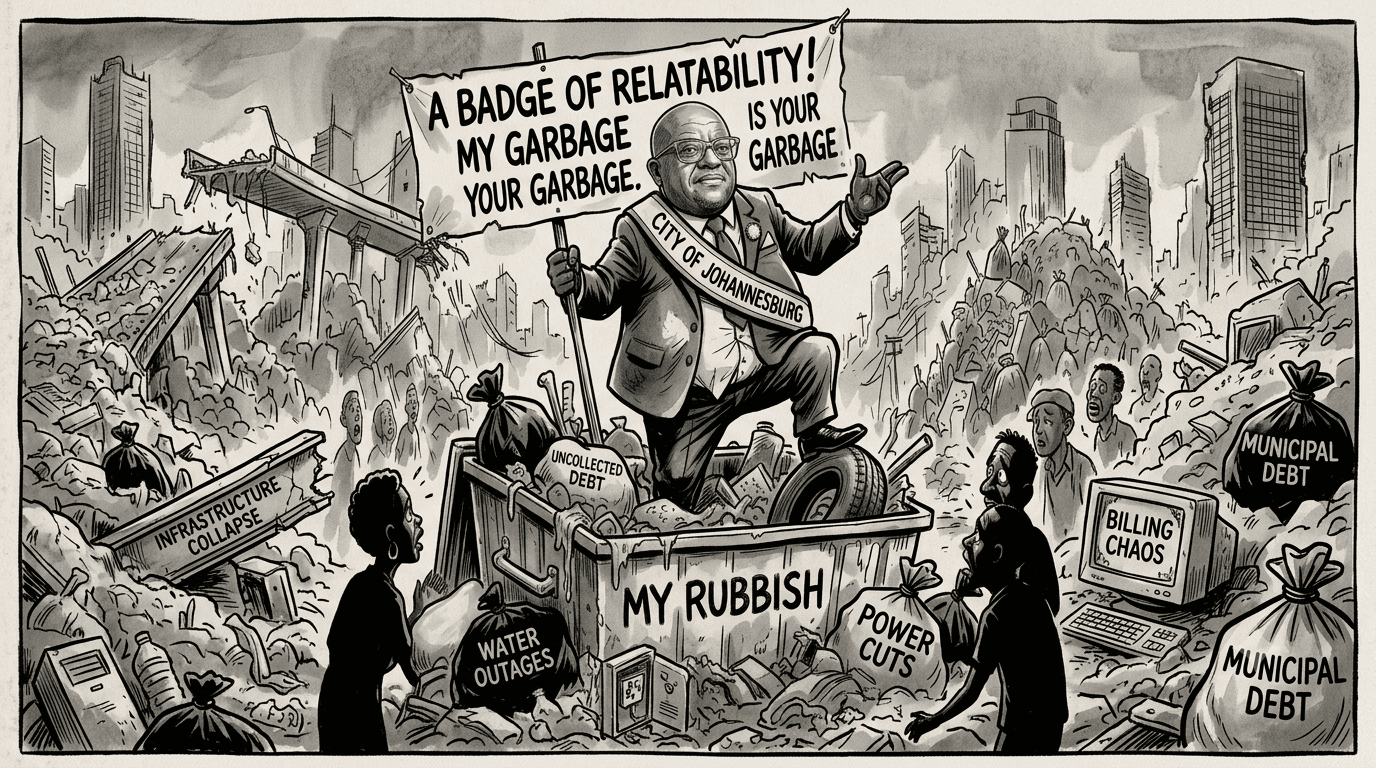
When the leader of a major metropolis turns his own overflowing dustbins into a badge of relatability, something has gone comically wrong with the civic script. It is the ultimate display of hubris: asking residents to applaud a captain who is actively sinking with the ship.
By Themba Khumalo
Pour a neat two fingers of single malt into a heavy-bottomed glass, tilt it against the light, and you will notice something beautiful: it never lies.
Whisky is the ultimate antidote to political gaslighting. It does not promise what it cannot deliver.
The deep amber hue, the rich burn, the slow legs crawling down the glass—they are the unyielding physical proof that if you follow a meticulous, patient process for twelve long years, you get a reliable, high-quality result.
It is an undeniable law of nature.
Then you look out the window at the City of Johannesburg, and you realise that local government is what happens when someone tries to brew moonshine in a rusty bucket, sets the distillery on fire, and then insists the smoke is actually a premium ambient fragrance.
Welcome to Africa’s premier world-class city, now re-branded as Africa’s premier world-class landfill.
Our esteemed Executive Mayor, Dada Morero, took to the podium on Wednesday, 8 July, to deliver a press briefing that should be studied in universities under the faculty of Surrealist Performance Art.
With the straightest of faces, Morero shared a deeply moving personal anecdote: even his rubbish in Region C had not been collected.
Let that sink in. We have achieved peak egalitarian dystopia. The breakdown of basic civilisation has become so democratic that the man steering the ship is actively drowning in the same garbage as the passengers.
You almost have to admire the sheer, unadulterated hubris required to stand before a room full of journalists and use your own uncollected rubbish as a badge of empathy, rather than what it actually is—a glaring, flashing neon sign of total operational impotence.
If your own employees will not even pick up your rubbish, Dada, who exactly is running this city? Hint: it is not you.
Our bins are overflowing, our bills are unpaid, and the smell of decomposing leftovers is fast becoming the official scent of the metropolis. It is enough to make a resident weep into their lukewarm, sporadically supplied tap water.
But do not worry, Joburgers, because during that Wednesday briefing, Mayor Morero assured us that everything is perfectly fine. In fact, he looked the public in the eye and denied that Joburg is in a financial crisis. He called the National Treasury’s latest financial intervention “comforting feedback.”
Comforting feedback?
Let us translate that from Politician-Speak into English. The National Treasury looked at Joburg’s books, realised the city’s adjustment budget was a work of pure fiction, and choked off R3.6-billion in conditional grants.
They found that the city had been practising a very specific kind of magical realism—grossly overstating how much money they would bring in while pretending their astronomical expenses did not exist.
The city has a mountain of R25.2-billion in debt and enough cash to survive for exactly 12 days. A toddler with a piggy bank has better liquidity.
And yet, when the headmaster walks into the classroom, slaps the city across the face with a financial ruler, and locks the cafeteria doors, Morero smiles and says, “Ah, what comforting feedback on our study habits”.
It makes you genuinely question his grasp of reality. If Morero were the captain of the Titanic, he would be standing on the tilting deck, ankle-deep in freezing Atlantic water, confidently telling the passengers that the iceberg was providing a “refreshing cooling mechanism” for the lower decks.
To save the city from immediate cardiac arrest, Morero had to sign a deal with National Treasury that reads like a confession of absolute negligence. The city has agreed to “ring-fence” money for Eskom and Rand Water.
In normal human terms, that means the state had to put Joburg on an allowance because it cannot be trusted to pay its light and water bills. They owe Eskom R3.7-billion and Rand Water R1.2-billion.
But the pièce de résistance of this entire financial comedy is the R10-billion wage agreement previously signed with the South African Municipal Workers’ Union (Samwu).
In a display of financial wizardry that defies the laws of arithmetic, the city promised billions it did not have to align salaries, a move Treasury bluntly warned would “destroy the sustainability of the City.”
Now, that deal has been awkwardly deferred. It is the political equivalent of swiping a credit card you know is maxed out, watching the machine say “DECLINED”, and then arguing with the cashier that the transaction was technically a success, it is just that the funds are currently residing in an alternate dimension.
To top it all off, the city claims it has “regularised” R1.8-billion in unauthorised, irregular, and wasteful expenditure. How? Morero did not say during the briefing.
The Auditor-General is already making polite noises that suggest the city did not actually fix the problem, but rather just took a giant eraser and rubbed the numbers off the chalkboard. Presto! No more bad spending!
As I take another sip of that beautifully aged whisky, I am left with a lingering, bitter aftertaste that has nothing to do with the alcohol. It is the burning frustration of knowing that while the politicians play semantic games in air-conditioned briefing rooms, the rest of us are left navigating streets lined with rotting plastic bags, preparing for the next massive Rand Water outage on July 17th.
The challenges, Morero assures us, are “real but not insurmountable.” He claims what is new is the “discipline, transparency, and accountability” of his administration.
Discipline? Your budget was frozen because it was fake. Transparency? We do not know how R1.8 billion was wiped clean. Accountability? The garbage is sitting outside your own front door, Dada.
If this is what an “okay” financial state looks like in the Mayor’s head, heaven help us if we ever actually reach a crisis.
Until then, keep your bins locked, your water tanks full, and your glasses topped up. We are going to need a much stronger bottle to get through the rest of this term.