

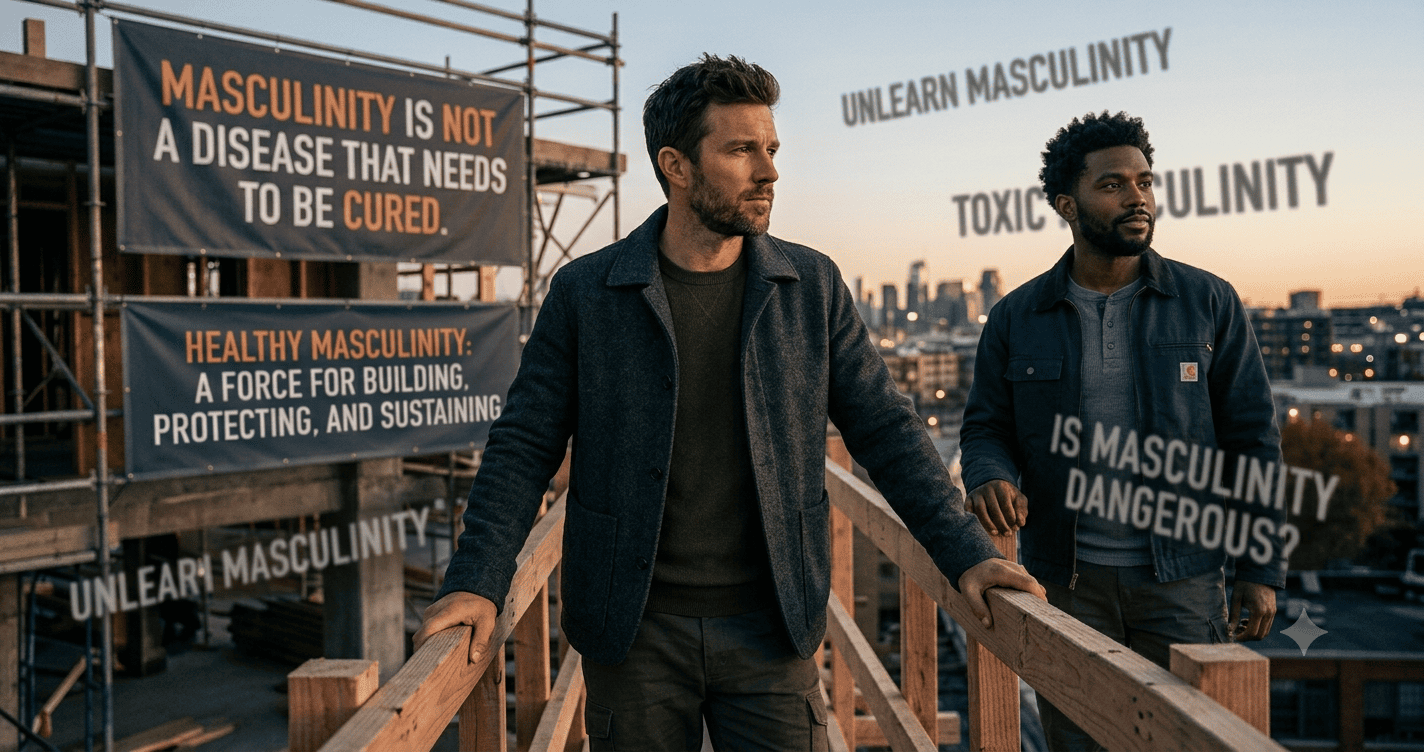
Constantly framing masculinity as inherently toxic damages young men who lack positive guidance. Halima Layeni highlights how persistent public criticism leaves boys confused, insecure, and hesitant to lead or express confidence. Instead of producing healthier individuals, eroding healthy masculine ideals produces isolated, silent, and deeply uncertain young men in society.

By Halima Layeni
For the first time in modern history, an entire sex is being encouraged to question whether a fundamental part of its identity is inherently dangerous.
Across universities, boardrooms, media platforms, classrooms, advertising campaigns, and social media, masculinity is increasingly spoken about as though it were a social pathology rather than a natural human trait.
The conversation has moved far beyond condemning violence or abusive behaviour. It now frequently questions masculinity itself. Boys are told to “fix masculinity.” Men are urged to “unlearn masculinity.”
Traditional masculine qualities are routinely described as toxic, oppressive, emotionally defective, or relics of a past that society should outgrow.
What was once regarded as strength is now viewed with suspicion. What was once celebrated as responsibility is increasingly portrayed as control. What was once admired as resilience is often dismissed as emotional repression.
This cultural shift has happened with astonishing speed. A generation of boys is growing up in an environment where masculinity is more likely to be criticised than understood. Public conversations often focus almost exclusively on what men do wrong, while saying remarkably little about what good men contribute.
News cycles disproportionately highlight male violence while rarely giving equal attention to male sacrifice. Entertainment frequently portrays fathers as incompetent, husbands as emotionally unintelligent, and masculine leadership as something that should be mocked or dismantled.
On social media, anti-male slogans such as “men are trash,” “men are scum,” “all men are potential predators,” and hashtags like #KillAllMen #MaleTears have circulated widely, often defended as jokes or expressions of frustration rather than recognised for the prejudice they promote.
Imagine, for a moment, if equivalent statements were directed at women or any other identifiable group. They would rightly provoke outrage. Yet when directed at men, they are too often excused, normalised, or ignored.
The consequences extend far beyond hurt feelings. When a society repeatedly tells boys that their natural identity is something to fear or apologise for, it creates confusion instead of confidence.
Many young men no longer know what healthy masculinity looks like because they are constantly told what masculinity should not be, but rarely shown what it is.
Some withdraw from leadership because they fear being labelled domineering. Others suppress confidence lest it be mistaken for arrogance. Some hesitate to protect because they worry their intentions will be misunderstood.
Many begin to carry an unnecessary burden of guilt simply for being male. At a time when men already experience disproportionately high rates of suicide, workplace deaths, homelessness, educational underachievement, substance abuse, family separation, and social isolation, this relentless cultural suspicion does not produce healthier men. It produces uncertain, disconnected, and increasingly silent men.
There is a profound difference between condemning destructive behaviour and condemning masculinity itself. That distinction has become dangerously blurred.
When society begins to treat masculinity as something that needs to be corrected, softened, or cured, it risks undermining many of the very qualities that have enabled families, communities, and nations to flourish for centuries.
Masculinity is not a disease that needs to be cured. It is one of humanity’s oldest and most valuable strengths. The real challenge is not eliminating masculinity but restoring an understanding of what healthy masculinity truly is.
To restore that understanding, we must first remember what masculinity has given to the world. Civilisation has been shaped by generations of men who accepted responsibility, embraced hardship, and devoted themselves to building something greater than themselves.
To restore that understanding, we must first remember what masculinity has contributed to the world. Civilisation itself bears the fingerprints of generations of men who accepted responsibility, embraced hardship, and devoted their lives to building something greater than themselves.
Across every continent and throughout every era, men have stood at the forefront of exploration, innovation, engineering, science, medicine, agriculture, transportation, governance, commerce, defence, and industry.
The modern world did not emerge by accident. It was built through the labour, ingenuity, resilience, and sacrifice of countless men whose contributions continue to benefit billions of people every single day.
In infrastructure alone, men have designed and built the roads that connect nations, the bridges that unite communities, the tunnels that pass through mountains, the railways that move economies, the ports that facilitate global trade, the airports that connect continents, the power stations that generate electricity, the water systems that provide clean drinking water, and the communication networks that keep the world connected.
They have erected skyscrapers, constructed hospitals, schools, universities, factories, dams, and homes that millions rely upon every day. These achievements required extraordinary vision, physical endurance, technical expertise, and an unwavering willingness to undertake dangerous work.
Across science, medicine, engineering, and technology, men have made discoveries that transformed human life. They have pioneered life-saving surgical techniques, developed vaccines and medical breakthroughs, advanced computing, engineered transportation systems, expanded space exploration, improved agricultural productivity, and invented technologies that have revolutionised communication, commerce, and education.
Every generation has benefited from men who dedicated years, and often entire lifetimes, to solving problems that improved the human condition.
Men have also carried an extraordinary share of the world’s most dangerous work. They overwhelmingly occupy occupations in construction, mining, offshore drilling, commercial fishing, forestry, sanitation, heavy manufacturing, electrical maintenance, military service, firefighting, emergency response, and search-and-rescue operations.
These are not prestigious occupations that attract admiration or applause. They are physically demanding, psychologically taxing, and often life-threatening. Yet they are indispensable.
Every time electricity is restored after a storm, every time a firefighter enters a burning building, every time disaster victims are rescued from collapsed structures, every time essential goods are transported across countries, every time critical infrastructure is repaired under dangerous conditions, society benefits from men who willingly accept risks that most people hope never to face.
The sacrifices of men extend far beyond the workplace. Throughout history, men have disproportionately borne the burden of military service, defending nations during times of conflict and often paying the ultimate price with their lives.
They have accepted prolonged separation from their families, endured harsh living conditions, and faced unimaginable physical and psychological trauma so that others might live in peace and security.
Even in times of peace, millions of men continue to spend months away from their spouses and children working offshore, on construction projects, in transport, security, humanitarian missions, or other demanding professions simply to provide a better future for those they love.
Within the family, masculinity continues to shape the next generation. Fathers provide protection, stability, guidance, discipline, encouragement, and emotional security. They teach resilience through example, demonstrate responsibility through consistent action, and help children develop confidence, self-control, and perseverance.
Countless fathers sacrifice personal ambitions, leisure, comfort, and financial security so that their children can enjoy opportunities they themselves never had. These sacrifices are rarely acknowledged because they are made quietly, without expectation of recognition.
Men have also contributed immeasurably to education, business, entrepreneurship, public service, law, innovation, philanthropy, sports, the arts, humanitarian relief, and community leadership.
They establish businesses that create employment, mentor younger generations, volunteer in their communities, lead charitable organisations, coach youth teams, fund scholarships, support ageing parents, care for sick family members, and provide countless acts of service that seldom make headlines.
Much of what sustains society is not built through grand gestures but through millions of ordinary men faithfully fulfilling their responsibilities every single day.
This is precisely why healthy masculinity must be promoted, celebrated, and appreciated. The world does not need fewer masculine men. It needs more men whose masculinity is guided by character, wisdom, humility, and purpose.
Instead of teaching boys to apologise for their masculinity, we should teach them how to use it well. Instead of mocking masculine virtues, we should cultivate them. Instead of treating masculinity as a problem to be solved, we should recognise it for what history has repeatedly shown it to be: one of the greatest forces for building, protecting, sustaining, and advancing human civilisation.
Halima Layeni is a Speaker | Global Voice For Men’s Mental Health & Policy Reform | Author of Dear Man | Executive Director, Life After Abuse Foundation | Mental Health Coach For Professionals