

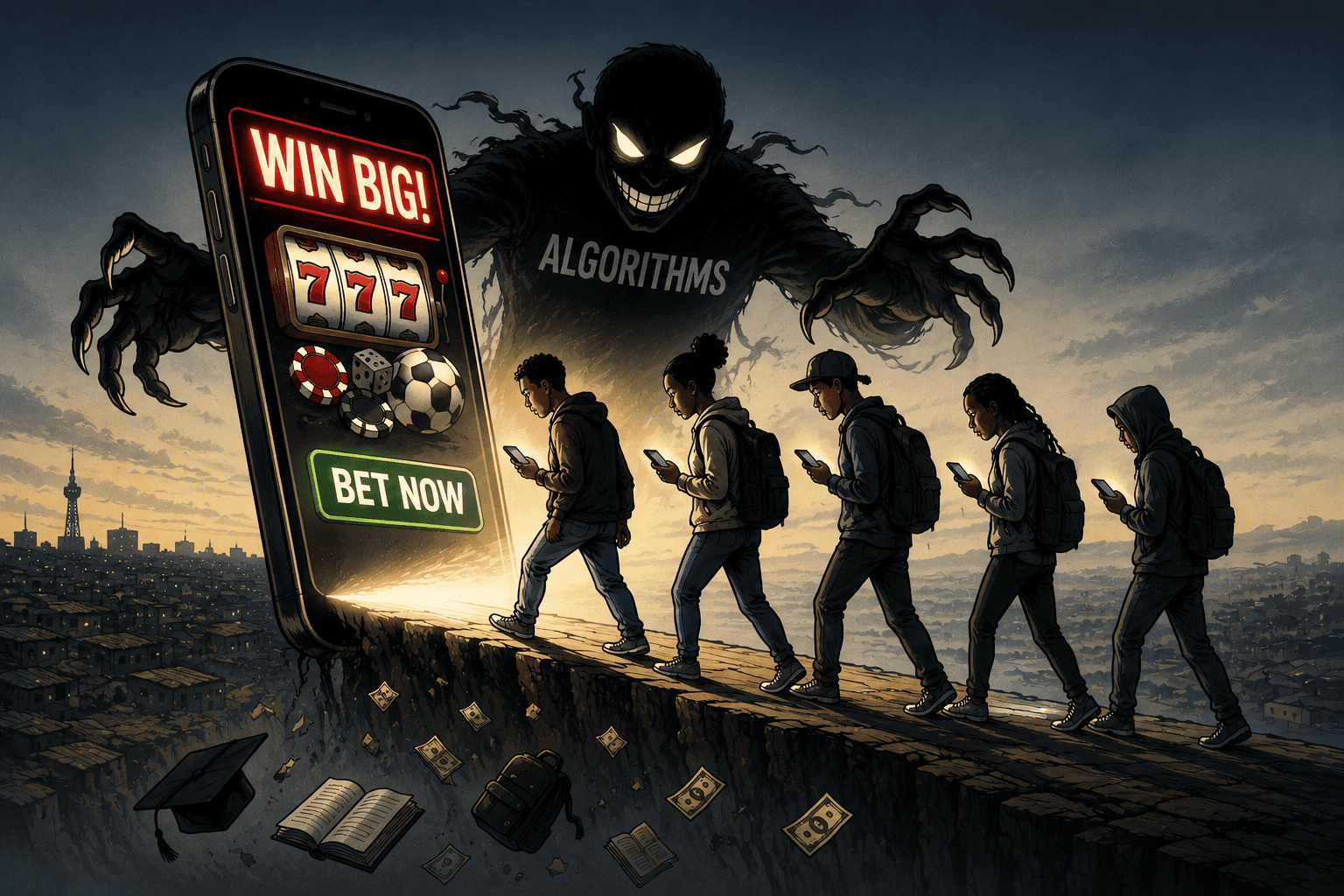
The glow of a smartphone now hides one of South Africa’s darkest crises. Students gamble away food money, families lose everything, and fortunes disappear into machines engineered never to lose. While politicians debate tomorrow’s problems, an entire generation is being quietly swallowed today, one bet at a time.
By Themba Khumalo
Across this country, a silent predator is feeding.
It does not arrive in jackboots or announce itself with sirens. It slips beneath bedroom doors after midnight, glows softly in the palms of restless hands, and patiently harvests an entire generation one tap at a time.
While South Africa argues over politics, crime and collapsing infrastructure, another catastrophe is quietly digging a mass grave for youthful ambition.
It is dressed as entertainment. It calls itself online gambling.
In a timely and deeply unsettling piece of research published by GroundUp, final-year computer science students Joel Cedras and Jake Katzen expose this predator with clinical precision in their study, Five Gambling Myths That May Bankrupt You.
Their work reads less like an academic paper than a coroner’s report on a nation bleeding internally. Every page strips away another comforting lie until only the naked machinery of exploitation remains.
They are not describing a harmless pastime. They are documenting a system engineered to convert desperation into profit.
READ MORE: Five Gambling Myths That May Bankrupt You
The first deception they dismantle is perhaps the cruellest of all: the fantasy that the game can somehow be beaten.
Every day, thousands of young South Africans, already gasping beneath the weight of unemployment, rising prices, and empty bank accounts, pay strangers on the messaging app Telegram for software that supposedly predicts when games like Aviator will crash.
Hope has become a commodity sold by charlatans to people who can least afford another disappointment.
Cedras and Katzen obliterate the myth with mathematics. The algorithms governing these games possess neither memory nor compassion. They do not recognise hunger. They do not pause for desperation. They cannot be persuaded by faith, instinct or experience.
Every round begins with the cold indifference of a loaded universe. The prediction software flooding social media is not clever technology. It is simply another parasite feeding on victims already being drained by the casino itself.
Then comes the glittering death trap of the multi-leg parlay. Across TikTok, Facebook and Instagram, influencers parade impossible winnings beneath seductive slogans like “Project 19 Million”, inviting followers to believe that a handful of rand can bloom into unimaginable wealth.
It is financial alchemy marketed to the poor.
Reality is infinitely more brutal. Every additional selection suffocates the probability of success until the odds become microscopic. The dream grows larger precisely as the chance of achieving it evaporates. Yet the influencers lose nothing. Their commission arrives whether their followers win or lose.
Like smiling pied pipers, they dance at the front while an army of desperate young people marches willingly towards financial ruin.
The infamous Martingale strategy offers no sanctuary either. It is often presented as an ingenious formula for recovering losses. In truth, it is little more than a beautifully packaged suicide note for your bank account.
Double every losing bet, and the numbers explode into insanity with terrifying speed. After only a handful of losses, modest wagers mutate into sums that most South Africans could never hope to produce. Long before the gambler reaches theoretical recovery, betting limits slam shut like prison gates.
Hope collides with mathematics, and mathematics never blinks.
This is no longer a story about bad choices or weak self-control. It is the anatomy of exploitation. South Africa’s economic collapse has created the perfect hunting ground. Where stable employment disappears, fantasy flourishes. Where opportunity dies, desperation breeds.
Millions no longer gamble because they enjoy risk. They gamble because reality has become unbearable. The betting app has replaced the job application. The spinning wheel has become the interview. The jackpot has become the last remaining interview panel that never asks for qualifications.
The figures uncovered by Cedras and Katzen are almost too monstrous to comprehend.
South Africans now bet approximately R1.5 trillion every year, a torrent of money amounting to more than one-fifth of the country’s gross domestic product.
Online betting dominates the landscape. Searches for Betway and Hollywoodbets routinely eclipse searches for SASSA grants.
That fact alone should stop Parliament in its tracks. It reveals a society where millions appear to have placed greater faith in digital roulette than in the social safety net meant to keep them alive.
On university campuses, the tragedy grows darker still. NSFAS allowances intended to purchase textbooks, rent and groceries disappear into betting accounts before lecture notes are even downloaded. Food money becomes gambling capital.
Tomorrow’s professionals bet away tomorrow itself in pursuit of winnings that rarely materialise.
Behind every statistic lies another student skipping meals, another family discovering emptied bank accounts, another future quietly collapsing behind a locked bedroom door.
Meanwhile, problem gambling has surged from 6% in 2017 to more than 31% today.
Calls to the National Responsible Gambling Programme from young adults have doubled. Those are not merely statistics. They are smoke rising from a fire already consuming the foundations of an entire generation.
And what of the state?
It stands like a lighthouse whose keeper has abandoned his post while the rocks below fill with shipwrecks.
Regulators appear paralysed as betting companies pour limitless advertising into sporting events, social media feeds, YouTube channels and celebrity endorsements.
Gambling is no longer marketed as a dangerous vice. It has been rebranded as culture. As aspiration. As financial literacy. As entertainment. It has seeped so deeply into everyday life that it now feels as ordinary as checking the weather.
That normalisation may prove to be the greatest deception of all.
History teaches us that civilisations rarely collapse overnight. They decay quietly, almost politely, while everyone convinces themselves that tomorrow will somehow correct today’s excesses. By the time the cracks become impossible to ignore, the foundations have already given way.
Joel Cedras and Jake Katzen have performed a public service by dragging this national emergency into the light. They have removed every convenient excuse for ignorance.
What remains is deeply disturbing: an industry that prospers only when hope dies, one engineered to extract wealth from those who possess almost none, while selling dreams it has absolutely no intention of delivering.
Walk through any lecture hall. Sit inside any taxi. Stand outside any spaza shop after sunset. The glow illuminating so many young faces is not the light of opportunity.
It is the reflection of a fire.
A country that cannot protect its young from predators does not merely mortgage its future. It buries it.
The house does not simply win.
It feeds. And if South Africa continues to look away, there may soon be very little left for it to consume except the nation itself.