

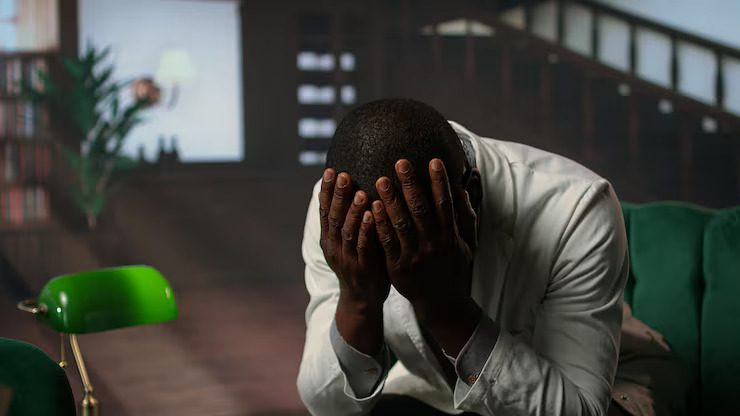
Gender equality means more than correcting the injustices women have historically faced. It also requires confronting the assumptions that make male victims harder to believe, fathers easier to marginalise and vulnerable men harder to support.

By Halima Layeni
Sexism is usually understood through the discrimination and prejudice women have historically experienced because of their sex.
That history is real, and addressing discrimination against women remains important. But a serious conversation about gender equality cannot stop there.
Men can also experience prejudice because they are men, and some of the assumptions directed at them have become so normalised that they are rarely recognised as sexism. This becomes particularly visible when men occupy the position of victim.
National surveys from public health agencies document that men experience intimate partner abuse in significant numbers. Yet shelters, hotlines and protective services were built largely around female victims, and a man who reaches out may be disbelieved, redirected or treated as the likely aggressor. Some are told, in effect, that the service is not meant for them.
A response of that kind makes a statement about whose pain counts, and men hear it clearly. Many conclude there is no point in reporting what happened to them, which is why the true scale of male victimisation remains so poorly measured.
The same reflex appears in how the justice system treats men. Analyses of sentencing data in several jurisdictions have found that men receive longer sentences than women for comparable offences, even after accounting for criminal history and the nature of the charge.
In disputes over where children will live, fathers frequently report that courts begin from an unspoken presumption that the mother is the primary parent, leaving men to prove what women are assumed to possess.
Individual cases turn on their facts, and not every outcome is unjust. Still, a system that sorts people by sex before examining evidence is practising the very thing it claims to oppose.
Public culture reinforces all of this. Advertising, television comedy and social media regularly portray men as incompetent, dangerous, emotionally stunted or expendable. The father in a commercial cannot operate a washing machine.
The husband in a sitcom is a project to be managed. Reverse the roles and the same material would draw swift condemnation. That imbalance reflects a tolerance for contempt that would not be extended to any other group, and steady exposure shapes how people expect to treat the men around them, including how seriously they take a man who says he has been wronged.
Sex-based assumptions can also affect how fathers are perceived. Men are often expected to provide financially, protect their families and remain emotionally strong, yet their importance can become less visible when relationships end.
During separation and divorce, some fathers report feeling that their role as parents is treated as secondary or that they have to prove their commitment to their children in ways mothers are not expected to. This does not mean that every family court decision is biased against fathers, nor that mothers are automatically treated favourably.
Family cases are complex and decisions must be based on the circumstances and safety of individual children. However, concerns about gender assumptions in family justice deserve serious examination because equality requires that fathers are recognised as parents rather than reduced to financial providers.
There is another form of prejudice that is less visible but equally damaging: the belief that men do not need emotional support. Men are frequently told to be strong, resilient, independent and capable of solving their own problems. These expectations may sound positive, but they can become restrictive when they leave no acceptable space for vulnerability.
A man experiencing grief, relationship breakdown, domestic abuse or psychological distress may feel that asking for help violates the very identity society expects him to perform. Society can therefore demand that men protect others while giving them few opportunities to be protected themselves.
There is also a growing need to examine how gender stereotypes operate in public discourse. Criticism of harmful male behaviour is legitimate. Accountability for violence, abuse and discrimination is necessary regardless of who commits it.
But an entire sex should not become a proxy for the behaviour of individuals. When men are routinely described through stereotypes of being dangerous, emotionally deficient, inherently abusive or incapable of vulnerability, individual men can become reduced to a category before their circumstances are even understood. A man reporting abuse can therefore enter a conversation in which he is already expected to explain why he should be believed.
Education and work tell a similar story. Young men now trail young women in university enrolment and completion across much of the developed world, and the gap has widened over years. Institutional response has been muted compared with the energy devoted to gaps running the other direction.
Scholarships, mentorship schemes and hiring initiatives are routinely designed with one sex in mind, and some are closed to men outright. Targeted support is legitimate wherever a real disadvantage exists. That principle has to hold in both directions, so that when men fall behind, the same seriousness applies.
Health completes the picture. Men have shorter life expectancy than women in nearly every country. They are less likely to see a doctor, more likely to be diagnosed late and more likely to have emotional distress waved away when they finally describe it.
Public health campaigns directed at men remain comparatively rare and underfunded. Individual reluctance explains only part of this. Systems that expect men to endure quietly, and then offer little when they cannot, are shaping those outcomes.
What links these patterns is a set of beliefs that people treat as safe to hold: that men are inherently suspect, that their grievances are exaggerated, that their pain is less urgent and that their standing in any dispute is weaker.
Applied to any other group, beliefs like these would be named as prejudice without hesitation. Applied to men, they are often defended as a correction to history.
Equality does not mean pretending that men and women experience every problem in identical ways. They do not. It means refusing to allow sex to determine whether a person deserves dignity, credibility, protection or support.
A fair approach to gender must be capable of acknowledging women’s vulnerability without denying men’s vulnerability, challenging male violence without assuming that every man is a perpetrator, and supporting female victims without making male victims an afterthought. The goal is not to replace one form of gender prejudice with another, but to reject prejudice wherever it appears.
The new sexism may not always announce itself openly. Sometimes it appears as an assumption, a joke, a policy, a missing service, a dismissive response or a question that would never be asked of someone of another sex. It can operate quietly through expectations about who is strong, who is dangerous, who is credible and who deserves protection. That is precisely why it deserves attention.
A society committed to equality cannot decide whose pain is credible based on gender. Men deserve the same fundamental principle that women have rightly demanded for generations: to be seen as individuals, to be heard when they speak, and to receive protection when they are harmed.
Halima Layeni: Speaker | Global Voice For Men’s Mental Health & Policy Reform | Author of Dear Man | Executive Director, Life After Abuse Foundation | Mental Health Coach For Professionals | U.S. Consul General Award Recipient