

A July Constitutional Court ruling has reopened access to South Africa’s asylum system, but its implementation is fuelling conflict across the country. Protesters, politicians, officials and judges are now confronting the same question: how should asylum rights work alongside effective border control?
By Staff Reporter
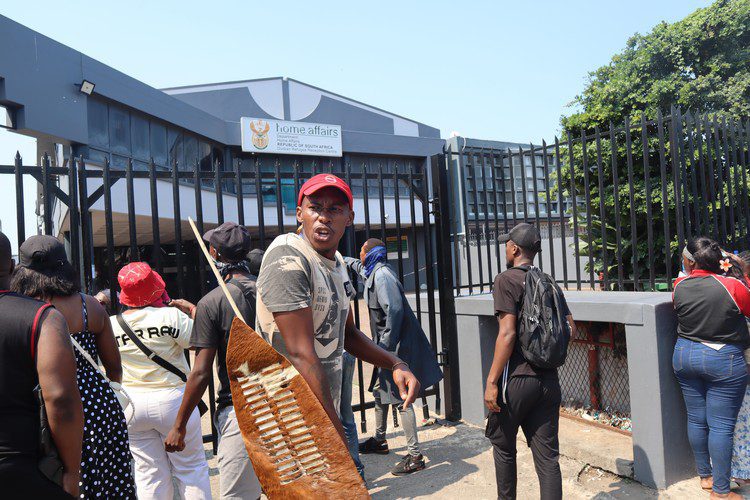
Outside the gates of the Department of Home Affairs Refugee Reception Centre on Che Guevara Road in Durban, the morning air was thick with tension as residents pushed against police barricades, chanting slogans and demanding an immediate halt to the processing of foreign applicants.
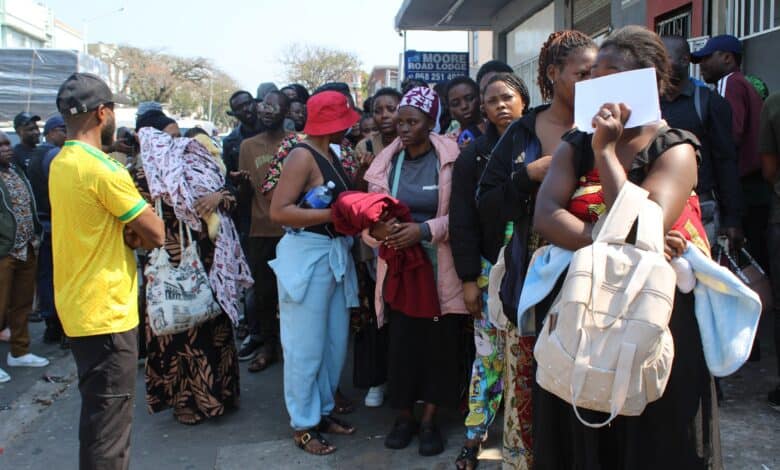
A few metres away, beyond the perimeter fence, hundreds of asylum seekers—many of whom had waited since before dawn—clutched worn plastic folders containing their documents.
“It is absolutely shocking that every person who enters this country can access the asylum process without the implications for our immigration system being properly considered,” said Jacinta Ngobese-Zuma, leader of the March and March movement, standing among demonstrators outside the Durban facility. “How will the state know who has a criminal record if a person never passed through an official port of entry?”
The confrontation in KwaZulu-Natal is the immediate fallout of a nationwide policy overhaul triggered by an official Home Affairs circular signed on 28 September by Acting Director-General Thulani Mavuso.
The instruction orders all refugee reception offices across South Africa to resume processing new applications with immediate effect, removing procedural barriers that had effectively blocked the asylum system for over six years.
The directive enforces a landmark 7 July Constitutional Court ruling, Scalabrini Centre of Cape Town v Minister of Home Affairs, which struck down restrictive provisions of the Refugees Act. The court invalidated strict five-day filing windows and rules requiring applicants to show “good cause” for late submissions, affirming the international principle of non-refoulement—the legal prohibition against returning refugees to countries where they face persecution.
Under the new operational rules, reception staff must accept anyone who reports in person and declares an intention to seek asylum. This applies even if the applicant crossed the border unlawfully, lacks a valid transit visa, or has lived undocumented in South Africa for over a decade.
Not a Blanket Legalisation
As public friction intensified, state authorities moved swiftly to counter claims that the ruling creates an unmanaged open-door policy.
“The Department is constitutionally obliged to implement the binding judgment handed down by the apex court,” Home Affairs Minister Leon Schreiber stated during a press briefing addressing the operational shift. “This does not mean South Africa’s borders are unmanaged or that this judgment grants blanket legalisation to everyone.”
Department officials emphasised that receiving an application is merely the first step. While applicants are issued a temporary visa that halts immediate deportation while their file is assessed, every claim must still undergo individual vetting on its merits.
Government spokespersons also pointed to a separate Constitutional Court judgment handed down in May—Director-General of Home Affairs v Irankunda—which established that individuals whose asylum claims have already been rejected cannot re-apply, preventing rejected applicants from infinitely cycling through the system.
Advocates Celebrate Historic Win
For human rights organisations that spent years litigating against the 2020 Refugees Act amendments, the administrative circular marks a decisive triumph for constitutional rights.
“The effect of those restrictive provisions was aggravated by the severe harm they imposed on vulnerable families,” said a legal representative from the Helen Suzman Foundation, which joined the court battle as an amicus curiae. “Children of asylum seekers who failed to show ‘valid reasons’ for late filing were routinely subject to deportation alongside their parents, without the substantive merits of their asylum claim ever being assessed. Removing these arbitrary hurdles restores protection to those genuinely fleeing conflict.”
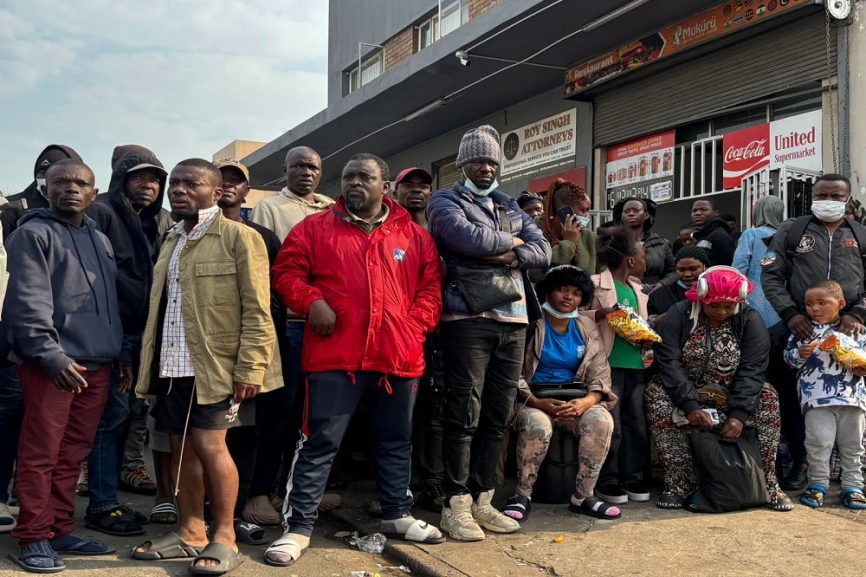
Advocates underscored that migrants escaping war or political violence rarely have the administrative capability to secure transit visas or report within 120 hours of crossing a border.
Operational Bottlenecks and Judicial Confusion
While human rights groups celebrated, officials on the ground warned that the practical rollout is pushing an already fragile system to the brink of collapse.
With only five functional Refugee Reception Offices operating in the entire country, staff face an unprecedented backlog.
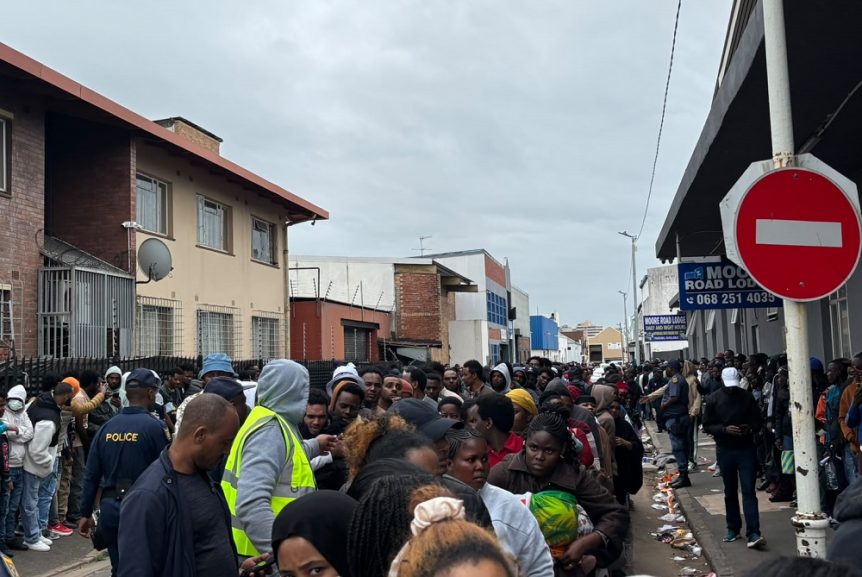
At the Gqeberha facility in the Eastern Cape, where only three reception officers are assigned to handle walk-ins, processing capacity is capped at roughly 15 new applications per day, leaving long queues of migrants waiting outside each day. The surging numbers prompted the Inter-Ministerial Committee on Migration to hold an emergency briefing on 8 October to evaluate operational capacity.
The sudden influx has also caused severe procedural confusion within the judiciary. In the Gauteng High Court, two judges interpreting the Constitutional Court ruling reached opposing conclusions on how to treat detained undocumented foreign nationals who declare an intent to apply for asylum while in custody. One judge ordered the immediate release of a detained migrant upon their declaration, while a second judge ruled that the individual should remain in custody while Home Affairs officials conducted an immediate interview.
Faced with conflicting precedents, Gauteng Judge President Aubrey Ledwaba stepped in to halt the uncertainty.
“To prevent conflicting directives across our courts and establish legal certainty, a temporary moratorium is placed on hearing all deportation and detention applications of this nature,” Ledwaba instructed in an administrative directive, referring the matter to a Full Court bench for a definitive ruling.
Political Backlash
In Parliament, opposition lawmakers expressed sharp concern over the state’s readiness to manage the influx.
“The Constitutional Court has determined that unlawful entry cannot, by itself, close the door to an asylum application, and the government must comply with that judgment,” said Lerato Ngobeni, Parliamentary Chief Whip for ActionSA. “However, the practical consequences of implementing this wide-access policy through an already broken, severely understaffed asylum system would be disastrous for local infrastructure and public services.”
Ngobeni urged the government to establish dedicated processing centres near border entry points rather than allowing applicants to disperse into local communities while awaiting adjudication.
“Mere lodgement of an application should not allow undocumented migrants to disappear into society for years pending determination,” Ngobeni added. “Government still has a responsibility to secure our borders, verify biometrics, protect genuine refugees, and immediately deport those who do not qualify.”
As the Full Court in Gauteng prepares to deliberate on the judicial standstill, Home Affairs offices nationwide remain under orders to process every walk-in applicant, leaving front-line staff balancing court mandates against escalating public pressure.