

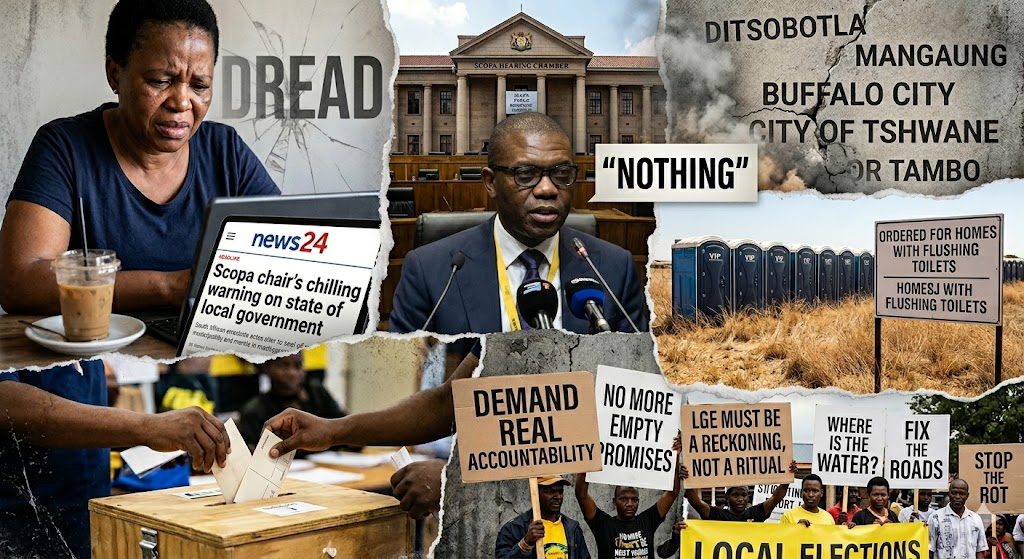
With dysfunction laid bare and warnings growing louder, South Africans can no longer afford to accept empty promises. This year’s Local Government Elections must mark the moment we demand real accountability and change.
By Themba Khumalo
There are mornings when you can drink your coffee and let the world’s troubles pass by—but today, the news slammed into me with the force of a brick through glass.
Reading the exclusive interview on News24, Songezo Zibi’s words did not whisper—they roared. I sat with my cup cooling in my hands, the bitter taste of dread rising in my throat. This is a story that demanded to be heard—an alarm bell clanging for all of us who care about the future of our towns, our streets, our country.
Zibi, the chairperson of Scopa, did not dish out the usual platitudes. He spoke the language of bleak reality—a language our leaders seldom use. When asked what could be done to fix our broken municipalities, he simply told News24: “Nothing.”
The word hung in the air like a death knell, echoing in the silence. It felt like a warning shot fired into the heart of every citizen.
How often do we hear leaders speak so plainly? Zibi’s candour is not just a slap in the face—it is a cold bucket of water thrown over a sleeping nation. We have been lulled by slogans, anaesthetised by hollow promises. Today, the mask slipped. We cannot afford to look away.
This is no stage play. These are not actors reading from some tired script. Zibi’s words followed a parade of broken municipalities—some of the country’s largest and most vital—dragged under harsh lights before Scopa to answer for their spectacular failures.
In recent weeks, names like Ditsobotla, Mangaung, Buffalo City, the City of Tshwane, and OR Tambo have echoed through the committee chambers. These are not just places; they are warning beacons. Each was summoned to account for dysfunction so deep it shocked even the most jaded MPs.
Ditsobotla, for instance, appeared before Scopa and left MPs in little doubt about the scale of its collapse. One MP is said to have exclaimed, “This is very, very bad.”
The committee expects Ditsobotla to return—there is much more unravelling to come.
Zibi has made it clear that this is not a passing exercise. Scopa’s programme is to call municipalities to account until 2029. “We think if we focus on them, we will then begin to make a difference in terms of the economy,” he told News24.
But even he cannot hide his concern for the “really bad ones”—Ditsobotla, Masilonyana, Maluti-a-Phofung—sent to Scopa’s dock after the Auditor-General flagged their governance as effectively collapsed.
And then, the stories that show just how deep the rot goes. Zibi offered a shocking example to News24, from Ditsobotla: “They ordered VIP toilets, like hundreds of them, including for houses that had flushing toilets. This was for hundreds of millions. The people then said, ‘Well, we do not know why they brought them, but we do not use them because we have flushing toilets.’”
These expensive, unused toilets now stand as silent monuments to waste and contempt—while the people look on, confused and frustrated.
Local Government Elections are upon us again. Soon, the air will be thick with songs of progress, banners fluttering like false flags, politicians rehearsing their lines as if lies are something that can be spun into gold. They will promise us better roads, reliable water, working streetlights—a future that gleams.
If we are to break this cycle, we must do more than simply show up at the polls. Voters must demand clear and practical solutions from politicians and parties, along with concrete timelines for delivery. We should refuse to accept vague promises or empty slogans. Instead, we must ask tough questions: What, exactly, will you fix first? How will you do it, by when, and how will we hold you accountable if you fail?
Only by insisting on specifics and measurable commitments can we turn this election from a hollow ritual into a real reckoning.
Yet even as we demand specifics, Zibi’s words remain—a fog that will not lift: “They will never function, they will never function.” This is not a warning for distant places, but for every town and city where hope is running out like water through cracked pipes.
The truth, when laid bare, is more frightening than any campaign poster dares admit. Our local government machinery is not just stalling—it is rusting, buckling, pulling itself apart. Ditsobotla, Mangaung, Buffalo City, Tshwane—these are not just points on a map, but places where the promise of democracy is being smothered under the weight of incompetence and greed.
The people stare, uncertain, as their future is quietly auctioned off.
Zibi offered no sugar to coat this bitter pill. He described a collapse so absolute that only the most radical surgery—a complete removal of the political infection—might save us. “Otherwise, we have a situation where the theory of democracy is eating those same municipalities.”
Imagine that: democracy, once a shield for the people, now sharpening its teeth on the bones of our towns. It is a chilling reversal, and we are living it.
Where does the money go? Not to roads, not to water, not to the lifeblood of communities.
Buffalo City is reported to have spent just 1% of its budget on infrastructure—an insult, a cruel joke. The roads rot, tap water dries up, and engineers vanish because there is nothing left to build except empty promises. The real business is procurement: contracts handed out like sweets at a funeral, feeding a handful while the rest starve.
Zibi spoke of a syndicate in the Eastern Cape whose tentacles wrap around municipality after municipality. The stench of corruption is so thick you can taste it, and the thieves do not even bother to hide. They have thrown open the vault, daring anyone to care.
This is not just a failure of money or management. This is a collapse of backbone, a drought of conscience. Zibi said what alarmed him most was the fear that these syndicates inspire among those meant to stand guard. Even when the evidence is stacked high, when reports recommend the recovery of hundreds of millions, the wheels of justice are seized and rusted. Paper piles up, the money evaporates, and the people are left with nothing but dust and disappointment.
Still, as these Local Government Elections creep closer, we are told to clap for the parade, to believe the banners and swallow the slogans. We are told that progress is just over the hill, that tomorrow will be brighter if we only keep the faith.
But how can we, when those who have peered behind the curtains come back to warn us the house is already on fire?
The time for slogans and empty promises is done. We must tear down the bunting, strip away the glitter, and demand to see what lies beneath. We owe it to ourselves to ask the hard questions, to demand answers that do not arrive wrapped in silk and spin.
If democracy is to survive, it cannot be a ritual performed every five years. It must be a living, breathing demand for honesty, accountability, and real service.
As I look out over my own street, I wonder what we will choose in November. Will we face the discomfort of truth, or will we retreat into the arms of comforting lies? This choice is not a small one. It will shape not only our towns and cities, but the very soul of South Africa.