

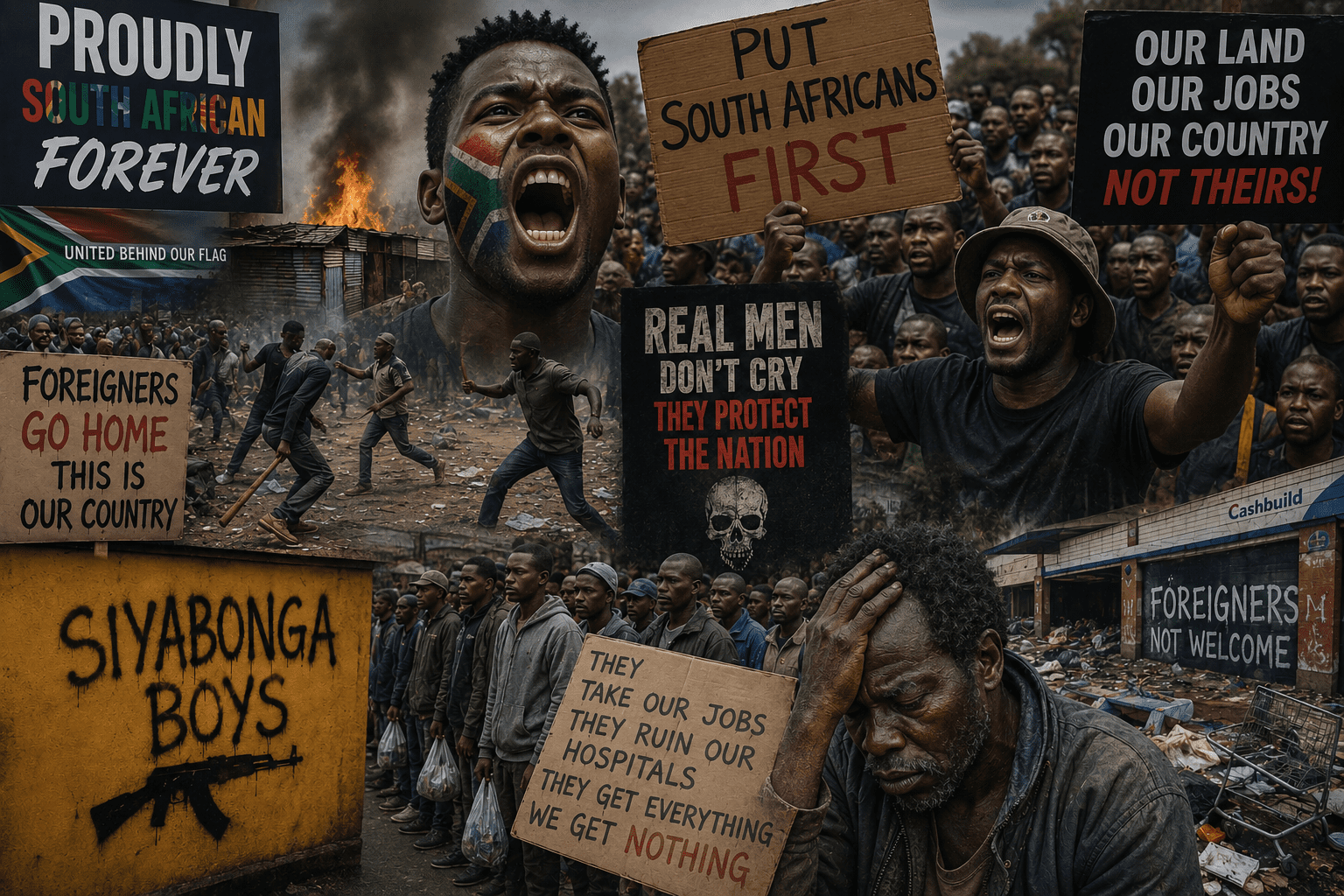
Chauvinistic patriotism is where the politically idle and intellectually bankrupt go to feel important. It offers all the noisy satisfaction of doing something—without the bother of actually fixing anything. Empty, lazy, and dangerous, it is the national pastime of those who would rather shout than solve.
By Themba Khumalo
The line between civic pride and rabid patriotic chauvinism is as thin and fragile as a soap bubble stretched across a knife’s edge—one careless exhalation and the whole thing bursts, unleashing a noxious torrent that chokes reason and decency alike.
In times of economic rot and moral bankruptcy, when the bridges crumble, the job queues lengthen, and corruption seeps into the water supply, patriotism is all too often snatched by the grubby hands of demagogues, mutated into a weapon fit for the intellectually unfit and the politically slovenly.
Chauvinistic patriotism does not lift a nation; it digs a trench, fills it with bile, and dares the world, and its own people, to cross. It is not a flag raised in hope, but a banner stitched with exclusion, its colours running in the rain of collective despair. This is the opiate of the lazy, the last refuge of those bankrupt in thought and bankrupt in courage.
Chauvinistic patriotism is as methodical as it is poisonous. It operates on a playbook so depressingly familiar that one could set a pendulum by its pulse. Where healthy patriotism gathers the many around constitutional ideals and civic duties, chauvinism insists on an enemy—real, imagined, or simply convenient.
It concocts a toxic us-versus-them mindset: the pure “in-group” and the existential “out-group.” By painting minorities, migrants, or refugees as a creeping plague, it forges tribalism so fierce it blinds the desperate to their own puppet strings. One’s worth is filtered through the grubby lens of birth or accent, the nation’s soul reduced to a members-only club of the perpetually aggrieved.
True reform is hard, expensive, and demands the sort of competence that is in chronically short supply among the blowhards leading these movements. So, instead of rolling up their sleeves and confronting corruption or incompetent governance, they reach for the crack cocaine of politics: scapegoating. Rather than facing the real architects of ruin, they pin every unemployment statistic and every failing hospital on an easy, voiceless scapegoat.
The effect is immediate and intoxicating—a sugar rush of blame that empties the mind and fills the veins with righteous fury. All the while, the rot remains untouched, festering under the surface.
With sanctimonious hypocrisy, these movements trumpet their devotion to “law and order.” But scratch the surface and the legalistic veneer peels away, revealing a roiling mob. Calls for “legality” and “documentation” are nothing but fig leaves for bigotry. The mob is encouraged to bypass the very courts and laws they claim to revere, conducting street-level witch hunts and demanding papers like a pantomime of the worst chapters in history.
The state’s monopoly on force is quietly eroded until only the law of the mob remains, red in tooth and claw.
Allow chauvinistic patriotism to seep into the mainstream, and you have handed a blowtorch to a toddler. The dangers are not theoretical—they are systemic and existential. The rhetoric promises precision; the reality is carnage. Mob justice does not check passports or paperwork. The net sweeps up anyone with the wrong accent, the wrong skin, the wrong success. Legal refugees, naturalised citizens, and even those with centuries-old roots find themselves in the crosshairs.
This is not the pursuit of law; it is the pursuit of purity—an ethnic cleansing in everything but name.
The architects of this disaster are masters of the coward’s double-tongue. First, they unleash their followers with incendiary tirades and apocalyptic ultimatums; then, with a lawyer’s wink, they tack on a damp squib of legalese—“We only want peace,” they intone, even as the windows shatter and the blood pools. This two-faced messaging ensures the demagogue keeps his hands clean while his followers are up to their elbows in the consequences.
Chauvinistic patriotism does not merely ignore constitutional institutions; it declares open season on them. Watchdogs, human rights commissions, even the courts themselves—anyone who stands in the way is smeared as a traitor. Public trust is eroded, stone by stone, until only the demagogue’s voice remains, echoing in the hollowed-out shell of a once-proud democracy.
The script never changes, only the actors and the scenery. It begins with online mobs and digital bile, escalates to street intimidation, metastasises into localised violence, and finally threatens the sanity of the entire nation. The tragedy is that the original, festering wounds—corruption, misrule, decay—are never addressed.
The mob, addicted to its own venom, will always find a new target: today, the migrant; tomorrow, the dissident or the inconveniently independent woman.
In the end, patriotism that survives on a diet of hatred is not patriotism at all, but a contagious sickness. Nations do not rise by shrinking their hearts or narrowing their minds, but by demanding accountability, fortifying their institutions, and upholding the law’s dignity.
To let the loudest, most brittle voices dictate who belongs is to commit a slow, public suicide—one mob at a time.