

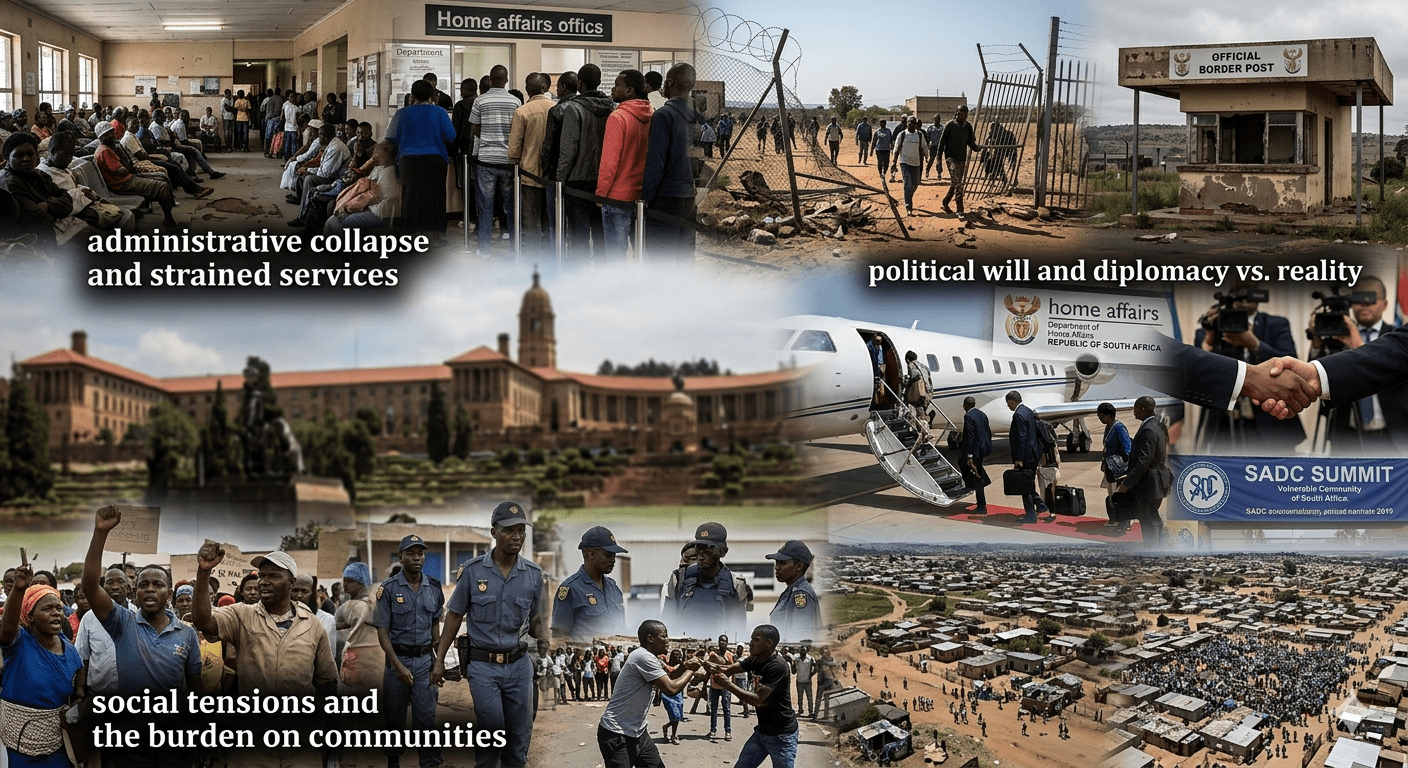
Despite clear immigration laws, political will is absent, and government machinery idles as public relations efforts mask the decay. This burden of administrative paralysis falls on overstretched public services, creating a vacuum that invites vigilantism.
EDITORIAL COMMENT
There is a specific brand of cowardice that characterises the modern South African state: the unshakeable belief that any domestic catastrophe can be managed if you simply throw enough taxpayer-funded business class flights at it.
For decades, the Union Buildings and the Presidency have treated the republic’s borders not as sovereign thresholds, but as abstract suggestions. Immigration laws have been met with a collective, bureaucratic shrug—selectively enforced or ignored—while the rule of law was systematically hollowed out.
Now, as the predictable chickens come home to roost, the state’s grand remedy is to panic, dust off the ministerial luggage, and dispatch a flock of high-priced envoys into the skies.
It is a study in political theatre, a frantic bout of diplomatic firefighting meant to distract from a smoking ruin of institutional neglect. We are treated to the absurd spectacle of shuttle diplomacy—envoys touching down in neighbouring capitals, shaking hands for the cameras, and whispering sweet nothings into the ears of foreign potentates.
It is public relations masquerading as statecraft.
Let us call this what it is: an expensive, international PR campaign designed to placate foreign governments who have spent years happily externalising their own domestic failures onto South African soil. Our leaders’ breathless, cap-in-hand appeasement—especially toward regimes that offer little meaningful cooperation in addressing irregular migration—is deeply troubling.
You cannot negotiate your way out of a governance collapse diplomatically. You cannot sweet-talk a porous border back into integrity.
It is important to recognise that South Africa’s migration crisis does not exist in a vacuum. The realities of the region—political instability, economic hardship, and conflict in neighbouring states—drive people across borders in search of safety and opportunity. Humanitarian obligations under international law require South Africa to process legitimate asylum claims with dignity and compassion.
At the same time, the porousness of borders and the scale of population movements place immense strain on our already overstretched public services, schools, and healthcare facilities. These pressures are felt most acutely in vulnerable communities, often exacerbating social tensions and competition for resources. The state’s challenge is not merely to enforce the law, but to do so in a manner that balances security, humanitarian duty, and the realities of regional interconnectedness.
The reality on the ground does not care about the polite communiqués drafted in Pretoria. When laws are applied selectively or neglected for well over a quarter-century, the consequences do not vanish; they compound and fester. The burden of this administrative paralysis is borne by public services buckling under strain, by local communities left to navigate unregulated integration alone, and by frontline law enforcement agencies hollowed out by corruption and starved of resources.
The very social compact that holds this fragile nation together is being ground to dust between the gears of state apathy and public resentment.
The bitter irony is that South Africa does not need to invent a solution. The tools are already at hand. The existing immigration framework provides the legal mechanisms required to regulate migration, secure frontiers, process legitimate asylum claims with dignity, and decisively address unlawful entry. The machinery exists; the blueprints are signed. Specific reforms—such as digitising visa processing, restoring capacity at border posts, and adequately resourcing the Department of Home Affairs and SAPS—could make an immediate, tangible difference.
The tragedy is that the machine has no fuel, because the tank of political will is completely empty. The state lacks either the administrative muscle or the moral courage to implement its own statutes consistently and impartially. It is easier to play the continental statesman than to do the grimy, difficult, and politically inconvenient work of domestic law enforcement.
This is fundamentally a domestic crisis of accountability, not a foreign policy riddle for clever bureaucrats at SADC summits. External diplomacy is a useful accessory, but it is a useless substitute for basic competence.
Until the government accepts that respect for the rule of law must be the uncompromising cornerstone of the state, these diplomatic missions are little more than a waste of aviation fuel. We are treating a metastasising tumour with a heavy dose of public relations.
Firm, lawful, and effective enforcement at home is the only cure—and no amount of first-class diplomacy can hide the fact that the government appears unwilling to administer it.