

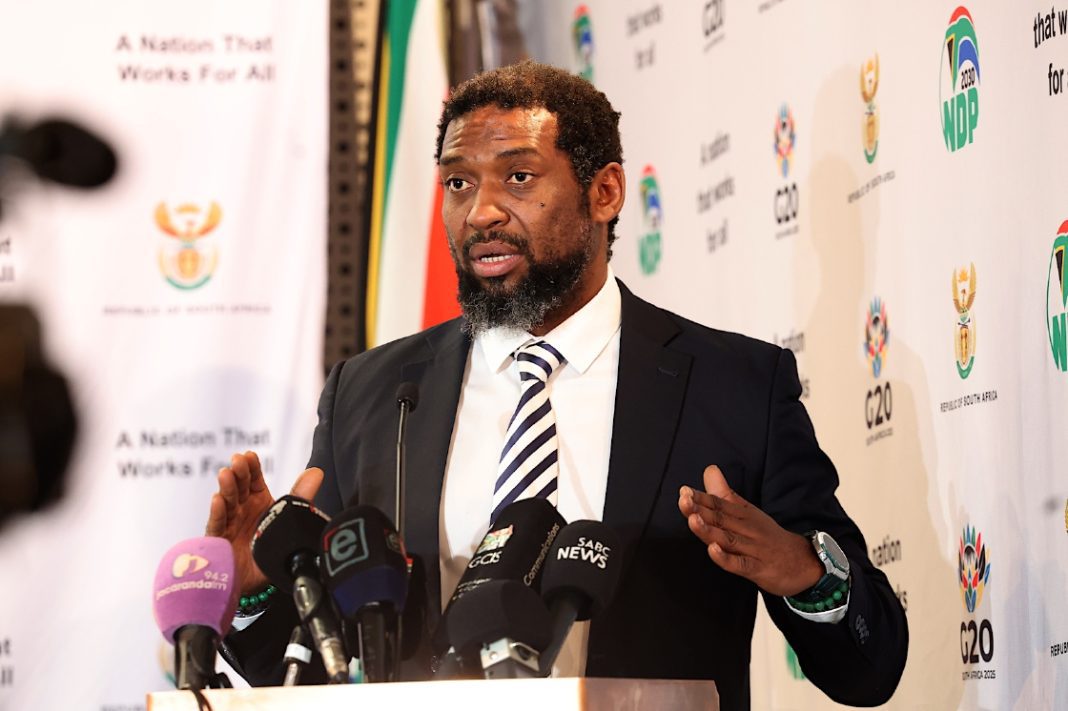
The higher education sector is set for change as Manamela pledges to uphold immigration laws and protect workers’ rights. At the same time, he recognises the crucial role of African academics in research and teaching, and promises new systems for transparent reporting and balanced transformation.
By Staff Reporter
The Minister of Higher Education and Training, Buti Manamela, has pledged that South Africa will continue to enforce its laws on the employment of foreign academics, while also emphasising the nation’s commitment to fostering continental collaboration and transformation in higher education.
Addressing the Portfolio Committee on Higher Education and Training this week, Manamela presented the most comprehensive data yet on the employment of foreign nationals in the Post-School Education and Training (PSET) sector.
The committee had requested a detailed breakdown amid rising debate and misinformation surrounding the employment of non-South African academics.
Manamela was forthright in cautioning against what he described as a debate “clouded by vague categories and misinformation.”
He reaffirmed that while South Africans have every right to expect public institutions to prioritise them for employment, the conversation should not descend into xenophobia or be distorted by inaccurate information.
“There are legitimate concerns in this conversation, and we do not pretend otherwise,” Manamela told MPs. “South Africans are entitled to expect that public institutions prioritise them for employment, that everyone who teaches does so lawfully, and that transformation is not quietly deferred. These are not xenophobic concerns, but we must be careful of the great deal of misinformation and disinformation that circulates around this debate.”
Providing clarity, Manamela shared the latest data across the three main sub-sectors of the PSET system. In the TVET college sector, of the 265 foreign academics employed, 158 are either naturalised South African citizens or permanent residents. The majority of the remaining non-citizens possess critical and scarce skills, and most are in permanent posts. Many who occupy management roles have progressed through South Africa’s own institutions.
In the Community Education and Training (CET) sector, 31 foreign nationals are employed across five colleges, mainly teaching Mathematics, Physical Sciences, and other scarce-skills subjects. Many of these appointments date back to before the sector’s formal establishment in 2015.
Within the university sector, the largest share of international academics come from the African continent, with a high proportion holding doctoral degrees. These academics are predominantly found in senior ranks, driving research and supervising postgraduate students.
Manamela underscored the importance of distinguishing between categories, warning against lumping together citizens, permanent residents, critical-skills visa holders, and those on temporary contracts. “When we collapse the citizen, the permanent resident, the holder of a critical-skills visa and the person on a temporary contract into a single category of suspicion, we are not analysing a policy problem, we are manufacturing a grievance,” he said.
He identified two key concerns: compliance with immigration law—where invalid work visas can expose institutional leadership to criminal liability—and the increasing casualisation of academic work, which raises serious questions about labour practices and transformation. These, he insisted, should not be confused with questions of nationality.
He made it clear that the solution does not lie in excluding foreign academics but in building up South Africa’s own academic ranks.
“Localisation cannot be achieved by subtraction. Localisation happens by building,” he said, highlighting government initiatives such as the National Research Foundation’s doctoral pipeline, the New Generation of Academics Programme, research chairs, centres of excellence, and postgraduate funding schemes that prioritise South African citizens and permanent residents.
He further acknowledged the crucial role foreign academics play in sustaining the supervisory capacity needed for producing more South African PhDs. Manamela situated the issue within South Africa’s broader ambition to be a leader in African research and innovation, in line with the African Union’s Agenda 2063, which champions a skills revolution across the continent.
To support a more honest debate, Manamela announced a comprehensive overhaul of the Department’s information management system. The revised system will require precise and mandatory reporting of nationality, citizenship, and visa status, eliminating vague categories that have previously muddied the waters.
In addition, the Department is operationalising a joint task team with the Department of Home Affairs and Universities South Africa to address visa backlogs and strengthen compliance.
A 19-member advisory panel, comprising internationalisation experts from all 26 public universities, has been established to develop a standardised framework for visa pathways, skills-transfer obligations, and employment-equity expectations, with a view to presenting this to stakeholders by the fourth quarter of 2026.
Universities will also be required to account for how they balance internationalisation with transformation in their annual performance plans.
Manamela’s address signals a firm but balanced approach: South Africa will enforce its laws and protect workers’ rights, but it will not turn its back on the vital role of African academics in building the nation’s and the continent’s intellectual future.