

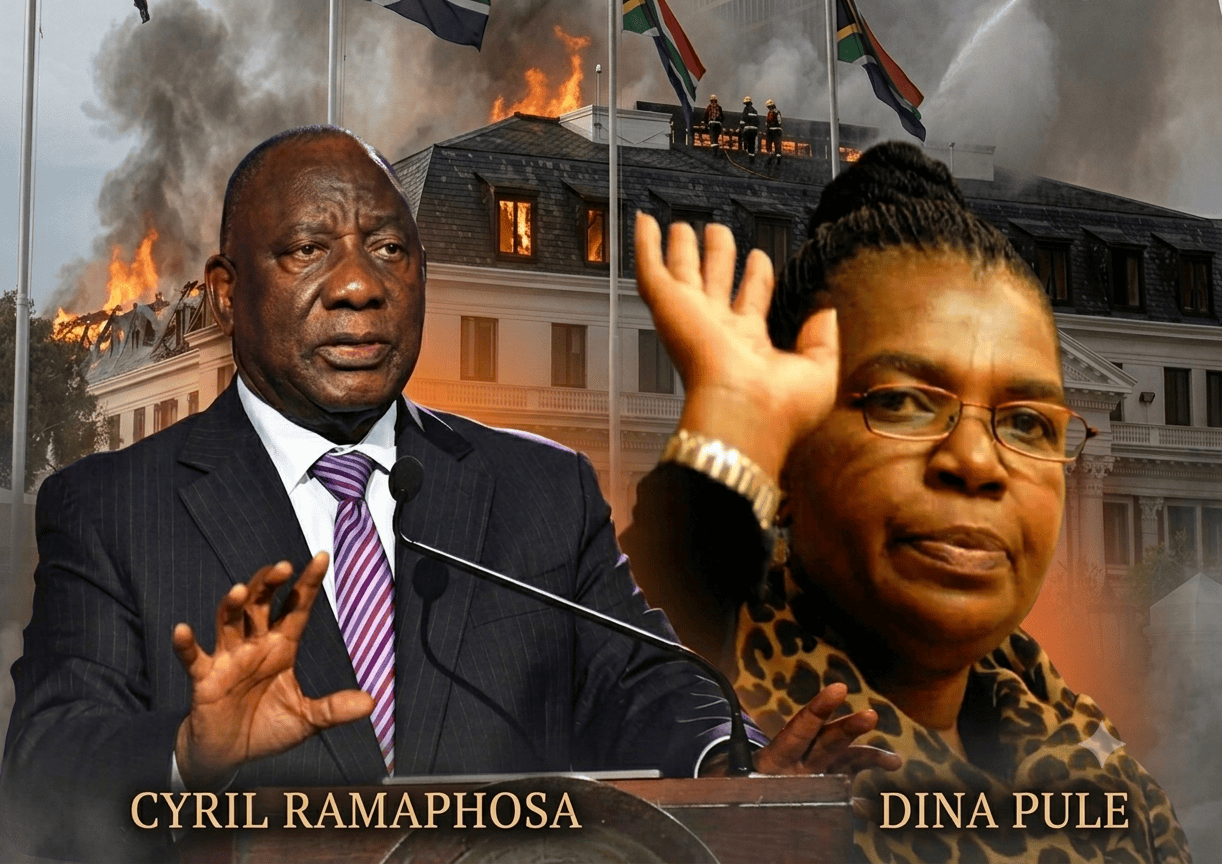
Just when it seems a politician found on the wrong side of the track will remain there, something different happens, raising familiar questions about political rehabilitation, judgement in high office, and the standards that guide who is deemed fit to return to the centre of power.
By Themba Khumalo
Some crafts have a marvellous habit of reminding us how rarely excellence is accidental.
Whisky distilling is one of them. It is not a product of haste or impulse, but of patience disciplined into precision — barley, water, yeast, and time coaxed into harmony by judgement that understands restraint as a form of intelligence.
The best distillers do not rush their work; they respect it. They allow the process to do what personality alone cannot.
And yet, the true measure of any distillate is not only in the making, but in the moment it is finally drawn, poured, and held up to the light. There is a quiet satisfaction in that pause before the first sip — the amber stillness in the glass, the slow release of aroma, the sense that something has been patiently earned rather than quickly assembled.
One does not interrogate it at that point. One observes it. One respects the work that brought it there. And, if it has been done properly, one simply allows oneself the small, unhurried pleasure of acknowledging that some things are meant to be appreciated rather than explained.
There are times I truly wonder what public life would look like if it ever absorbed even a fraction of that discipline.
Appointments, in principle, are supposed to be the distilled outcome of judgement: the careful separation of what is ready from what is merely available, what is clarified from what is still cloudy, what has earned its place from what has simply arrived early.
Cabinet, in that sense, is meant to represent the final product of political refinement — a spirit stripped of impurities through scrutiny, consequence, and time.
In a functioning system, it would be the moment when judgement finally settles, when the froth of ambition has been skimmed away, leaving only the clear residue of competence.
Yet politics, unlike whisky, is not always patient with its own maturation process. It does not always wait for clarity. Sometimes it bottles the turbulence itself and calls it readiness.
Of all the people available to President Cyril Ramaphosa to lead one of the country’s most important departments — accomplished administrators, development specialists, seasoned politicians, experienced public servants and respected professionals — it is Dina Pule who emerges from the presidential distillery as the finest expression of executive judgement.
You just have to admire the confidence. The reasoning, however, remains stubbornly elusive.
The difficulty is not in recognising political rehabilitation as a principle. Democracies, after all, are built on the possibility of return, correction and reinvention. The difficulty lies in the transformation of rehabilitation into endorsement, and endorsement into elevation.
Dina Pule entered Cabinet in October 2010 when President Jacob Zuma appointed her Minister of Communications. Less than three years later, in July 2013, the very same President removed her from office after Parliament’s Joint Committee on Ethics and Members’ Interests found that she had breached the Executive Ethics Code by failing to disclose her relationship with businessman Phosane Mngqibisa, who benefited from his association with the ICT Indaba.
Parliament formally reprimanded her, imposed a financial penalty and suspended certain parliamentary privileges.
The Public Protector, in a separate investigation into the ICT Indaba, identified irregularities in the administration of public funds. Those findings have not evaporated simply because the calendar has moved on.
What matters is not the existence of a past, but its political interpretation in the present.
Which brings us back to President Ramaphosa.
Rehabilitation is one thing. Reappointment to the highest decision-making table in the country is quite another. Those are two entirely different political choices.
The first says people deserve second chances. The second says this was the best person for the job. That is the leap in logic the Presidency has yet to explain.
And it is here that the discomfort deepens, because Cabinet appointments are not symbolic gestures. They are instruments of governance. They determine the tone, competence and credibility of the state’s executive machinery.
Each appointment, therefore, is not merely an act of inclusion, but an act of definition: what the state considers acceptable as custodianship of power.
One cannot help wondering what the Cabinet discussion sounded like. Was the parliamentary ethics finding discussed over tea? Did the Public Protector’s report make a brief appearance before quietly excusing itself from the room?
Or was everyone simply encouraged to regard institutional memory as one of those optional extras that governments periodically switch off and on like load-shedding?
There is, in that image, something almost procedural about forgetting — as though governance itself now depends on selective recall rather than accumulated learning.
The irony is almost theatrical. A department still trying to recover from one minister’s troubled tenure — most recently under Sisisi Tolashe, whose departure from Social Development in 2026 followed sustained scrutiny and controversy — is handed another whose own ministerial history comes with an ethics chapter already written.
If irony were a social development programme, this department would surely qualify as its pilot project.
It is not simply repetition. It is the quiet normalisation of recurrence. And recurrence, in politics, has a habit of hardening into pattern before anyone agrees it exists.
Because at a certain point, governance begins to speak in habits rather than decisions. And habits, once formed, are far harder to interrogate than policies.
Master distillers speak of the “angel’s share”—the portion of whisky that quietly evaporates during years of maturation, the price paid for excellence.
I sometimes wonder whether South African politics has developed its own version. Only here, it is not alcohol that disappears. It is institutional memory.
And the loss is not merely symbolic. Memory is what allows institutions to distinguish between precedent and repetition, between recovery and relapse, between judgement and coincidence. Without it, every decision feels new even when it is not.
The result is a state that remembers everything in theory, and very little in practice.
For if memory evaporates, judgement becomes repetition rather than refinement. And if repetition is mistaken for renewal, then nothing is ever truly corrected — only reissued under different political lighting.
That, perhaps, is the quietest failure of all: not that mistakes are made, but that they are no longer recognised as such.
For now, let me just appreciate these slowly formed golden liquid legs in my glass and take another well-deserved sip to stay calm, because there is a long road ahead of us.