

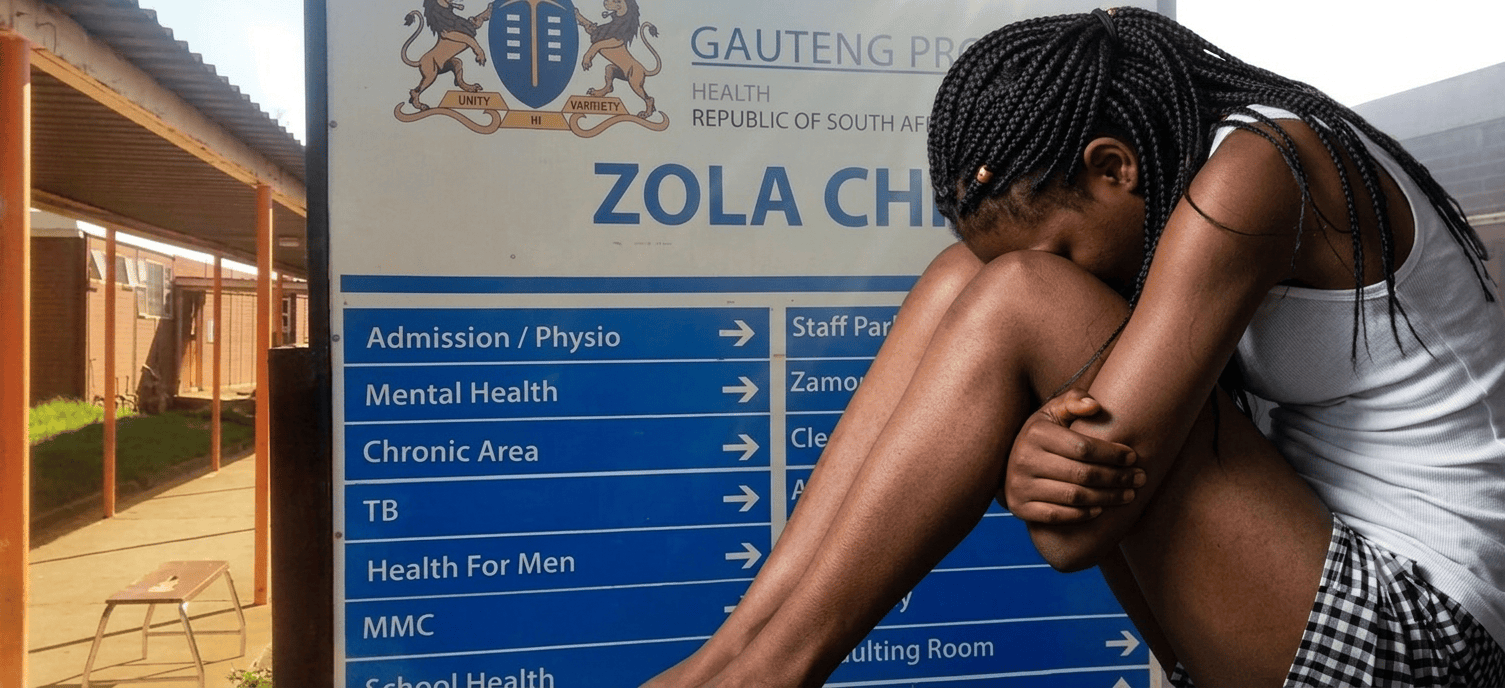
When Mphonyana Mtamane was violated by a friend’s boyfriend, little did she know it was the beginning of a trauma that would be replayed by a clinic supposed to offer her comfort. Instead of sanctuary, she met an indifference so cold it broke her willingness to seek justice.
By Themba Khumalo
Evil does not always come screaming out of a dark room, with flames pouring from its mouth.
Most of the time, it does not even come brandishing a weapon. It does not lurk in dark alleys, nor does it strike with physical violence.
Instead, it sits quietly behind a clinic desk, sipping tea from a ceramic mug and shuffling paperwork with agonising slowness.
It looks out at a traumatised human being with a blank, dead gaze—an indifference so cold it borders on the psychopathic.
On 27 May, that cold gaze was fixed directly on Mphonyana Mtamane. Her ordeal at Zola Clinic in Soweto is not merely a shocking indictment of a dysfunctional medical facility; it is a sickening, stomach-churning demonstration of institutional cruelty.
It is an account that should make the blood of every right-thinking citizen boil with unadulterated, venomous rage.
Consider the sheer, unmitigated horror of the situation. A twenty-year-old woman was subjected to the unspeakable trauma of rape, allegedly committed by her friend’s boyfriend. She was bruised and emotionally traumatised. Her face bore the visible scratches of a violent assault.
She was a walking open wound of emotional and physical devastation.
Knowing that her life hung in the balance, she dragged her shattered body to Zola Clinic, acutely aware of the seventy-two-hour window—the razor-thin margin of time between safety and a lifetime of living with HIV.
She arrived at nine o’clock in the morning, desperate, pleading, and terrified.
And what did the state-funded apparatus of mercy do? What did those individuals who swore an oath to heal and protect do?
They told her to sit down and wait.
For five agonising hours, Mphonyana Mtamane sat in that waiting room.
Five hours. Three hundred minutes of watching the clock tick down towards an irreversible medical catastrophe.
She repeatedly explained to the staff that she had been raped. She begged for Post-Exposure Prophylaxis. Yet, the bureaucratic ghouls of Zola Clinic remained unmoved.
The administrator responsible for the file was away from the desk, and upon returning, possessed such a staggering lack of basic human empathy that they simply dismissed a traumatised rape survivor as if she were a minor inconvenience blocking the queue.
Let us speak with absolute honesty: this is not a “systemic weakness.” This is not a “resource shortage.” These are the sanitised, cowardly phrases cooked up by spineless public relations departments and bureaucratic mouthpieces to shield monsters from accountability.
Read more: Rape Survivor Waits Five Hours For Life-Saving HIV Treatment
While dedicated activists like Chris Maseko are left to pick up the pieces of these catastrophic failures, the PR machine actively works to normalise the horror, using corporate doublespeak to gloss over a deliberate, malicious refusal to care.
It is a manifestation of a bureaucratic rot so deep that a fellow human being in the throes of mortal terror is viewed as nothing more than an irritation.
Had it not been for a caring health promoter who possessed a shred of decency and went outside her official duties to open a file, Mphonyana Mtamane might well have been condemned to a life-altering infection by the sheer lethargy of the Zola Clinic staff.
The health promoter herself laid bare the situation at Zola Clinic, stating that she always goes above and beyond to help young people because of the facility’s poor service.
The depravity did not cease once Mphonyana finally saw a doctor. The doctor, presumably educated and tasked with holistic care, prescribed the medication without asking a single question about the assault.
There was no referral to a social worker. There was no offer of counselling. There was no connection made to gender-based violence victim empowerment services. They handed over the pills as if they were dispensing medication for a mild headache, utterly blind and indifferent to the psychological carnage before them.
The consequences of this institutional malice are devastating. Mphonyana was so extremely broken by the treatment she received at Zola Clinic that she abandoned all hope of justice.
She refused to report the rape to the South African Police Service. Why? Because the very people paid to protect her taught her a brutal lesson: “No one cares.”
The rapist walks free today, unbothered by the law, precisely because the staff at Zola Clinic retraumatised his victim so severely that she lost the will to fight.
They acted as the perpetrator’s silent accomplices, finishing the job he had started by crushing whatever remained of her spirit.
This is the harrowing reality that lies beneath the polished public relations campaigns and the empty political posturing. We are told ad nauseam that South Africa is fighting a war against gender-based violence.
Politicians stand at podiums draped in expensive suits, shedding crocodile tears and promising reform. Yet, on the ground, at the primary healthcare level where the battle is actually fought, survivors are met with the cold, dead eyes of indifferent clinic staff.
It is precisely because of this pervasive, unblinking indifference that we cannot rely on the healthcare system to police itself. Internal reviews and department memos will achieve nothing when the core issue is a complete absence of human decency.
The rot within these walls cannot be sanitised by the very institution that permitted it.
Therefore, there must be an immediate, fully independent investigation launched into the administration and medical staff of Zola Clinic. We cannot trust the department to mark its own homework.
An external, transparent inquiry must expose all individuals who turned their backs on Mphonyana during those five hours of torment.
Once that investigation uncovers the full extent of this negligence, the punishment must be absolute. The individuals concerned must be stripped of their professional licences, cast out of the healthcare service, and held legally accountable for the secondary victimisation of a citizen.
Zola Clinic has proven itself to be a place where compassion goes to die.
If this cold-blooded betrayal does not ignite a demand for truth and consequence, then we have truly lost our collective soul.