

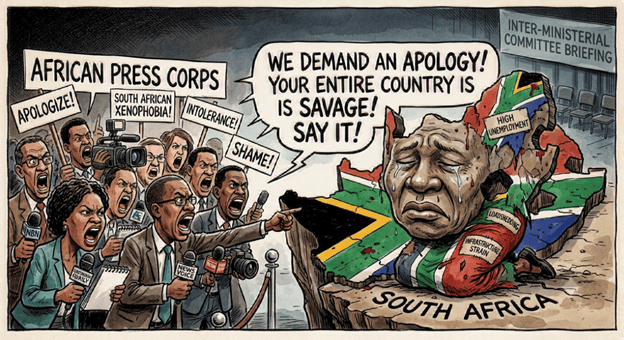
Our high-society press corps has replaced fair and objective context with a hypocritical double standard. They broadcast local structural strain as pure prejudice, deliberately airbrushing the massive regional collapses out of the picture.
By Themba Khumalo
There is an absolute, uncompromised beauty in a glass of single malt whisky; it is an unapologetic, crystalline defiance against a world obsessed with cheap shortcuts and mass-produced mediocrity.
It is a peerless manifesto of purity, a liquid alchemy that delivers a bewildering aroma of peat, oak, and smoke before it even touches my lips. When it finally does, the explosion of flavour is nothing short of transcendent—a taste so profound it brings celestial beings to dance in my mouth and awaken my very soul.
It represents the pinnacle of craftsmanship, where patience, discipline, and absolute adherence to standards create perfection.
If only the continental press gallery possessed a fraction of that purity.
By all accounts, the continental press gallery has morphed into a high-society book club.
Its members sit in air-conditioned comfort, sipping imported mineral water, utterly terrified of breaking the unwritten rule of modern African journalism: Never, under any circumstances, ask a fellow African leader a difficult question.
If you want to see the exact moment objective journalism died and theatrical activism took its place, look no further than the briefing room at Tshedimosetso House in Pretoria during the Inter-Ministerial Committee on Migration briefing.
There, a Nigerian broadcast journalist, Ireti Bakare-Yusuf, completely discarded the vestments of professional balance to stage a performance for the cameras.
Confronting the Minister of Justice, she did not ask a single probing question about the systemic collapses, the lawless syndicates, or the economic push-factors driving her own compatriots to flee their homeland.
Instead, she weaponised the briefing to launch into an unruly, personalised grievance, aggressively demanding an apology because her feelings—and those of her social circle—had been bruised by official remarks regarding documented drug dens in Hillbrow and Sunnyside.
The spectacle was so disrespectful and argumentative that officials had to intervene and threaten her removal from the room.
It was the perfect, ugly distillation of the modern continental press corps. When faced with the catastrophic failure of regional governance that forces millions into precarious migration, these commentators suffer a total loss of voice.
But when given a microphone in Pretoria, they transform into a feral lynch mob, hunting for safe local scapegoats and cheap personal grandstanding while the real architects of continental ruin are let entirely off the hook.
Let us be very clear before the outrage brigade prepares its placards: South Africa has a visible, ugly underbelly of xenophobic violence.
The vigilante attacks, the burning of shops, and the hateful rhetoric spewed by certain local politicians are repulsive and thoroughly indefensible. They deserve every bit of condemnation they get.
But our continental journalists are not just reporting this nuance—they are chasing pure sensation, desperately trying to paint the entire country as a monolithic tribe of bloodthirsty savages.
It is lazy, it is dishonest, and worse, it serves as a highly effective smokescreen for a much larger, continent-wide failure.
While the cameras remain obsessively trained on our townships and major cities, a deafening silence hangs over the grand palaces of Addis Ababa and Gaborone.
Where is the searing investigative reporting into the African Union (AU) or the Southern African Development Community (SADC) failures?
When was the last time a brave scribe cornered a regional heavyweight and demanded to know why his or her citizens are fleeing their countries by the millions?
For decades, SADC has sat on a supposedly grand plan for regional development, yet it remains a toothless bulldog, completely unable—or perhaps completely unwilling—to hold member states accountable for the governance collapses that trigger mass displacement.
They ignore how regional leaders sit on their hands, turning a blind eye while neighbouring states fall apart at the seams.
And what of the ultimate tragedy? The thousands of young Africans who drown every year in the Mediterranean Sea, or perish in the sands of the Sahara, trying to reach a Europe that does not want them.
Where is the media-driven fury directed at the governments whose systemic failures drive their youth to view a watery grave as a better alternative to staying at home?
It is far easier, it seems, to write a sanctimonious op-ed about South African intolerance than it is to hold a mirror up to the continent’s failed leadership.
Let us look at the cold, hard numbers that our journalists find too inconvenient to print.
Verified tracking of migration routes reveals that the Mediterranean Sea has effectively been converted into a watery graveyard. On average, between 150 and 200 young Africans drown every single month attempting the perilous crossing to Europe.
That is a continuous, silent tide of preventable loss. These are the prime human capital of a continent, individuals who are choosing the distinct probability of a watery grave over the absolute certainty of starvation at home.
This brings us to the elephant in the room—a beast that has been grazing comfortably on the continental lawn for over half a century.
Most African nations have enjoyed independence for upwards of five decades. Fifty years is not a transition period; it is a lifetime. Yet, stable economies remain as rare as hen’s teeth.
The political class has long mastered the art of passing the buck, blaming colonial ghosts for modern potholes.
It is a highly lucrative business model: line your pockets, run the national treasury into the ground, and when the electricity fails or the currency collapses, simply point a finger at historic injustices.
They are perpetually crying over spilt milk while actively knocking over the bucket themselves.
The fundamental, unvarnished truth is that a stable economy for every country is a non-negotiable prerequisite to stopping illegal migration.
People do not pack their lives into a single plastic bag and walk across a continent because they want an adventure; they do it because staying at home is an economic death sentence.
You cannot catch water with a sieve, and you cannot expect people to remain in countries where the future has been systematically looted.
By completely ignoring these root causes, the press is effectively telling regional despots to carry on as normal.
They are letting the looters off the hook while ordinary South Africans—who are themselves living from hand to mouth amidst a local unemployment rate hovering around thirty per cent—are left to bear the physical and social brunt of a broken continent.
Our local infrastructure was never built to act as the default social security net for the failures of a dozen other sovereign nations.
Public hospitals and municipal services are buckling under a mathematical strain that has nothing to do with prejudice and everything to do with capacity. Yet, the press gallery remains dead silent on this, terrified that acknowledging the basic physics of a crowded room might disrupt their preferred narrative.
They look right past the well-documented rise of sophisticated, cross-border criminal syndicates operating within illegal immigration networks—syndicates that exploit vulnerable migrants and terrorise local communities alike.
To report on this would complicate the media’s preferred narrative of simple, flawless victimhood, so it is quietly swept under the rug.
It is high time for the African press corps to stop burying their heads in the sand. If they truly cared about human dignity, they would stop polishing the halos of failed leaders.
They must start asking why, after fifty years of self-governance, our brightest minds are still choosing to vote with their feet.
Until they find the courage to hold that mirror up to power, their journalism will remain a cheap, watered-down imitation of the truth.
It lacks the spine, the depth, and the clarity of that perfect single malt dram.
We do not need any more diluted narratives or cheap blends; we need a press that cuts through the noise with the searing, unfiltered purity of a fine single malt, leaving no room for the hypocrites to hide while the soul of the continent burns.