


As the firearms registry falls into disarray, the state’s promise of safety unravels, putting both citizens and public order at risk from a crisis no one can afford to ignore.
By Themba Khumalo
Every single day in South Africa, an average of 30 people are shot dead. It is a daily toll of violence that quietly outpaces the country’s notoriously lethal road accident statistics.
However, while the bloodshed plays out publicly on the streets of Khayelitsha, Westbury, and Umlazi, a quieter, systemic crisis is unfolding inside the dusty back offices of the South African Police Service.

South Africa’s firearm relicensing system has collapsed.
According to a report by the campaign group Gun Free South Africa (GFSA), which analysed the police’s own official figures, applications to renew gun licences crashed by 74% in just two years.
They plummeted from over 213,000 applications in the 2021–22 financial year down to just under 56,000 last year.
This is not merely a problem of administrative delays. In a country already heavily affected by the proliferation of illegal weapons, these figures mean hundreds of thousands of guns that were once safely on the police database have quietly slipped into the dark. Overnight, these registered weapons have crossed the line into illegal, untraceable, and highly dangerous status.
The “Dead Licence” Trap
To understand how this point was reached, it is necessary to examine the strict finality of South African gun laws. Under the Firearms Control Act (FCA), a gun licence is not like a driving licence. If a driving licence expires, the driver faces a fine, but does not lose the underlying right to own the vehicle.
A gun licence operates under entirely different rules.
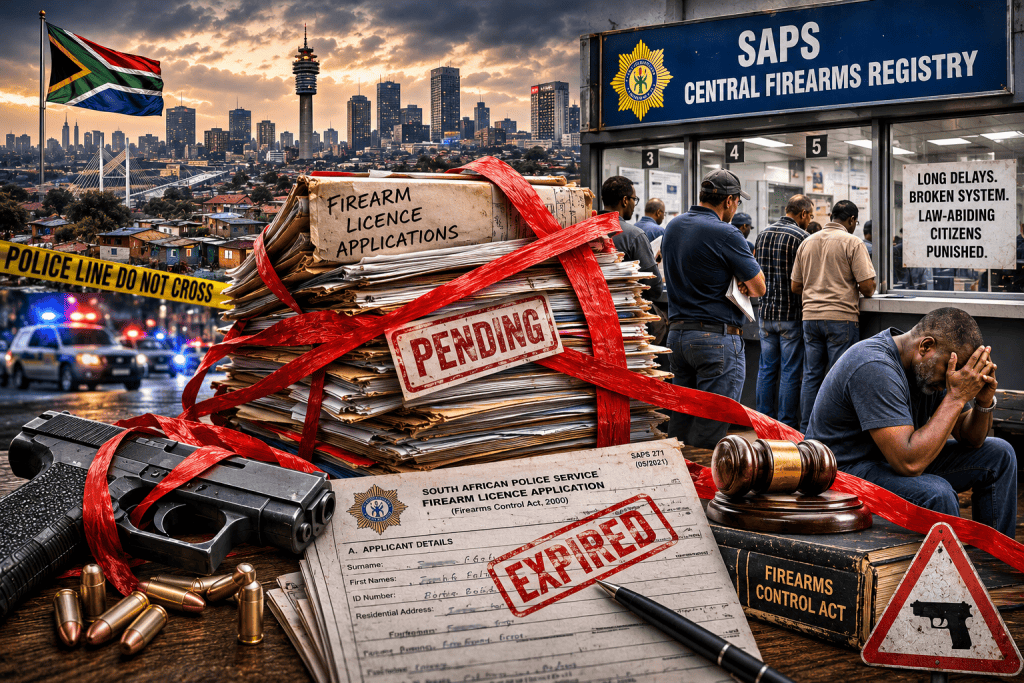
“Once a gun licence expires, it is dead,” explains Claire Taylor, a researcher with GFSA who has tracked police firearm data since 2006. “It cannot be renewed late—even if the owner shows up at a police station the very next day. Instead, the owner has to start the entire, costly application process from scratch. The only way to keep a firearm legal is to apply for a renewal before the current licence expires.”
When these licences run out, the weapons do not vanish. They remain in bedside drawers and home safes, but their legal status evaporates.
In 2020, the Supreme Court of Appeal warned that unlicensed guns pose an acute risk of being lost, stolen, or diverted directly into the hands of house robbers and violent syndicates. Without a functional, highly efficient renewal system to maintain oversight, every single unlicensed gun becomes a threat to public safety.
“The legal status of a gun does not, on its own, decide whether it gets lost, stolen, or used in a crime,” Taylor points out. “Any gun can be misused, whether licensed or not. What licensing does is manage that risk. It keeps the weapon on a live record, requires regular checks on the owner’s mental and domestic fitness, and leaves a clear paper trail if something goes wrong.”

Right now, that paper trail is burning. Over the last three years, South African gun owners have reported an average of 8,000 licensed firearms lost or stolen annually. Once a licence expires, the police’s ability to track these weapons effectively disappears.
The Police Red-Tape Nightmare
But are South African gun owners wilfully choosing to break the law, or are they victims of a collapsing state machinery that is turning them into criminals?
For organisations representing gun owners, the claim that ordinary citizens are simply being lawless is a convenient cover-up for a police department unable to manage its own administrative duties.
“To whatever extent relicensing applications have declined, that decline is not evidence of lawlessness among licensed firearm owners,” argues Damian Enslin, Chairperson of the South African Gunowners’ Association (SAGA).
“It is the predictable result of a legal framework Parliament has failed to repair, and a Central Firearms Registry—the main police gun database—that has been structurally dysfunctional for years.”
Enslin points to a watershed legal moment in May 2022. The Constitutional Court confirmed a crucial legal distinction: while a licence may expire, the underlying ownership of the physical property (the firearm) does not terminate. The court ruled that owners with lapsed licences could indeed apply for a new licence through ordinary administrative channels.
Rather than resolving the crisis, however, this ruling triggered an era of profound confusion.
“Since then, gun owners have faced massive uncertainty about what the law actually requires of them,” says Enslin. “Meanwhile, the Central Firearms Registry has continued to sit on applications for months, and in many cases, years. When the state makes compliance slow, agonisingly bureaucratic, and unrewarding, application numbers fall. That is a failure of administration, not of gun owners.”
From Enslin’s perspective, the state is targeting the wrong demographic. The citizens who let their paperwork lapse are the very people who have already passed competency testing, survived background checks, and installed police-approved home safes.

“Conflating a vetted owner with an expired licence with an armed, violent criminal does absolutely nothing to make South Africans safer,” Enslin warns.
Punishing the Responsible Owner
This view is backed heavily by Jonathan Deal, the Director of Safe Citizen, an organisation representing thousands of law-abiding, responsible firearm owners. Deal points out that the state is demanding flawless compliance from citizens while running an administrative machine that cannot even process applications, keep its servers online, or answer its own phone.
“This isn’t a debate about whether firearms should be regulated — it’s an insistence that regulation actually functions,” Deal says. “No citizen should have to choose between staying within the law, becoming a de facto criminal because of broken administration, or giving up because the law’s own machinery has broken down.”
Deal argues that the system effectively turns honest people into outlaws through pure bureaucracy. “An expired licence caused by a backlog nobody disputes is not a crime. It’s a state failure wearing a citizen’s name,” he states. “You can’t be branded an outlaw for waiting on a form the state itself has lost — the law has to hold government to the same standard it holds citizens to.”
Furthermore, Deal notes that these long delays directly harm the safety standards the state claims to uphold. By creating massive backlogs, the system keeps responsible owners away from shooting ranges and prevents them from buying practice ammunition. “The state is undermining the very competence it claims to protect, by keeping responsible owners away from the range and the licence they need to be there legally,” he warns.
The Danger of an Empty Registry
Beyond individual frustration, Deal highlights that the registry’s breakdown poses an extreme public safety risk. If the state cannot maintain its records, the entire concept of gun control falls apart.
“If the registry standards further deteriorate, we cannot say with certainty who is legally holding a firearm, and that uncertainty is a bigger public safety risk than any single licence delay,” Deal explains. He adds that a broken system actively fuels the black market.
“Whenever the registry fails a legitimate transfer, it may divert that transaction to the informal market instead — the exact opposite of what regulation exists to prevent.”
According to Deal, the police department has effectively abandoned the public by staying silent on paperwork. He highlights the “18-month failure of the Minister to maintain a working appeal board” as a clear example of this collapse. “A regulator that goes silent instead of saying yes or no isn’t regulating — it’s abandoning the citizens who still believe in doing this properly.”
The broader operational bottleneck is also breaking public morale. When the police database constantly crashes, the state loses all credibility. “It teaches good people that compliance gets punished and shortcuts get rewarded, which is the most dangerous lesson any licensing system can teach,” Deal stresses. “A system that can’t process a renewal has no sustainable credibility to claim it’s protecting the public from anyone.”
A Crisis of Messaging and Will
How did a system designed to regulate deadly force degenerate into an administrative stalemate? According to GFSA, the current collapse is a perfect storm of three distinct failures:
Legal Confusion: The 2022 Constitutional Court ruling was widely misread across social media and gun forums, leading many owners to falsely believe they no longer needed a valid, active licence to keep their weapons.
Lobbyist Disinformation: Conflicting interpretations of the law pushed by various interest groups created a culture of complacency.
Police Lethargy: The South African Police Service (SAPS) has consistently failed to proactively enforce the renewal and termination provisions of the Firearms Control Act.
This paralysis stands in stark contrast to the past. In 2016, when SAPS issued a strict, unambiguous directive regarding licence renewals—backed by real enforcement—relicensing applications more than doubled.
“The lesson is straightforward,” Taylor says. “When gun owners receive clear messaging backed by meaningful consequences, they respond and comply.”
South Africa already battles one of the most severe gun-violence epidemics on earth. Yet, as the administrative apparatus of the state crumbles, a crisis of illegal firearms is allowed to grow in the dark.
Faced with this gridlock, Deal believes the path forward is purely practical, not political. “Every functioning firearm-control system in the world rests on data integrity, not good intentions — and right now we’re trying to run 21st-century regulation on a system that can’t reliably answer its own questions,” he says.
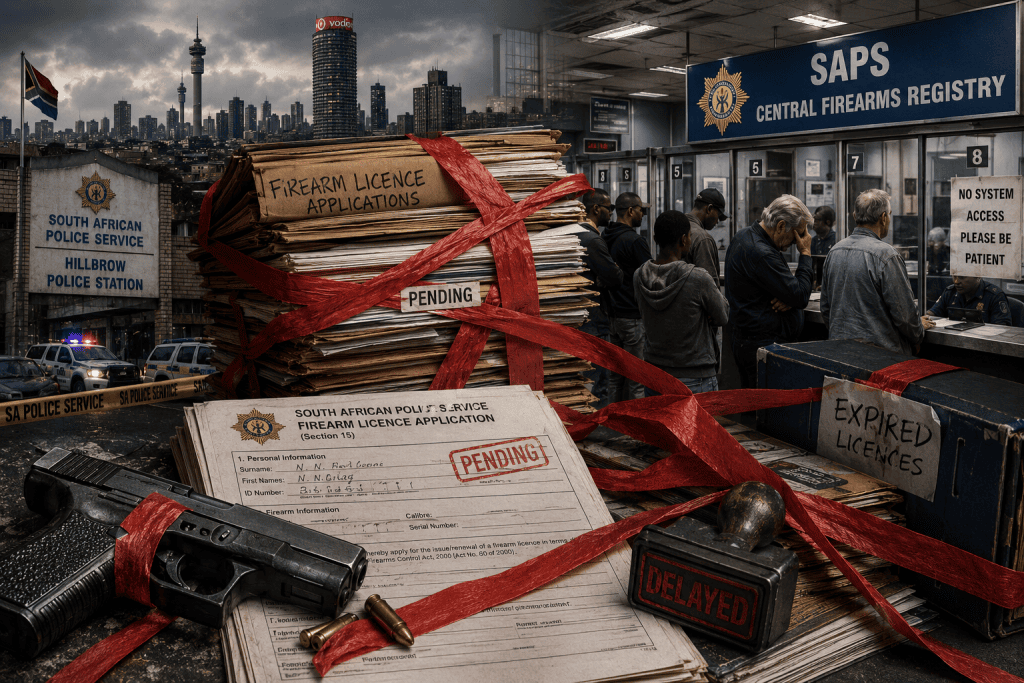
“Safe Citizen is not asking government to choose between safety and rights — we’re asking it to fund, digitise, and staff the registry so that the law it already wrote can actually be consistently applied,” Deal concludes. “Fix the machinery, and compliance stops being punished. That is the fastest, cheapest, most politically uncontroversial safety win available to the Minister today.”