

Government cannot simultaneously portray private security as too dangerous to trust while relying on the same industry when the state falls short. Public safety demands more than political convenience. It demands a coherent policy that does not change according to circumstance.

By Jonathan Deal
Here is a straightforward question that government policy has consistently managed to sidestep: is private security a necessary partner in keeping the country safe, or is it a threat that needs to be reined in?
Right now, officialdom appears to treat it as both, depending entirely on which day of the week you ask.
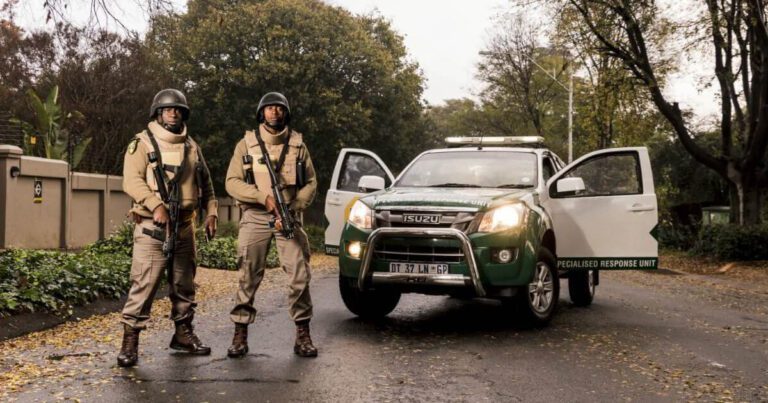
During major crises—such as the widespread unrest in 2021 and the recent civil disruptions in mid-2026—the state turned directly to private security firms, Community Policing Forums, and neighbourhood watches.
Around R600 million was allocated towards joint operational support in the 2026 response alone.
Chairperson of the Parliamentary Portfolio Committee on Police Ian Cameron highlighted the basic reality behind that decision: the South African Police Service (SAPS) simply cannot tackle violent crime entirely on its own.
That is not a partisan claim. It is a practical observation shared by anyone who has ever had to wait for a police vehicle during an emergency.
Private operators answered the call because the state requested their assistance, stepping in with trained personnel and tactical equipment to stabilise communities when public infrastructure was stretched to its limit.
The contradiction emerges in how those same companies are treated once the immediate crisis recedes.
While relying on private officers to secure streets during periods of high tension, the Private Security Industry Regulatory Authority (PSIRA) has simultaneously pursued regulations that would sharply restrict the sector’s operational capabilities.
Proposed measures include limiting semi-automatic rifles to narrowly defined use cases, introducing vaguely defined ammunition restrictions, and mandating tracking devices on all firearms—a requirement for which no viable commercial technology currently exists.
Furthermore, security firms under preliminary investigation, even before formal charges, could face immediate restrictions on arming their staff.
In response to concerns raised by industry representatives, PSIRA’s leadership has stated that no disarming is taking place, maintaining that the regulations do not outright prohibit equipment. However, for the roughly 580,000 active security officers and the businesses employing them, the operational impact tells a different story.
The Policy Double Standard
The contradiction deepened further just weeks later. On 21 July, Deputy Defence Minister Bantu Holomisa delivered a candid assessment of the South African National Defence Force (SANDF), warning that relying solely on state funding was no longer viable: “The Department cannot simply assume that every infrastructure backlog, every equipment requirement, and every modernisation project will be fully funded through additional allocations from the National Treasury. That is not a realistic assumption.”
His proposed solution was to invite private capital, private expertise, and commercial partnerships to assist in propping up military housing, training facilities, and basic equipment support.
The Underlying Contradiction:
In Public Safety: Private capacity is subjected to tightening regulatory limits on the tools required to perform its duties.
In National Defence: Private capacity is invited to provide financial and logistical support where state budgets fall short.
When private expertise saves the state money or fills an immediate operational void, it is welcomed as an essential asset. When that same capacity operates independently to protect homes and businesses, it is frequently viewed with administrative suspicion.
This is not a coherent policy framework; it is an ideological double standard.
Civil rights organisation Safe Citizen has posed a logical response to this dual approach: the government needs to decide on its stance. If private security is a vital force multiplier that lightens the burden on an overstretched police service, it should be regulated fairly and treated as an institutional partner.
If, conversely, the state genuinely regards armed private security as too dangerous to trust, it cannot reasonably turn to that same commercial sector to subsidise national defence.
Policy cannot be built on two opposing premises at once—not when public safety is on the line.
Jonathan Deal is National Coordinator & Director at Safe Citizen Campaign