

In Gauteng politics, yesterday’s liability has a habit of becoming today’s most valuable asset. When a man once blamed for a municipal financial crisis lands one of the most powerful fiscal positions in the province, two kinds of people emerge: those who are outraged, and those who saw it coming.
By Themba Khumalo
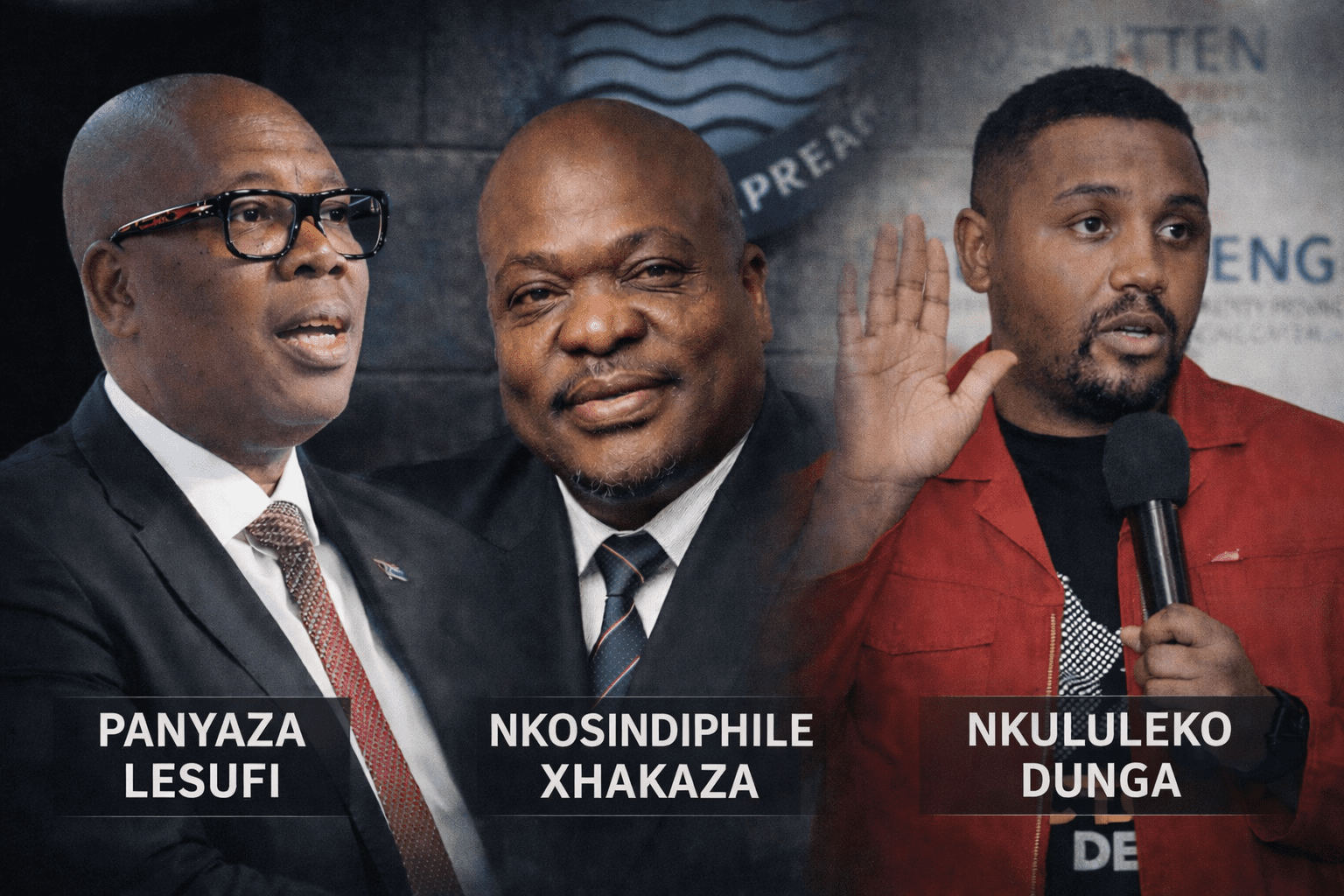
What has unfolded in Gauteng’s corridors of power is almost operatic — a discordant political duet in which Nkosindiphile Xhakaza and Panyaza Lesufi have cast the same man, within the span of a year, as both arsonist and fire chief.
One condemned him. The other just handed him the keys.
At the centre of this political spectacle stands Nkululeko Dunga, a figure who has undergone one of the most remarkable rehabilitations in recent provincial memory — not through exoneration, nor through demonstrated excellence, but through the blunt arithmetic of power.
Last year, Xhakaza did not simply dismiss Dunga; he politically convicted him. The charge sheet was damning: a paralysed budget process and a municipality drifting into financial anxiety. The city’s fiscal spine was bending under mismanagement. This was not the language of routine reshuffling. It was the language of necessity. It suggested a system on the brink. Dunga, in that telling, was not a casualty of factional skirmish. He was the problem.
And yet, in the peculiar logic of Gauteng’s coalition age, the man who was the problem has been recast as the solution.
Lesufi’s decision to hand Dunga the provincial treasury is not merely a contradiction; it is an inversion. One is tempted to ask: what changed? Was there a sudden revelation of competence? A forensic clearing of doubt? A demonstrable turnaround in governance?
No. What changed was the balance of power.
This is the quiet truth humming beneath the surface of Lesufi’s public reasoning. He has been unusually candid, almost disarmingly so, in admitting that this is not about technocratic merit but about political survival. The African National Congress, haemorrhaging electoral dominance and now hovering below the psychological comfort of majority rule, finds itself negotiating not from a position of strength but from the edge of vulnerability. In that weakened state, principle becomes negotiable, and consistency becomes expendable.
The budget — typically the foundation of responsible governance — has been reduced to a bargaining chip, stripped of its sanctity in the process.
Lesufi frames his decision as a pragmatic act, a necessary compromise to avoid legislative paralysis. Without external support, the budget would stall, the province’s machinery would grind to a halt, and governance itself would seize. This is the argument of the realist, the man who claims to see the world not as it ought to be, but as it is.
But realism, in politics, is often just a more palatable name for capitulation.
Because what is being asked of the public is not merely patience; it is amnesia. Voters in Ekurhuleni must forget that Dunga was once deemed unfit to command a R66 billion municipal purse. They are expected to accept, without protest, that he is now trusted with a R179 billion provincial war chest. The scale has changed, but the questions have not. If anything, the questions have grown.
The dissonance is not subtle. It is deafening.
Even within governing circles, there is a sense of quiet bewilderment. Structures that once endorsed Xhakaza’s purge now find themselves staring at its reversal, as though watching a verdict overturned without appeal. It is the kind of political whiplash that erodes not only credibility but institutional memory. Decisions begin to feel less like outcomes of principle and more like placeholders — temporary positions awaiting the next negotiation.
And the true value here is not effective governance — it is deal-making. The appointment of Dunga is less a policy decision than a receipt: proof of payment in a transaction where political survival is the currency.
A growing chorus of critics has framed this not as pragmatism but as naked self-preservation — and whether that judgement is fair or not, it has taken root. The move carries all the markings of a leader fortifying his position at considerable cost.
The celebration from Dunga’s political allies is therefore not surprising. It is the rhetoric of arrival — the language of those who have moved from the periphery of protest to the centre of fiscal power. But beneath the slogans of “people-centred governance” lies a more strategic victory: leverage converted into authority.
But the cost of this bargain is not confined to political rivals or allies.
The very idea of accountability bears it — quietly and at great expense.
Because what message does this send? That failure, once politically inconvenient, can be rebranded as competence when circumstances demand it? That dismissal is not a judgement, but a pause? That the standards by which leaders are evaluated are as fluid as the coalitions they inhabit?
In this performance, consistency is the first casualty.
Lesufi may well argue that he is playing a longer game — and the argument, taken on its own terms, is not without merit. Coalition governance is not the same as majority rule. When a party governs without a mandate to control, it must negotiate not from principle but from position. The alternative to compromise, in this reading, is not some purer form of accountability — it is deadlock. A stalled budget does not punish the politicians who blocked it; it punishes the residents who depend on it.
Beyond that, there is the co-option theory: by drawing former adversaries into the machinery of administration, you strip them of the luxury of opposition. You force them to govern, to own outcomes, to stand in front of the same public they once courted with protest. If Dunga succeeds, the province benefits. If he fails, the failure is shared.
On paper, there is even a certain strategic elegance to it — if the ship sails smoothly, the governing hand claims stewardship; if it falters, the blame is diluted.
But this is a gamble dressed as a strategy — and it depends on a condition that has not been met: transparency. The co-option theory only holds if the public is let into the logic. If Lesufi had stood before Gauteng residents and said, plainly, “I have no majority, these are my constraints, and this is the least bad option available to me” — that would be realism. What happened instead was the language of merit applied to a decision made entirely on the basis of leverage. The justification arrived after the deal, not before it. And that sequencing matters enormously. It transforms what might have been an honest act of political necessity into something that looks, from the outside, like a cover story.
And the public is not naïve. They see the contradiction. They feel the dislocation between what was said and what is being done now. They understand, instinctively, that something does not quite add up when a man deemed unfit for one ledger is handed a far larger one without explanation.
In the end, this is not just about Xhakaza and Lesufi, or even about Dunga. It is about what coalitions do to political memory — how the logic of survival quietly dismantles the language of accountability, until the two become indistinguishable.