

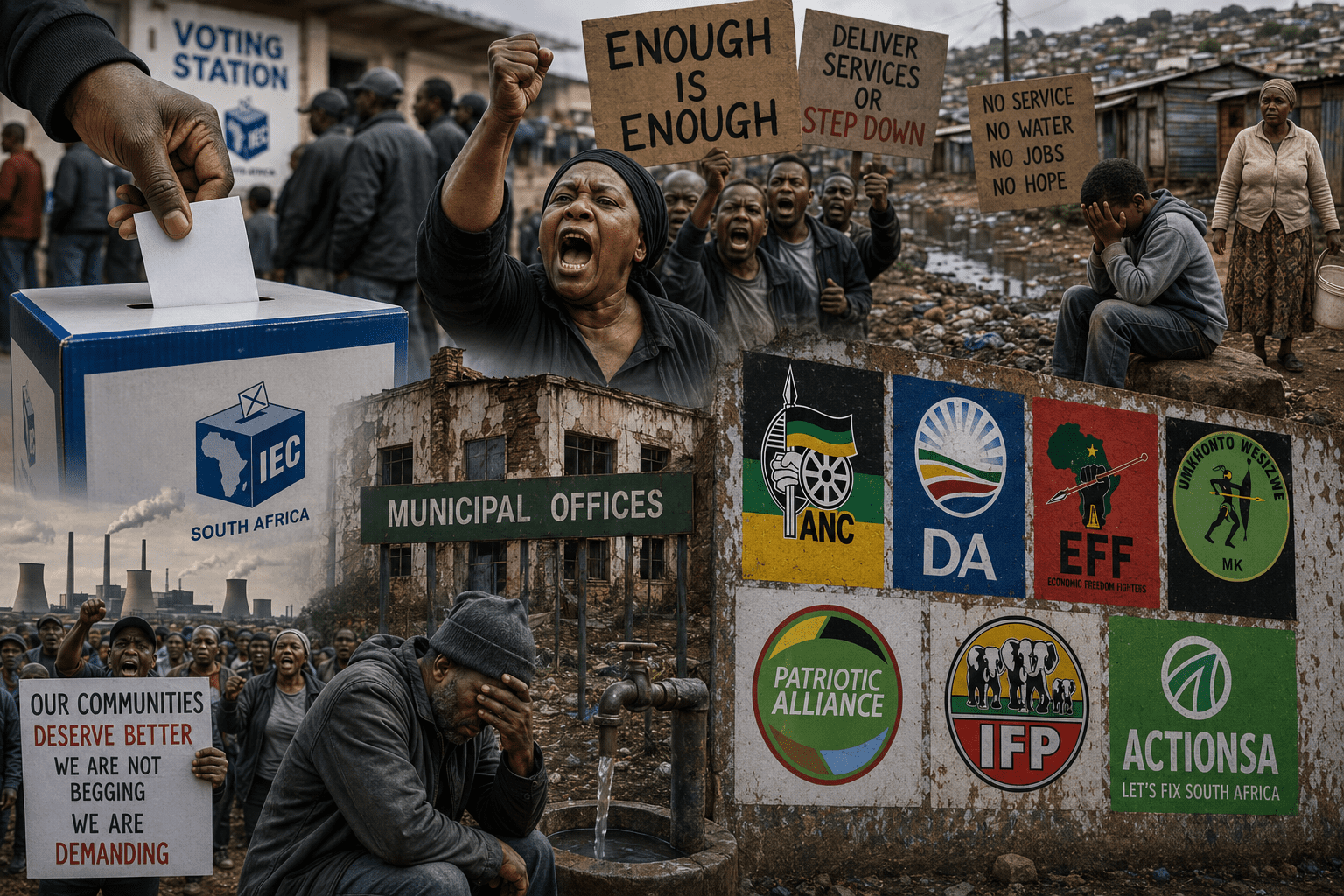
The upcoming local government elections will test more than party popularity. They will challenge South Africa’s political leaders to reconnect with communities weary from hardship and broken promises. Amid growing apathy and anger, the outcome could determine whether the country’s fragile democracy can be revived—or whether voters will stay away in record numbers.
By Themba Khumalo
As dusk settles over Diepsloot, on the northern edges of Johannesburg, a scene unfolds that is all too familiar across South Africa’s sprawling settlements.
Children dart between shacks and potholes, residents haul buckets from overburdened communal taps, and groups of young people gather on street corners—swapping stories of frustration with a system that seems to offer more rhetoric than real change.
This is the lived reality for millions of South Africans, and it is shaping the mood as the country prepares for the 2026 Local Government Elections.
The stakes could not be higher. Two years ago, South Africa’s political landscape shifted dramatically: for the first time since 1994, the ANC lost its grip on outright power, ushering in a Government of National Unity. That historic moment was seen by many as an opportunity for renewal.
Yet, as South Africans turn their attention to the local ballot box, doubt and fatigue dominate the conversation.
A Nation Turning Away from the Ballot Box
The numbers tell a sobering story. In 2016, just over half of eligible voters participated in municipal elections; by 2021, this had decreased to less than half. In neighbourhoods from Diepsloot to Khayelitsha, the refrain is repeated: “What’s the point?”
For many, voting feels like shouting into the void.
This apathy is not just a matter of lethargy or lack of awareness. It is rooted in daily disappointment. Across the country, basic services have collapsed—water shortages that drag on for days, sewage running in the streets, rubbish piling up, and electricity that goes off, sometimes for days, without official warning.
Such failures have eroded faith not just in political parties, but in democracy itself.
When Protest Feels More Powerful Than Voting
Speak to residents in neglected communities, and you will hear a growing belief that protest, not the vote, gets things done. “We march, we block the roads, someone comes to listen,” says a resident of Ekurhuleni. “But when we vote, nothing changes.”
This sense of futility is a warning siren for South Africa’s democracy.
If millions feel their vote is meaningless, then the very foundation of the system is under threat.
Political Cynicism: Who Can Be Trusted?
Trust in local government is at a low ebb. Tales of municipal corruption are so common they hardly raise an eyebrow—mayors accused of tender fraud, councillors handing jobs to friends and family, funds intended for clinics or roads simply disappearing. For many, this feels like a betrayal of the hope kindled in the early days of democracy.
Coalition chaos has only deepened the malaise. In major metros like Johannesburg, Tshwane, and Ekurhuleni, unstable alliances have led to a revolving cast of mayors and endless political infighting. Service delivery has suffered, and voters see their choices traded away in deals that yield little benefit for those on the ground.
Young People: South Africa’s Absent Majority
Perhaps the greatest worry is among the youth. In the last local elections, only 15% of eligible 18- to 21-year-olds registered to vote. For a nation with such a young population, this is a crisis.
Young South Africans are blunt: “No jobs, no prospects, no reason to vote.”
With youth unemployment among the highest in the world, a sense of exclusion runs deep. Political parties appear distant, more interested in slogans than in the daily battles of survival.
“They talk, but they don’t hear us,” says a 23-year-old in Diepsloot searching for work.
Voting as a Luxury, Not a Right
For millions, voting is not simply a right—it is an expense. The woman selling amagwinya at the roadside cannot afford to lose a day’s earnings to queue at a polling station. Parents juggling work and childcare, or the elderly in remote villages, must weigh up the cost of travel and time. Without real support, voting becomes a luxury many simply cannot afford.
A Ballot Paper Crowded with Confusion
This year’s ballot will be the most crowded yet, with breakaway factions, emerging movements, and established parties all jostling for space. The sheer proliferation of political parties has further fractured the field. For ordinary voters, the result is overwhelming: too many names, too many promises, too little clarity.
Some parties have turned to identity politics and divisive rhetoric to rally support. While this energises their core base, it often leaves undecided voters cold—deepening political fatigue and a longing for leaders who speak for everyone.
Misunderstood Mandates: What Can Councillors Really Do?
A further problem is confusion about what local government is responsible for. Many expect councillors to fix national problems like unemployment or major infrastructure. When these expectations go unmet, disappointment turns to cynicism, and local elections are seen as irrelevant.
The Toll of Corruption and Collapse
The scars of corruption and mismanagement are everywhere. In eThekwini, senior officials—including a former mayor—have faced prosecution for tender fraud. Johannesburg and Ekurhuleni have seen repeated scandals. Auditor-General reports confirm what many already know: most municipalities are financially distressed, with wasteful expenditure and outright theft commonplace.
For residents who have watched projects stall and services collapse, the message is clear: the system is not working, and voting alone will not fix it.
Can Parties Win Back the Voters?
Political parties are under pressure to change. Opposition formations tout themselves as stable alternatives. The ANC and its allies promise to root out corruption and rebuild local structures.
The Electoral Commission is working to register new voters, especially the youth.
However, the big question remains: can any party break through the cynicism and offer credible, local solutions that are real to ordinary people? South Africans are tired of grandstanding. They want water in the taps, working roads, jobs that pay, and leaders who serve.
A Turning Point for Democracy
As the 2026 polls approach, South Africa stands at a crossroads. The outcome will not only decide who runs the nation’s municipalities—it will reveal whether trust in democracy can be rebuilt, or whether millions will continue to turn away from the ballot box.
In places like Diepsloot, as in communities across the country, the answer will be written not in campaign speeches, but in whether ordinary people once again believe that their vote matters. The future of South Africa’s democracy may well depend on it.