

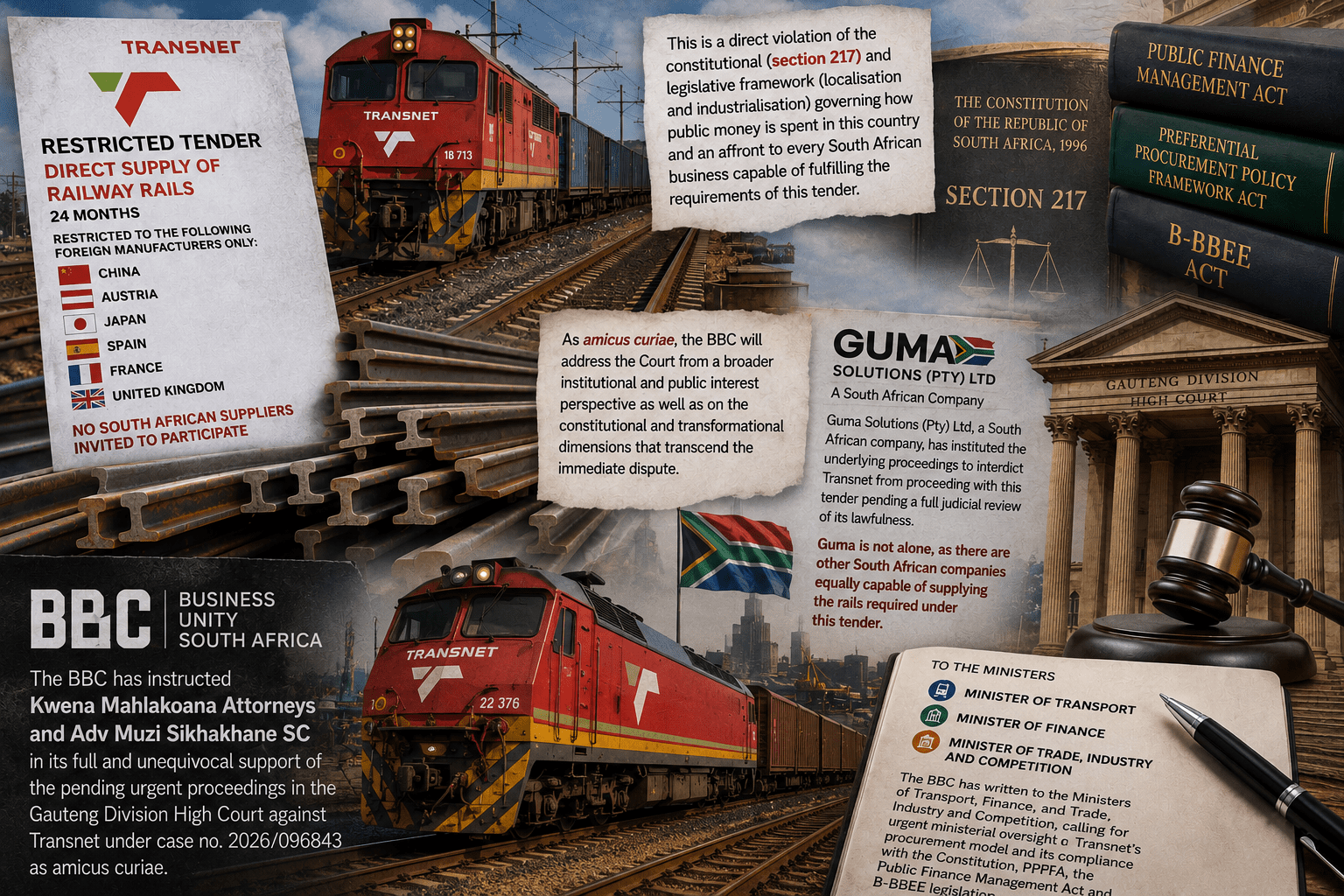
By the time South Africans finish paying taxes into the rickety machinery of the state, they are entitled to expect at least one thing in return: that public money should help build public prosperity at home. Instead, Transnet appears determined to export opportunity abroad, while local industry watches from the platform like an abandoned passenger clutching a cancelled ticket.
By Themba Khumalo
The latest controversy surrounding Transnet’s restricted railway rails tender is not merely another procurement dispute. It is a devastating indictment of how state-owned entities have mastered the art of speaking the language of transformation while practising the economics of exclusion.
Transnet no longer looks like a state-owned enterprise trying to rebuild South Africa’s shattered rail economy. It looks like a border post through which billions of rand are quietly escorted offshore while local industry is left standing in the dust, hat in hand, watching opportunity disappear into foreign boardrooms.
The fury now erupting around the restricted tender is not merely about steel tracks. It is about the tracks upon which South Africa’s constitutional promises were supposed to travel. And once again, those promises appear to have been derailed by a state-owned entity that speaks the language of transformation in public while practising exclusion behind procurement doors.
The decision to confine a 24-month rail tender exclusively to six foreign manufacturers from China, Austria, Japan, Spain, France and the United Kingdom — while excluding every South African supplier without exception — is not a clerical oversight. It is not a harmless technical procurement adjustment. It is an astonishing act of economic self-sabotage dressed up in bureaucratic jargon.
At a time when unemployment sits like a concrete slab on the chest of this country, when factories are closing, when black entrepreneurs are fighting for oxygen in a suffocating economy, Transnet has effectively hung a sign on the gates of a strategic national contract that reads: “South Africans Need Not Apply.”
That should outrage every citizen.
The constitutional implications are enormous. Section 217 of the Constitution does not merely instruct the state to procure goods cheaply and efficiently. It demands that public procurement be fair, equitable, transparent, competitive and cost-effective while advancing those previously disadvantaged by apartheid’s economic architecture.
Localisation and industrialisation are not decorative buzzwords for conference podiums and glossy government PowerPoints. They are legal and moral obligations. Yet here stands Transnet — one of the country’s largest state-owned entities — behaving as though those obligations are optional inconveniences.
The Black Business Council’s intervention as amicus curiae in the Gauteng High Court challenge brought by Guma Solutions is therefore not only justified; it is necessary. The case has become far bigger than one company or one tender. It now sits at the centre of a defining national question: does South Africa genuinely believe in economic transformation, or is “transformation” merely ceremonial language recited before procurement decisions are funnelled towards established foreign interests?
Transnet insists it remains committed to a “fair, transparent and legally compliant procurement framework”. Those words would carry greater weight had the entity not simultaneously constructed a procurement process that excluded every local participant before the race even began.
A race in which only foreigners are permitted to stand at the starting line is not competition. It is choreography.
The explanation offered by Transnet Rail Infrastructure Manager — that direct dealings with original equipment manufacturers supposedly ensure cost efficiency and supply security — collapses under scrutiny. Guma Solutions says it has been a compliant supplier to Transnet since 2014. Other South African firms reportedly possess similar capabilities. If that is true, then the justification for exclusion begins to look less like prudent governance and more like institutional contempt for domestic capacity.
And that is the rot at the heart of this affair.
South Africa’s governing elite has developed a dangerous addiction to importing competence while starving local capability. State entities repeatedly lament the weakness of domestic industry after spending years bypassing and undermining it. One cannot suffocate local manufacturers and then complain they cannot breathe.
The hypocrisy becomes even more grotesque when viewed against the government’s constant rhetoric about reindustrialisation. Ministers deliver speeches about localisation with the enthusiasm of revivalist preachers, yet entities under their political supervision continue to structure billion-rand procurement models that bleed economic value out of the country.
It is the economic equivalent of preaching patriotism while wiring the payroll overseas.
The timing could hardly be worse. The government has just unveiled an ambitious National Rail Master Plan requiring nearly R2 trillion in investment over the next quarter-century. Rail reform is being sold as a cornerstone of economic recovery, industrial expansion and freight revitalisation. Yet what credibility can such plans possibly retain if the very institutions tasked with rebuilding rail infrastructure treat South African suppliers as undesirable spectators?
A rail revival built on imported exclusion is not national development; it is outsourced dependency.
The implications for black business are especially severe. For decades, black entrepreneurs were told that inclusion in the productive economy would come through participation, localisation and supplier development. They were encouraged to build capacity, acquire expertise, invest in infrastructure and compete. Now, when strategic procurement opportunities emerge, the doors are slammed shut before bids can even be submitted.
That is not transformation. It is humiliation masquerading as policy.
The Black Business Council is correct to frame this as more than a procurement dispute. It is a battle over the constitutional soul of the economy. When state procurement systematically bypasses local enterprise, especially black enterprise, the state ceases to function as an engine of transformation and instead becomes a clearing house for external interests.
And South Africans have seen this film before.
Every few years, another scandal erupts, exposing how public procurement has become detached from developmental priorities. The faces change. The explanations evolve. The consultants multiply. But the outcome remains depressingly familiar: local jobs disappear, domestic industries weaken, and taxpayers finance the enrichment of entities far beyond the country’s borders.
Meanwhile, the political class offers citizens the same anaesthetic phrases — “balancing operational requirements”, “cost optimisation”, “strategic sourcing”, “global competitiveness”. Corporate euphemisms have become the preferred burial cloth for accountability.
But ordinary South Africans understand the issue with brutal clarity. A country drowning in unemployment cannot afford procurement systems that treat local participation as an afterthought. A democracy built on redressing historical exclusion cannot allow state entities to replicate exclusion under the guise of efficiency.
The BBC’s legal intervention may therefore become a pivotal moment. If the courts permit procurement models that entirely bypass local suppliers without compelling justification, then localisation policy itself risks becoming little more than ceremonial theatre.
And that would expose an uncomfortable truth.
South Africa does not suffer from a shortage of transformation rhetoric. It suffers from a shortage of institutional courage to enforce it when powerful procurement interests are involved.
Transnet now finds itself at the centre of that reckoning. The entity can either demonstrate that localisation, fairness and constitutional compliance still matter in South Africa’s economic architecture — or confirm growing suspicions that state procurement has become detached from the developmental mandate it was designed to serve.
Because if a state-owned enterprise can spend public money while excluding every capable local supplier from even entering the room, then the constitutional promise of economic inclusion begins to look less like policy and more like fiction written for election season.