
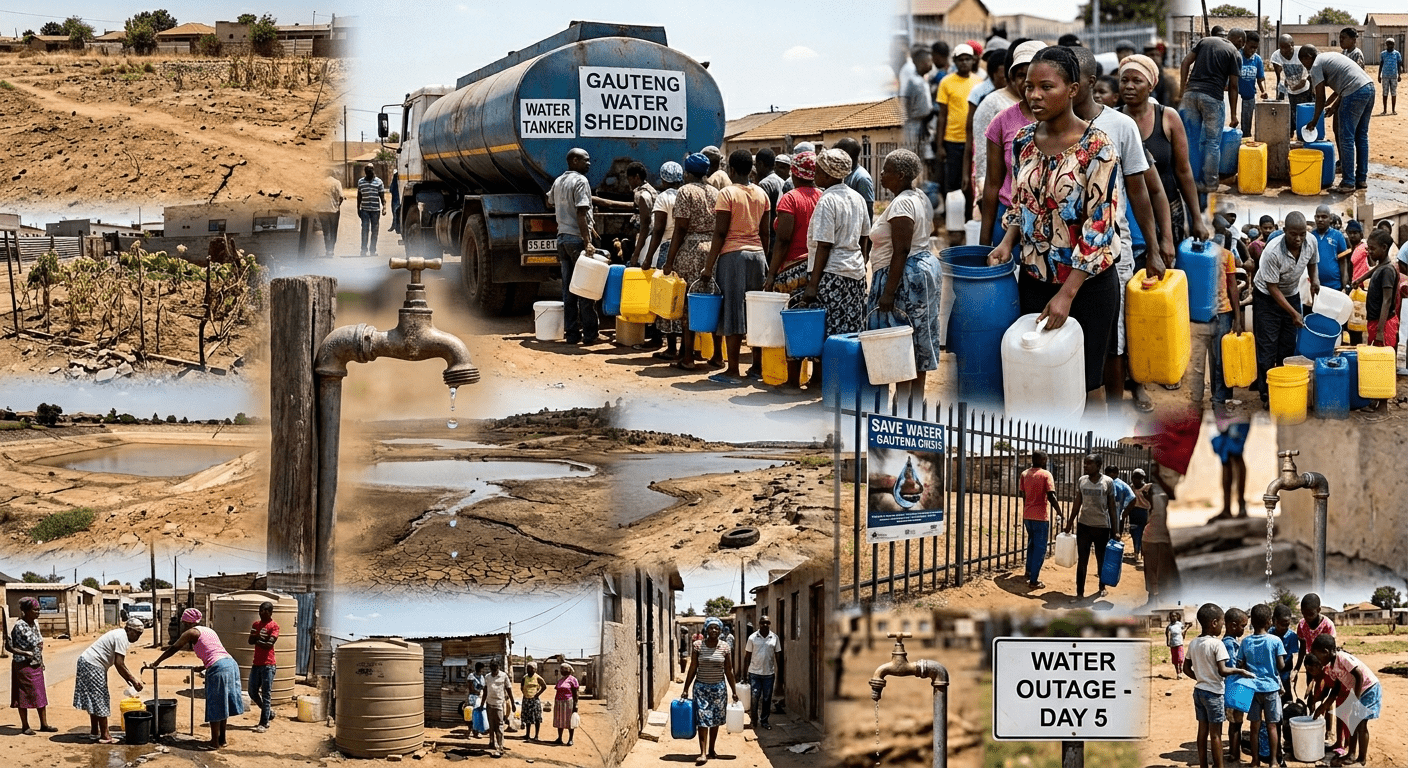
A submission to the ongoing inquiry into Gauteng’s water crisis, which commenced on Tuesday, 19 May, has accused municipalities of financial mismanagement, weak governance, infrastructure neglect and secrecy, warning that the province’s worsening water shortages are no longer merely a service delivery issue, but a full-blown constitutional and human rights emergency.
By SA Telegraph Reporter
The Gauteng water crisis is no longer being framed merely as a service delivery failure or infrastructure problem, but as a constitutional human rights emergency, with civil society organisation WaterCAN accusing municipalities of financial mismanagement, secrecy and governance collapse during hearings before the South African Human Rights Commission.
The commission’s three-day inquiry, which kicked off on May 19 and is ending on the 21st, is probing systemic infrastructure failures, intermittent water supply, and the disproportionate impact of the crisis on vulnerable communities across Gauteng.
In its submission, WaterCAN argued that the province’s worsening water shortages were no longer simply the result of drought or bulk supply constraints, but the consequence of years of governance failure, infrastructure neglect and weak financial controls.
“It is a systemic human rights crisis that is fed by governance failure, infrastructure neglect, poor to no financial controls, corruption and very weak transparency,” the organisation said.
“The taps did not run dry overnight. This crisis was budgeted for, ignored and allowed to deepen.”
The submission focused heavily on the City of Johannesburg and its water utility, Johannesburg Water, although WaterCAN warned that similar patterns were visible across Gauteng municipalities.
It cited examples of questionable spending across the province, including a R39 million sewer pipe project in Ekurhuleni and R24 million spent on just 30 toilets in Emfuleni — roughly R800,000 per toilet. It also highlighted the ongoing water crisis in Hammanskraal.
WaterCAN argued that while all levels of government contributed to the current situation, the crisis was now manifesting most sharply through failures at municipal level.
“In Gauteng, inequality is now visible in water pressure, tanker access and who can afford backup systems,” the submission stated.
The organisation warned that deteriorating infrastructure had become a direct assault on constitutional rights.
“The rights violation lies not only in the absence of water from taps. It also lies in the state’s repeated failure to prevent, disclose, plan, fund and remedy known risks to access to water and sanitation.”
Across the province, reservoirs, pump stations, towers and pipelines were described as damaged, collapsing, vandalised or inadequate. Sewer spillages, broken pump stations and poorly maintained wastewater treatment works were compounding the problem.
WaterCAN acknowledged that Rand Water played a role in the broader system, but insisted the central breakdown lay within municipal distribution infrastructure.
“Rand Water cannot think they operate in a vacuum — their actions affect municipalities in a weak system,” the organisation said.
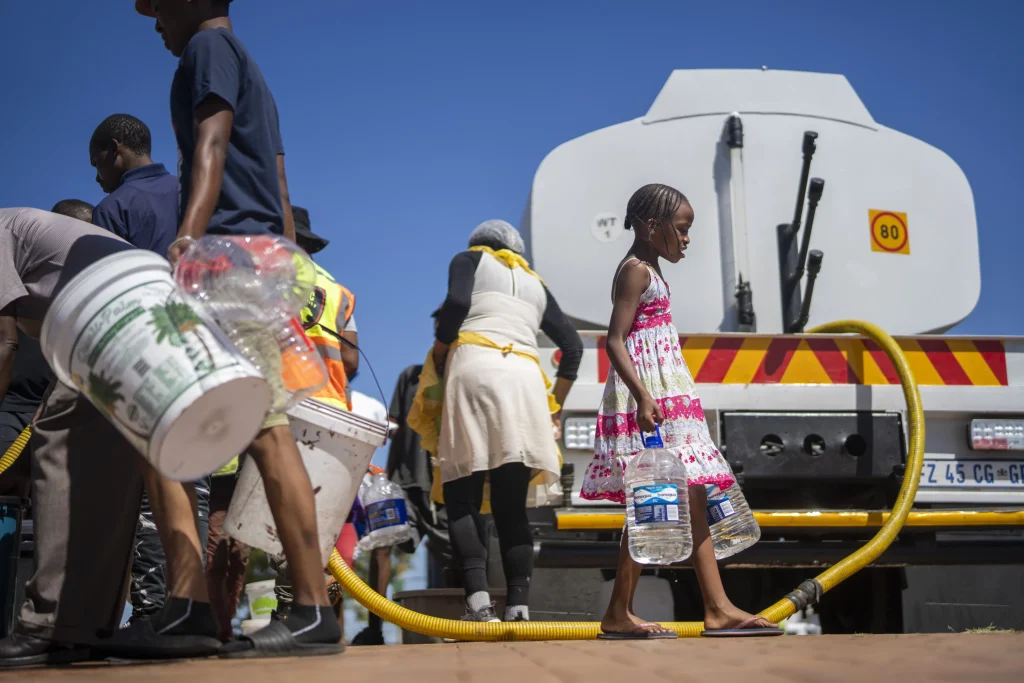
The submission also painted a stark picture of inequality in access to water. Beyond financial mismanagement, WaterCAN also highlighted the lived reality of inequality in access to water. While some affluent residents could rely on backup tanks and boreholes during outages, poorer communities — especially informal settlements — faced chronic shortages and dependency on water tankers.
“Some areas experience repeated dry taps, low pressure, water ‘load shedding’, tanker dependence and real hardship,” WaterCAN said. “Informal settlements often face permanent inadequate access to water. Other areas experience inconvenience rather than deprivation.”

WaterCAN questioned whether revenue from residents is truly used to maintain and improve water infrastructure, expressing concern over a lack of transparency in financial processes. The organisation highlighted the use of “sweeping accounts”, through which Johannesburg Water’s funds are transferred daily to the City’s accounts, making it unclear if water-related money is actually spent on essential services.
At the heart of the submission was a fierce critique of Johannesburg’s financial management of water revenue.
It raised alarm over the use of so-called “sweeping accounts”, through which Johannesburg Water’s cash is reportedly transferred daily into the City of Johannesburg’s accounts.
According to the submission, Johannesburg Water’s annual report showed that by June 2024, R2.811 billion belonging to the entity sat in the city’s sweeping account, while total loans to the city shareholder amounted to R4.144 billion.
“In plain language, the city can hold Johannesburg Water’s money, and it is not clear when, or whether, that money will return to the water entity,” WaterCAN argued.
“That is why WaterCAN asks: where is this money?”
WaterCAN further criticised the city for not properly ring-fencing water and sanitation revenue, warning that funds may be diverted elsewhere even as residents face rising surcharges and deteriorating services.
WaterCAN also questioned rising surcharges imposed on water users, stating that residents appeared to be paying more while services continued to deteriorate.
“Residents are paying for water twice — once through their tariffs, and again through dry taps, tankers and lost dignity.”
The submission claimed Johannesburg Water’s accumulated surplus could now be as high as R18.138 billion if surpluses since the 2023/24 financial year were added together.
“Again, we ask: where is this money?” it said.
Another major concern raised was the growing reliance on emergency interventions such as water tankers and JoJo tanks.
WaterCAN argued these measures had become symbols of systemic failure rather than temporary solutions.
“A tanker is not a water strategy. It is evidence that the system has already failed.”
The organisation warned that opaque procurement processes—such as Johannesburg Water’s failure to disclose bid prices or final awards for major tenders—create fertile ground for so-called “water mafias” and potential corruption, despite laws requiring transparency.
For example, Johannesburg Water allegedly published the names of 39 bidders for a potable water storage tender in January 2024 but did not publish bid prices or announce the final award.
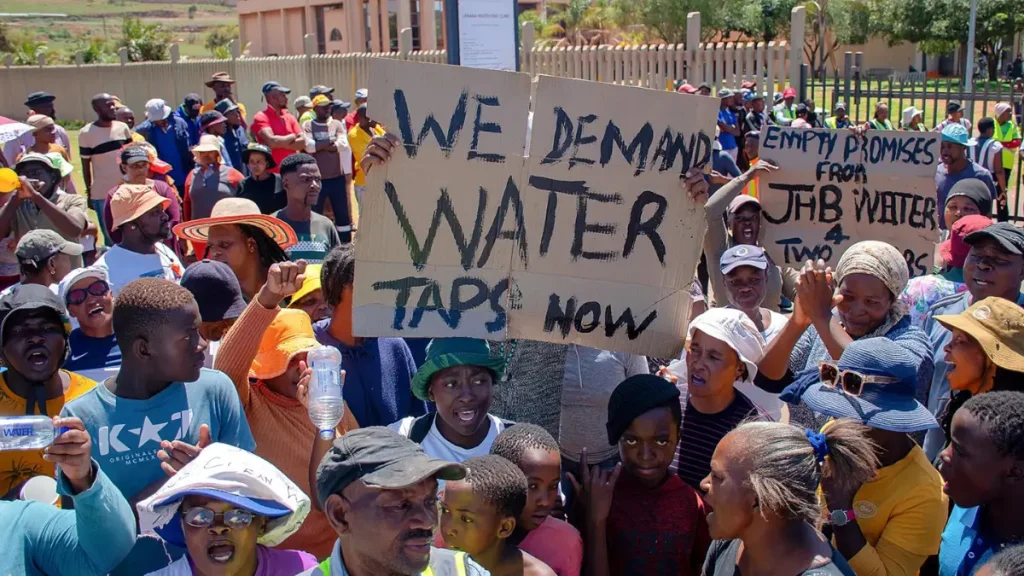
While acknowledging that vandalism of infrastructure was real, WaterCAN said some incidents reflected desperation among residents who lacked reliable access to water.
“If people are breaking into infrastructure because they have no reliable water supply, the response cannot simply be policing. The city must also address the underlying failure to provide basic services.”
The organisation warned that climate change would intensify the crisis if underlying governance failures remained unresolved.
“The cost of inaction will not be measured only in money, but in public health, inequality and social instability.”
WaterCAN urged the commission not to produce “another report that disappears”, but instead to issue enforceable directives with firm timelines, monitored actions and public accountability.
“The constitutional right to water cannot survive on press statements and task teams,” the submission stated.
The organisation called for municipalities to provide audited records of water and sanitation spending over the past decade, for water revenues to be ringfenced, for greater procurement transparency and for long-term infrastructure plans to reduce dependence on tankers and emergency interventions.
“It is about money, governance, rights and accountability,” WaterCAN concluded.
“Because for residents, this is not an abstract governance problem. It is a daily struggle for dignity, health, safety and survival. And it cannot continue.”