

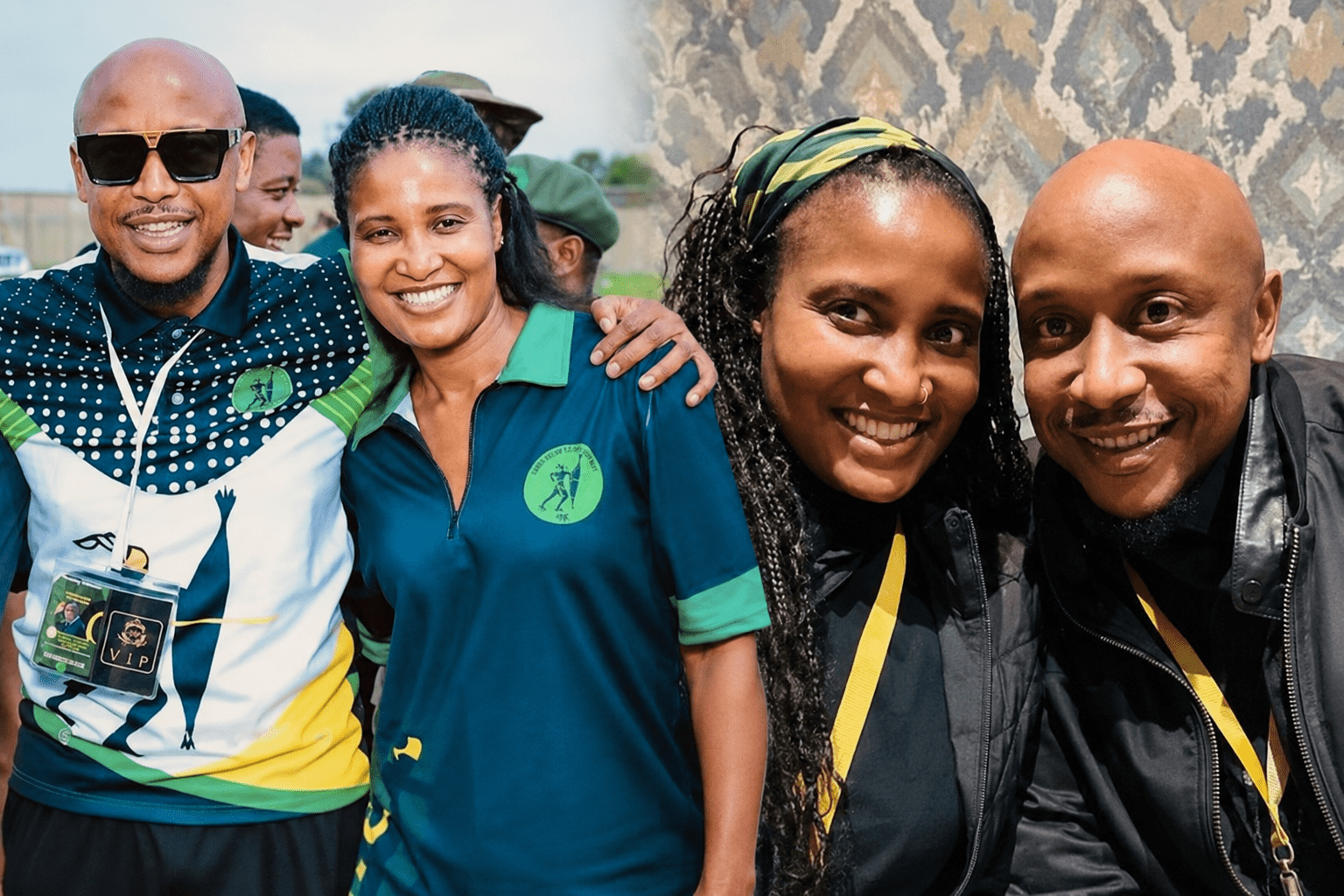
In a political party shaped by loyalty tests, sudden shifts, and the relentless threat of internal purges, safety is an illusion…even for the most trusted allies. In the MKP, survival demands constant vigilance, as those closest today can swiftly and mercilessly become tomorrow’s casualties in the party’s ongoing struggle for power.
By Themba Khumalo
Every time uMkhonto weSizwe Party (MKP) calls a press conference, one cannot help but get the distinct, macabre sense that the primary purpose of the gathering is not to articulate policy or outline governance.
Instead, it seems designed to display the freshly chopped heads of its latest internal casualties.
To suggest that the sudden, ruthless excommunication of Duduzile Zuma-Sambudla and former national spokesperson Nhlamulo Ndhlela is an unexpected institutional turn is to misread the entire lifecycle of this movement.
This is not a sudden evolution; the MKP did not recently discover the art of the political purge—it was born with it. From its inception, the party has operated as a volatile fiefdom where internal bloodletting is the default mechanism of risk management, routinely consuming its own creators the moment their immediate tactical utility expires.
To witness the purging of his own kin is a spectacular demonstration of the ancient adage that Saturn devours his own children.
Long before the name belonged to a ringed planet, Saturn was the Roman Titan of time and absolute rule, driven mad by a prophecy that one of his bloodline would strip him of his crown. His solution to risk management was total and immediate: he swallowed each of his children whole the moment they were born, cannibalising his own offspring to ensure that the throne remained permanently and securely his.
Over the centuries, this dark myth has hardened into political shorthand for the precise moment a party or a paranoid patriarch turns inward, extinguishing its closest allies and co-founders out of sheer, blinding instinct for self-preservation.
Thursday’s media briefing, delivered with cold bureaucratic precision by the MKP Secretary-General Sibonelo Nomvalo, merely followed this established script.
The expulsions were framed around allegations of misconduct, factional narratives, and behaviour that allegedly undermined organisational unity.
The party leadership cited unauthorised public commentary surrounding passing of Member of Parliament Muzi Ntshingila, during which both individuals transferred the ailing politician to another health facility without family or party consent, directly going against leadership structures.
To the casual observer, this may appear to be an isolated disciplinary matter. In reality, it reflects the volatile nature of a political party anchored not by institutionalised systems, but by the enigmatic will of a single patriarch.
Crucially, this pattern of public execution is the defining characteristic of the MKP’s operational style. The party’s history is already littered with the political carcasses of those who have been summarily axed or driven to a strategic exit.
One needs only to look back to the high-profile purging of Jabulani Khumalo—the very man who initially registered the party—alongside four other foundational leaders. This was swiftly followed by the wholesale dismissal of 18 Members of Parliament, a brutal clearing of the benches that was allegedly meant to pave the way for political defections from the EFF.
Nowhere is this administrative instability more starkly illustrated than in the office of the Secretary-General, which has resembled a corporate firing squad. Nomvalo is the eighth person to occupy this precarious position since the party was founded in late 2023.
The trail of fallen administrators before him paints a dizzying picture of brief, volatile tenures. Sihle Ngubane, the initial acting administrator, resigned within the opening months amidst early organisational shifts. He was followed by Arthur Zwane, who was promoted from deputy, only to be summarily fired by Jacob Zuma after a short stint, lasting a few weeks.
Dr Sifiso Maseko lasted a mere four to five months before resigning to return to his post at the Gauteng Department of Health. The subsequent administrative tenures, including the structural transitions involving Floyd Shivambu and the brief seven-month stint of Bongani Mncwango before his sudden dismissal, illustrate a deeper institutional volatility.
The instability has reverberated with equal force through the parliamentary structures, particularly concerning the deployment of the Chief Whip. The political fate of Colleen Makhubele clarifies a crucial distinction; she was not technically expelled from the party, but rather stripped of her powerful leadership role as Chief Whip during an abrupt executive restructuring.
Finding herself sidelined by the leadership core, Makhubele chose to control her departure, formally resigning as a Member of Parliament and quitting the MKP entirely.
Her successor, Mmabatho Nthabiseng Mokoena-Zondi, met an even more ignominious fate, facing a high-profile arrest over severe allegations of salary-splitting extortion involving parliamentary staff.
Furthermore, high-profile figures have chosen to jump before they were pushed. The iconic Tsonga musician Gezane Eric Kobane, popularly known as Papa Penny, abruptly resigned from both the party and his parliamentary seat, citing bitter internal conflicts. He claimed he was repeatedly undermined by hostile provincial structures in Limpopo.
Former PRASA head Lucky Montana similarly cut ties with the parliamentary caucus, adding his name to a growing chronicle of departures.
To the party’s detractors, this is another clear demonstration that the party is too unstable to be trusted with running the government. They will argue that an entity incapable of maintaining internal cohesion among its founding inner circle, and which treats its parliamentary list like a transient waiting room, cannot possibly be trusted with the intricate responsibilities of state governance.
It projects an image of a party governed by caprice rather than constitutionality, where yesterday’s heroes are seamlessly transformed into today’s pariahs.
To the MKP supporters, on the other hand, this will be more evidence of Zuma’s unparalleled brilliance. For them, every confusing tactical pivot is evidence of his masterly strategising. They will interpret this as a calculated masterstroke designed to dismantle the growing perception that the party is merely a private family enterprise or a political vehicle for the Zuma lineage.
By allowing the expulsion of his own kin, the former president seeks to project the image of an uncompromising disciplinarian who places the collective movement above familial sentimentality.
All that said, the ultimate architecture of the MKP remains entirely centred on its leader. The rest of the leadership collective is left to navigate a treacherous landscape.
Every official now smiles with visible trepidation, fully aware that in a court ruled by absolute authority, closeness to the throne offers no protection from the sudden strike of the axe.