

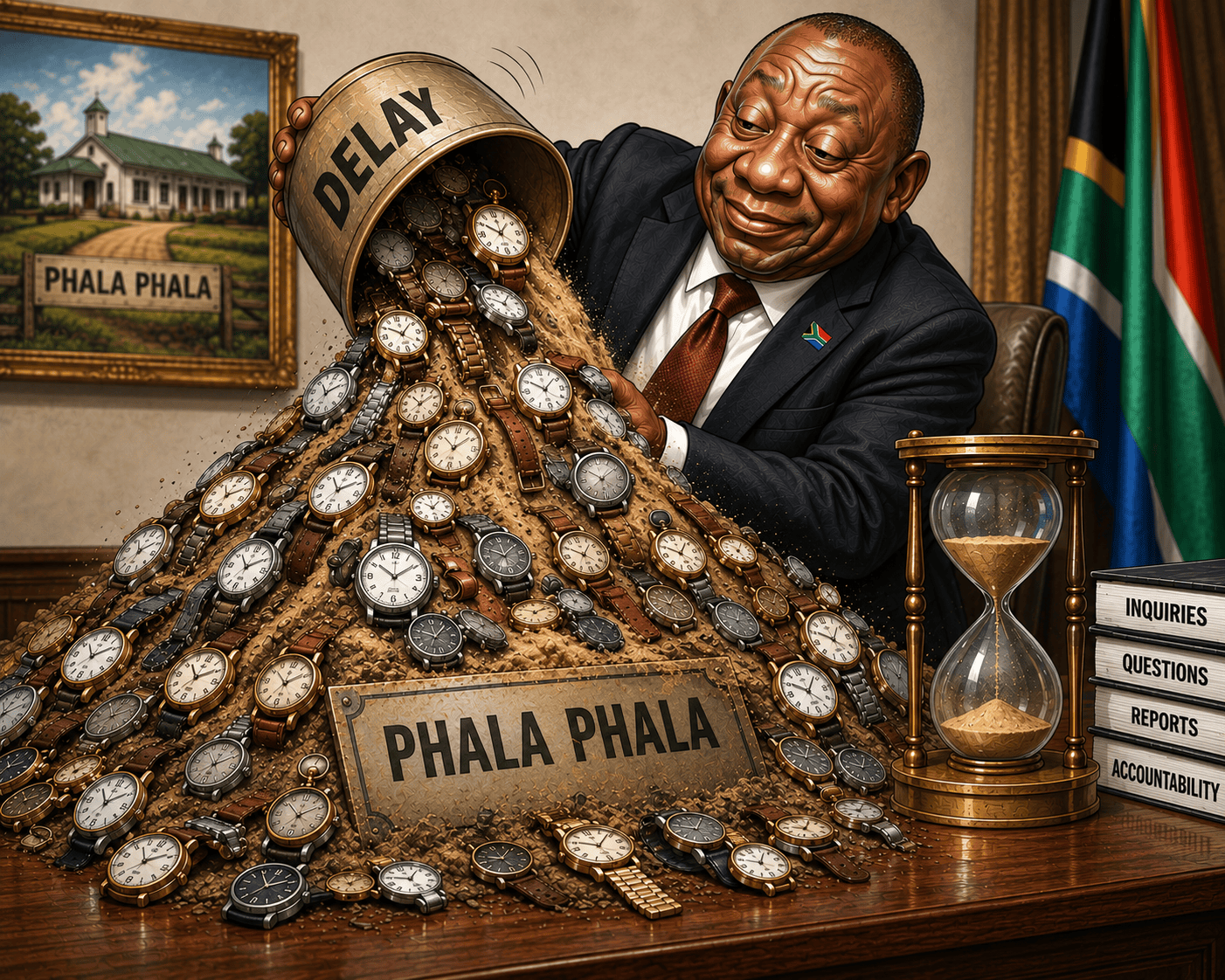
The man who asked time to come back when he has time has perfected a remarkable political craft: surviving political storms by politely asking them to return at a more convenient moment. In the theatre of constitutional drama, the President remains the leading performer in the long-running production titled: Please Hold.
By Themba Khumalo
There is a distinct, understated art to the Cyril Ramaphosa method of government.
Some politicians seize the day. President Ramaphosa, on the other hand, politely asks whether the day would mind coming back next Thursday.
In his administration, patience has not just been a virtue; it has become an operating system. If postponement were a renewable resource, the President would have solved the energy crisis years ago.
The Western Cape High Court’s latest majority ruling could hardly have arrived wrapped in prettier ribbon.
Having spent months staring down the barrel of a parliamentary impeachment inquiry, President Ramaphosa has secured an interim interdict that grants him what appears to be his favourite constitutional principle: just a little more time.
The Section 89 Committee must put away its awkward questions, lower its collective voice and wait patiently until the legal status of the original panel report has been properly tested.
For a President whose political philosophy sometimes appears to be “never answer today what can be litigated until tomorrow,” it is difficult to imagine a kinder judicial gift.
The majority reasoned that allowing Parliament’s inquiry to proceed before the legality of the panel report is settled would risk irreversible reputational harm. Once the public watched a sitting President answering difficult questions, the genie would be out of the bottle.
Quite right.
One cannot simply allow the genie — a curious creature smelling faintly of buffalo, foreign currency and expensive upholstery — to wander freely through the corridors of public scrutiny. It might start answering questions no one intended it to answer.
The court’s reasoning is an elegant piece of legal craftsmanship. If a later judicial review concludes that the original panel report was procedurally defective, then the public spectacle of an impeachment inquiry would have caused harm that could not simply be undone.
The toothpaste could not be squeezed back into the tube. Public humiliation, once televised, is remarkably difficult to unbroadcast.
One cannot help admiring such touching concern for presidential comfort.
The Constitution, painstakingly forged through decades of struggle, apparently contains an unwritten appendix devoted to protecting the emotional wellbeing of whoever happens to occupy the Union Buildings. One imagines future constitutional scholars discovering Chapter 14½: The Right Not to Feel Awkward Before the Cameras.
Meanwhile, Judge Francis, in dissent, committed the rather unfashionable act of focusing on Parliament’s own procedures. He observed that the Section 89 process already contains multiple safeguards, numerous opportunities for representation, and ample procedural fairness.
In other words, embarrassment is not the same thing as injustice. It was an awkward observation to make in a judgment so carefully upholstered.
Still, one should not underestimate President Ramaphosa’s greatest political talent. It has never been urgency. It has certainly never been haste. His real gift is making time itself appear negotiable.
Scandals arrive breathing fire, commissions publish findings, opposition parties demand answers, and somehow the calendar quietly wanders off to fetch another month.
There is something almost admirable about it. Most politicians dodge accountability. Ramaphosa prefers a gentler approach. He invites accountability into the waiting room, offers it a cup of tea, apologises for the delay and assures it someone will be with it shortly.
Hours become weeks. Weeks become months. Before long, accountability begins wondering whether it made the appointment on the wrong day.
And so South Africa finds itself in another exquisitely familiar constitutional tableau. Parliament waits. The courts deliberate. Lawyers invoice. The opposition fumes. The President acquires yet another modest extension in a political career built, brick by carefully measured brick, upon the proposition that tomorrow is almost always preferable to today.
Perhaps that is the real genius of modern governance. Why confront a crisis when one can simply reschedule it? Why wrestle with political consequences when the calendar remains such a loyal ally?
September will arrive soon enough. Until then, the legal files will grow thicker, the billable hours will accumulate with admirable efficiency, and the rest of us can only raise a very neat dram to the extraordinary discovery that, in South Africa, even time occasionally appears willing to apply for an extension.