

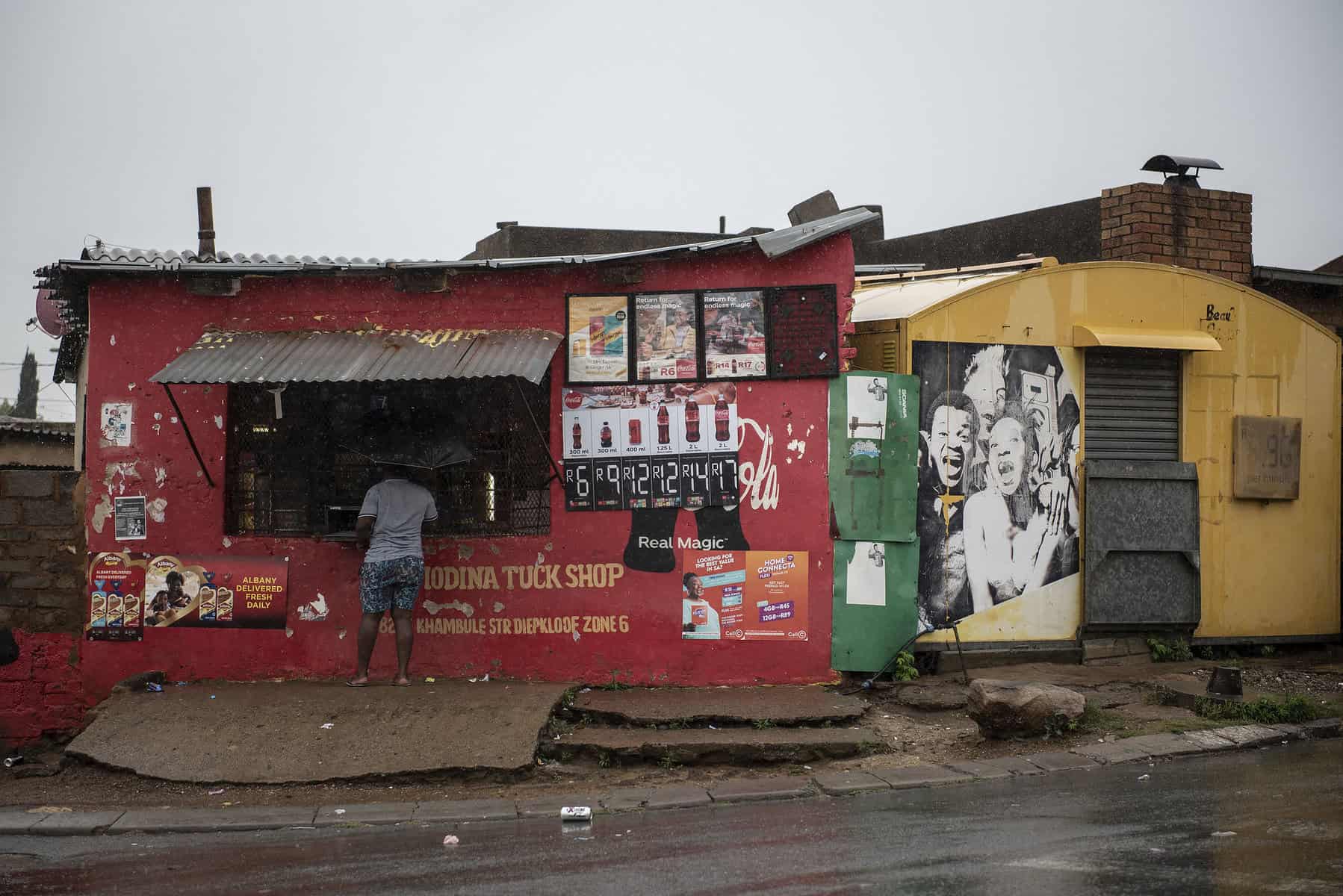
The spaza shop is a symbol of resilience, entrepreneurship, and survival. But elevating it into the centrepiece of economic transformation risks confusing relief with reform. A nation cannot manufacture prosperity through consumption alone. Without production, ownership, and industrial capacity, economic empowerment remains trapped at the bottom of a value chain controlled elsewhere.
By Themba Khumalo
There is a peculiar and deeply troubling habit developing within the economic imagination of the state: the tendency to confuse the management of poverty with the creation of prosperity.
In its desperate search for politically convenient answers to South Africa’s unemployment catastrophe, the state has elevated the humble township spaza shop from what it has always been — a grassroots survival mechanism born from economic exclusion — into something far grander: a supposed engine of structural economic transformation.
It is a seductive idea because it requires little imagination and even less courage. It allows policymakers to announce intervention, distribute funding, launch empowerment programmes, and produce glossy presentations about township revitalisation without confronting the far more uncomfortable question: why, after three decades of democracy, have millions of South Africans remained trapped on the margins of productive economic activity?
Nearly a year and a half ago, this philosophy found concrete expression in the state’s R500 million Spaza Shop Support Fund — an intervention presented through the polished vocabulary of “sustainable enterprise” and framed as another milestone in the long journey towards economic redress.
Yet beneath the carefully crafted language of empowerment lies a more uncomfortable question: does this intervention genuinely create a pathway out of dependency, or does it merely make survival at the bottom of the economic pyramid slightly more manageable?
The state has become increasingly skilled at presenting relief as revolution. Announcements are packaged as transformation. Funding allocations are presented as structural reform. Administrative activity is dressed in the language of economic liberation.
But the spaza shop is not the problem. It is a symptom.
It is the economic equivalent of a painkiller administered to a patient whose underlying disease has never been diagnosed. It provides relief. It serves communities. It creates livelihoods. It keeps households afloat. But it does not cure the deeper illness of industrial decline, weak productive capacity, inadequate skills formation, and the absence of meaningful economic inclusion.
To present informal retail as the great escape route from structural unemployment is not merely an economic miscalculation. It is a surrender of ambition. It represents a state that has quietly lowered the horizon of possibility — replacing the dream of building industries, factories, technologies, and globally competitive enterprises with the far smaller ambition of helping citizens survive at the bottom of a value chain designed elsewhere.
The fundamental economic architecture of this policy illusion is difficult to ignore.
A spaza shop occupies the final link in a vast commercial chain. It is a distribution point, not a production centre. Its owner operates at the sharp end of an economy largely designed and controlled by larger manufacturers, wholesalers, logistics companies, and multinational fast-moving consumer goods corporations.
The spaza trader sells bread, beverages, household goods, toiletries, and packaged food. But the value embedded in those products was created somewhere else — in factories, laboratories, farms, processing plants, and corporate supply chains far removed from the township street corner.
That distinction matters.
An economy cannot consume its way into prosperity. Nations do not become wealthy because they have more retailers. They become wealthy because they produce, innovate, manufacture, and export more.
When the state allocates hundreds of millions of rand towards stock support, inventory vouchers, and digital payment systems for informal retailers, it must ask a difficult question: is it building productive capacity, or merely improving the efficiency of consumption?
Because without local production, the economic leakage remains unchanged.
Money enters the township through wages, grants, or small-business activity. It passes through the spaza till and then rapidly exits again through corporate supply chains to distant manufacturers, wholesalers, and financial institutions.
The township becomes a marketplace, but not an economic ecosystem. It becomes a place where money circulates briefly before leaving, rather than a place where wealth is created and retained.
This is the uncomfortable contradiction at the heart of the current approach: a programme presented as township economic empowerment risks becoming a subsidy mechanism for the very corporate supply chains that already dominate the economy.
True transformation cannot happen by merely placing more people at the end of the economic queue. It requires moving communities closer to the beginning of the value chain.
And this is where the state must return to the drawing board.
The central question should not be: how do we help more people sell products manufactured elsewhere?
The question should be: how do we enable communities to manufacture the products they consume?
Where are the township-based industrial development zones designed around local ownership and production? Where are the state-supported mini-industrial hubs that allow entrepreneurs to move beyond trading into manufacturing?
Instead of financing thousands of traders to resell corporate-produced bread, maize meal, soft drinks, and household goods, why is the state not aggressively developing local production capacity?
Imagine township-based commercial bakeries supplying local retailers. Grain-processing facilities creating local food-security industries. Dairy processing plants serving regional markets. Packaging factories creating jobs while supplying local manufacturers. Furniture workshops, textile producers, chemical formulation enterprises, repair and engineering hubs, and logistics centres anchored within communities that have historically been excluded from industrial development.
That is how economic multipliers are created.
A factory does not only employ the person operating a machine. It creates demand for transport operators, maintenance technicians, accountants, suppliers, security services, engineers, designers, and countless secondary businesses. It builds skills. It creates assets. It develops ownership. It leaves behind something tangible.
A till does not.
This is not an argument against spaza shops. Quite the opposite. They remain vital institutions within township economies. They are often the first point of access for communities, particularly where formal retail has failed to reach. They demonstrate entrepreneurial resilience in environments where opportunity is scarce.
But survival should never be mistaken for transformation.
The danger is that the state begins celebrating the coping mechanisms of the poor instead of dismantling the conditions that make those coping mechanisms necessary.
For decades, apartheid deliberately engineered townships as reservoirs of labour and consumption — places designed to sustain dependency while production and economic decision-making power remained elsewhere.
A truly transformative economic policy should be designed to reverse that architecture.
The goal should not be a better-managed poverty economy.
The goal should be a productive township economy.
South Africa does not need a nation of better-funded traders standing at the edge of an economic highway built by others. It needs communities that own parts of the highway itself.
Until the state summons the courage to think beyond retail, beyond grants, and beyond short-term political optics, township economic liberation will remain trapped in the language of empowerment while the reality remains one of dependency.
The spaza shop has a place in townships and rural areas. But it should be the front door of a productive economy — not the final destination of a failed one.