
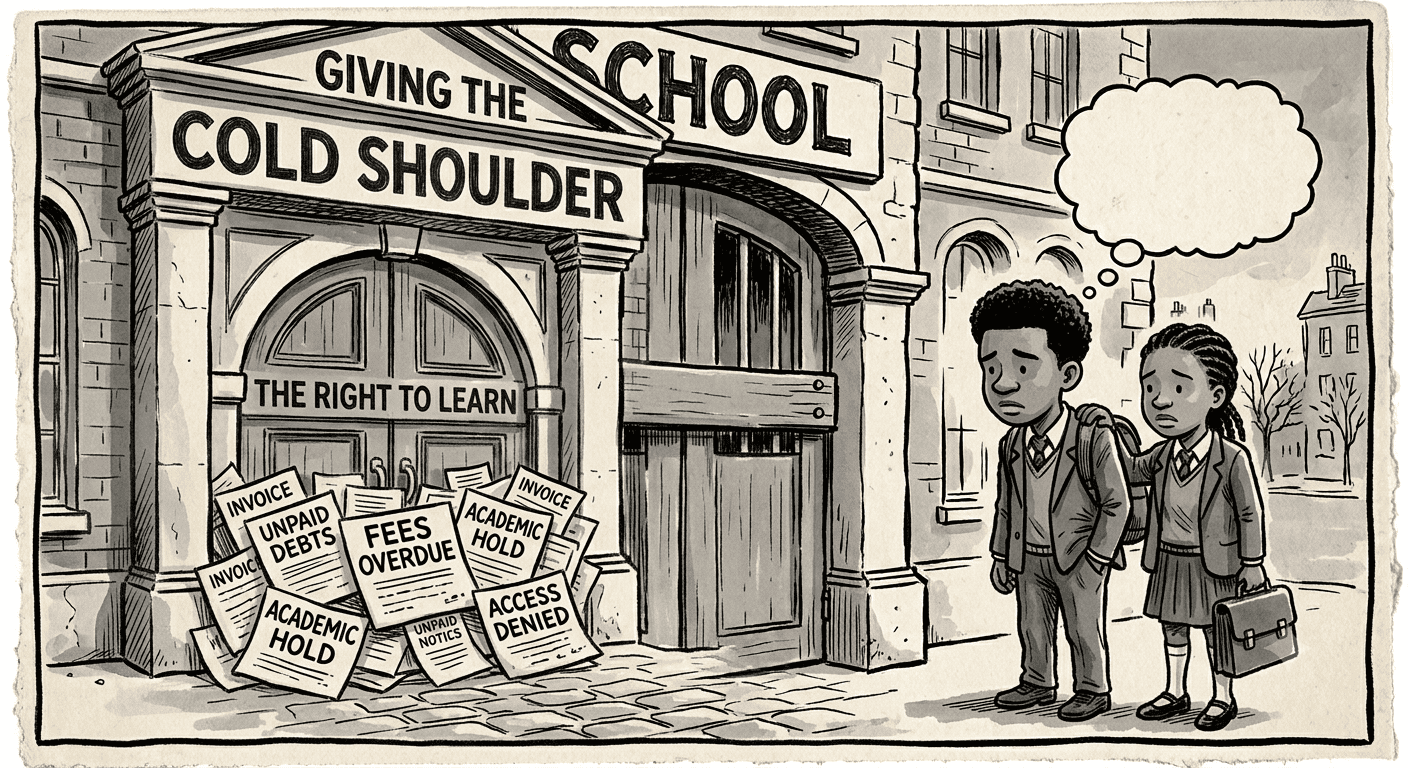
When a school treats a child’s education as leverage in a fee dispute, the issue extends far beyond one courtroom battle. It raises uncomfortable questions about the commercialisation of education, the collapse of public schooling, and the constitutional promise that no child’s future should carry a price tag.
By Themba Khumalo
Twelve years is a long time to ask a child to believe in the promise of education.
It is twelve years of alarm clocks before dawn, shoes polished the night before, forgotten lunchboxes, parents sitting under dim kitchen lights helping with homework they barely understand, teachers who become mentors, and the quiet conviction that if you work hard enough, one examination at the end of it all might open a door that poverty has spent generations trying to keep shut.
For two matric learners in Johannesburg, that promise now hangs not on their ability, nor on their willingness to learn, but on an unpaid account bearing their parents’ names.
That is the human story unfolding behind the legal papers now before the Gauteng Division of the High Court in Johannesburg.
It is easy to become distracted by notices of motion, affidavits and legal arguments. Yet this case is not fundamentally about legal procedure. It is about two young people whose final year of school has become entangled in a dispute over money.
According to SECTION27, which represents the parent, the High Court ordered Future Nation Schools, part of the Sifiso Learning Group, on 9 June to re-enrol the learners after they had been excluded because of outstanding school fees.
The court also ordered the school to instruct the Independent Examinations Board (IEB) to register them for their final matric examinations. SECTION27 states that the parent paid the IEB registration fees within 48 hours.
It now alleges that, although the learners have been allowed to return to class, they have not been fully reintegrated into school life and, crucially, have still not been registered for the examinations that will determine whether they receive their National Senior Certificate.
The school disputes these allegations. It has filed a Notice of Leave to Appeal, arguing that the court order is suspended pending the outcome of that process. It has also argued that the learners have other options available to them, including writing their matric examinations privately.
The courts will determine the legal questions. They cannot answer the moral ones. Those belong to the rest of us.
South Africa’s Constitution does not describe education as a privilege that survives only while parents are able to meet their financial obligations. Section 29(1)(a) guarantees everyone the right to a basic education.
Unlike many other socio-economic rights, the right to a basic education is immediately realisable. It is not a promise that depends upon available resources, nor one that can simply be postponed because a contractual dispute has arisen.
Our courts have consistently recognised the importance of that right. In Governing Body of the Juma Musjid Primary School v Essay N.O. and Others, the Constitutional Court held that the right to a basic education occupies a special place in our constitutional order.
The Court also reaffirmed another constitutional principle that is directly relevant here: Section 28(2), which provides that a child’s best interests are of paramount importance in every matter concerning that child.
These principles do not disappear because education is provided by an independent institution rather than the State. Independent schools therefore enjoy significant freedom, but they also assume significant constitutional responsibilities.
Private schools are entitled to recover fees that are lawfully owed to them. No sane or serious person disputes that. Teachers deserve salaries. Schools must maintain buildings, laboratories, libraries and sports facilities. Financial sustainability is not optional.
A school is not an ordinary business because education is not an ordinary product. A supermarket can refuse to sell groceries to someone who has not paid. A bank can repossess a vehicle. An airline can cancel a ticket. These are commercial transactions governed almost entirely by contract.
A school occupies a different moral and constitutional space because it is entrusted with giving effect to a fundamental right. Independent schools may be privately owned, but they do not operate in a constitutional vacuum. They educate children, not merely customers, and in doing so they shoulder responsibilities that extend beyond the balance sheet.
That is why the Constitution cannot simply yield whenever commercial interests collide with a learner’s right to basic education.
For that reason, this case reaches beyond a disagreement over unpaid fees. It raises an uncomfortable question about the relationship between contractual rights and constitutional rights.
A parent may owe money. A school may be entitled to recover it. Yet the debt belongs to the parent, while the consequences fall upon the child.
That distinction should trouble every South African.
The law provides schools with recognised mechanisms for recovering unpaid debt. Payment arrangements may be negotiated. Civil proceedings may be instituted. Judgments may be enforced.
None of these remedies requires a child’s education to become the point of pressure in a financial dispute between adults.
Yet this dispute suggests that the line between debt recovery and the right to education has become dangerously blurred.
The school’s conduct may have brought this dispute before the courts, but the roots of the problem run much deeper.
South Africans have not embraced private schooling because they are wealthy. They do so because they no longer trust the State to educate their children.
The collapse of many public schools has created a captive market in which education has become both aspiration and commodity.
Parents who enrol their children in independent schools are often making extraordinary sacrifices. They reduce household spending, postpone retirement, take on debt and abandon personal ambitions because they believe education remains the surest path out of poverty and insecurity.
They are not purchasing prestige as much as they are attempting to purchase certainty in a country where the quality of public education varies dramatically depending on geography and circumstance.
The steady expansion of the private education sector has been fuelled not simply by entrepreneurial ambition but by public failure.
Every overcrowded classroom, every neglected school building, every teaching vacancy left unfilled, every school without textbooks at the beginning of the year, and every administrative collapse pushes another family towards private education.
The market grows because confidence in the State continues to diminish.
To be fair, that market has also produced many excellent schools. It has also produced large education groups that increasingly speak the language of expansion, acquisitions, market share and growth.
There is nothing inherently wrong with operating a financially successful school. The danger arises when the commercial logic that governs a business begins to overshadow the educational purpose that justifies its existence.
Education is unlike almost every other service that money can buy.
The difference lies in what is lost.
A missed flight can be rebooked. A postponed holiday can be taken next year. A delayed vehicle delivery is an inconvenience.
A disrupted matric year is something else entirely.
For many South African learners, matric is the single most important educational milestone of their lives. It determines access to universities, colleges, apprenticeships and employment, shaping opportunities that may never present themselves again.
Every month lost during a matric year carries consequences that cannot easily be undone.
That is why this case resonates so widely. It forces us to ask whether education has gradually ceased to be understood primarily as a constitutional right and has instead become another commercial service, available only for as long as monthly payments continue to arrive.
There is an irony that should not escape us.
Independent schools exist partly because confidence in public education has weakened. Parents pay substantial fees because they believe they are purchasing stability, quality and opportunity. Yet when disputes over fees escalate to the point where learners find themselves at the centre of urgent court applications, the distinction between education and commerce begins to blur in deeply troubling ways.
Children do not sign school contracts.
Children do not negotiate payment terms.
Children do not decide whether household finances can withstand another school fee increase.
Yet they are often the first to experience the consequences when those arrangements collapse.
That is why the Constitution places such emphasis on their interests. It recognises that children occupy a uniquely vulnerable position. They should not become instruments through which adults seek to enforce financial obligations against one another.
The High Court will decide whether its earlier order has been complied with and whether contempt has been established. That is a matter of law.
The larger question, however, is one of national conscience.
What kind of country are we becoming if the promise made to a child on the first day of Grade 1 can be overshadowed, twelve years later, by an unpaid account?
If education is truly the bridge out of poverty, then that bridge cannot be lowered or raised according to the state of a parent’s bank balance. The Constitution does not permit it. More importantly, our collective sense of justice should not tolerate it.
A child is not an invoice. A matric certificate is not collateral. And no balance sheet, however important to a school’s survival, should ever outweigh a young person’s constitutional right to learn.