

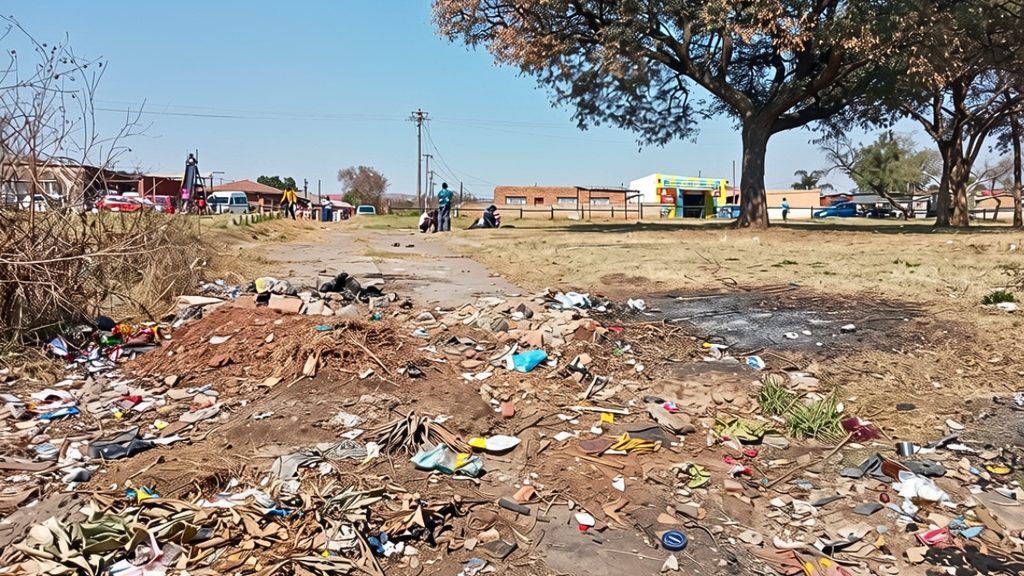
A municipal park should offer children safety, exercise, and community. In Saulsville, it offers sewage, rubbish, vandalised equipment, and a brutal lesson in what institutional neglect looks like.
By Themba Khumalo
As I was reading Chris Gilili’s report for Health-e News about children playing in Forest Park in Saulsville, west of Pretoria, I found myself becoming increasingly angry, and then deeply disgusted, because there is something profoundly wrong with a city that can allow a public space intended for children to deteriorate into a place where sewage flows through the grounds and rubbish is dumped among the very children who are supposed to be playing there.
It is difficult to read about such conditions without asking what has happened to the most basic sense of responsibility in local government, particularly when the people living around the park have apparently been complaining about its deterioration for years.
READ MORE: Children Play Among Sewage and Rubbish as Public Parks Deteriorate
The children still use the park, and that is perhaps the most painful part of the story. They are not using it because their parents have decided that playing beside sewage, rubbish, and discarded medical waste is perfectly acceptable. They are using it because children need somewhere to play and, according to residents, Forest Park is the only recreational space available in that part of Saulsville.
When there is nowhere else to go, a child does not have the luxury of making a sophisticated assessment of municipal failure. The child sees an open space and wants to play. It is the adults who have failed to make that space safe.
That failure should make the City of Tshwane deeply ashamed.
Instead, the City has produced the sort of response that has become depressingly familiar in South African municipal life. The City has become so accustomed to its own failures that it has developed a vocabulary to disguise them. It calls them service-delivery challenges. It talks about capacity constraints. It produces maintenance schedules, holds meetings and sends carefully worded responses to journalists, while the sewage keeps flowing and children keep playing beside it.
According to Gilili’s reporting, the City’s Lindela Mashigo disputed claims that Forest Park had not been maintained. Mashigo said the park, formerly known as Rotary Forest Park, was maintained during the week ending 20 July 2026 as part of the City’s rotational maintenance schedule, with litter collection, grass cutting, waste removal and painting of playground equipment and boundary railings among the work carried out.
Yet when Health-e News visited the park in August, sewage was still flowing through it, rubbish remained visible, and the infrastructure was deteriorating. When asked specifically about the sewage, Mashigo did not respond. That is difficult to reconcile with the City’s claim of maintenance because grass cutting and painting playground equipment do not address sewage flowing through a public space used by children.
The sewage is not a peripheral detail in this story; it is the central public health concern.
Residents understood the problem long before the City’s latest explanation. Jerry Pule told Gilili that residents had repeatedly asked their councillor to fence the park while it was still in decent condition, but their pleas fell on deaf ears. The consequences are now visible, with vandals stripping equipment and illegal dumping becoming part of the landscape.
This is what makes municipal neglect so infuriating. It is rarely some unforeseeable disaster that arrives without warning. Residents see a problem developing, raise the alarm and ask for something as basic as a fence. When nothing happens, the facility becomes vulnerable to vandalism and dumping, infrastructure disappears, and the problem becomes progressively more expensive to fix. Eventually, when the damage is impossible to ignore, the language of “challenges” arrives to soften what is plainly institutional failure.
Forest Park was once a popular recreational space. Brian Mabasa, who has lived in Saulsville all his life, told Gilili that families travelled from as far as Mamelodi to spend time there. He says the deterioration became apparent from 2016 and has continued ever since.
Residents have since taken to cleaning the park themselves, particularly during school holidays, because they want their children to have somewhere to play.
That should not be mistaken for a triumph of community empowerment. It is a community compensating for an institution that is supposed to provide the service itself. Mabasa says discarded medication and syringes are among the waste found in the park, while Pule describes nappies, spoiled food, dead dogs, and used condoms. Yet more than 100 children and adults reportedly continue to use the space each week because there is no meaningful alternative.
The cruelty of the situation lies precisely there. Parents cannot build another park. They cannot create safe open space where none exists. They cannot tell their children to stay indoors indefinitely because the municipality has failed to maintain the one recreational facility available to them. They have to make do with what they have, however unacceptable those conditions may be.
The City’s response also raises questions about accountability. It did not provide the amount spent specifically on Forest Park, explaining that expenditure on parks, open spaces, cemeteries, sports facilities and other public facilities is reported at regional level. That may be how the municipality organises its accounts, but it does not answer the question residents are asking: why has their park been allowed to reach this condition, and what is being done to restore it?
Nor can everything be dismissed as a question of money. Municipalities face budgetary pressures, but budgets also reveal priorities. When basic public infrastructure deteriorates in communities where residents have few alternatives, those priorities deserve scrutiny. The University of Pretoria research cited by Gilili reinforces the importance of green spaces for children’s physical activity and environmental health, particularly in communities where safe alternatives are scarce.
A child does not become less deserving of a clean, safe place to play because the child lives in a poorer neighbourhood. If anything, the lack of private gardens, sports facilities and other recreational options makes properly maintained public spaces more important.
And Forest Park is not alone. Gilili reports that Health-e News found similar conditions at other parks in Pretoria. At a public park near the Atteridgeville Library in Tsunami, there are only a few cement picnic benches and no playground equipment.
Tshepang Motaung, who has lived in the Tsunami informal settlement for ten years, says he has never seen equipment there for children or young people. The park has become a place where people drink alcohol and young people smoke nyaope, while the absence of fencing and lighting contributes to insecurity and residents report muggings.
Taken together, these examples point to more than a few neglected patches of municipal land. They reveal what happens when public spaces are allowed to deteriorate in communities that depend on them. A park is not an ornamental extra that can be maintained when the municipality has spare capacity. It is part of the social infrastructure of a neighbourhood, particularly for children whose families cannot simply find private alternatives when public facilities collapse.
The City of Tshwane therefore cannot hide behind the technical language of maintenance schedules while residents describe sewage, hazardous waste, vandalism and years of neglect. The residents had warned the municipality. They asked for a fence. They cleaned the park themselves. They continued bringing their children there because they had nowhere else to go.
By the City’s own account, officials have visited the park, yet the sewage remains.
Nobody is asking for a palace in Saulsville or an extravagant recreational complex that becomes another opportunity for a ribbon-cutting ceremony. Residents want a clean and safe park, functioning equipment, proper fencing, the removal of waste, and the sewage dealt with. These are basic municipal responsibilities, and the people asking for them should not have to plead indefinitely for what ought to be routine.
The most troubling part of Gilili’s reporting is therefore not simply that Forest Park is filthy. It is that the City appears to have had repeated opportunities to prevent this decline and still allowed the situation to reach the point where children are playing in an environment contaminated by sewage and hazardous waste.
That should embarrass Tshwane.
More importantly, it should move the City to act. Because residents can explain the problem perfectly well without a municipal vocabulary of “capacity constraints” and “rotational maintenance”. They know what they see when they enter the park. They know what their children are exposed to. They know what the park used to be, and they know what it has become.
The City should know it too.