

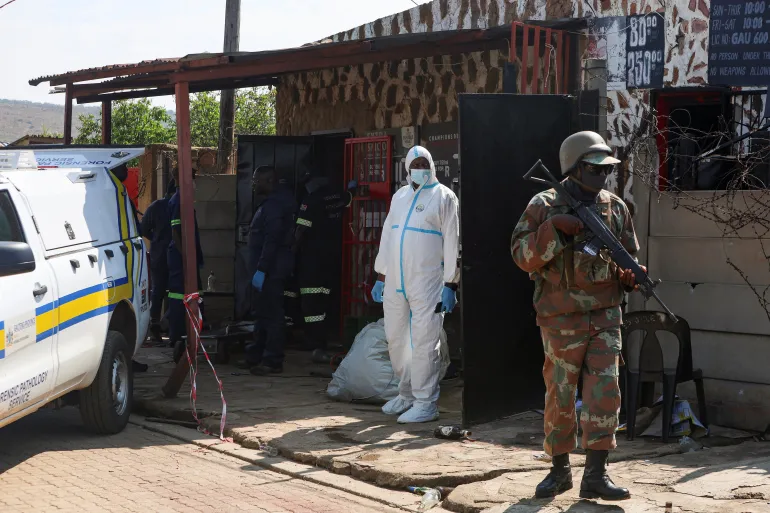
South Africa keeps counting the murdered while the guns keep cracking. Three mass shootings in a single week have left 38 people dead — and still the same grim cycle turns: outrage, condolences, promises, press conferences, then, right on schedule, another massacre and another round of funerals.
By Themba Khumalo
We are not at war. There is no invading army crossing our borders, no bombs falling from the sky.
And yet, in the space of one week, gunmen tore through three separate corners of this country — a mining town outside Johannesburg, a township outside Cape Town, and a township outside Durban — and left a trail of bodies that stretches from KwaZulu-Natal to Gauteng and the Western Cape.
This is not one isolated tragedy. It is a nationwide slaughter, coast to coast, and we are burying our people by the dozen — shot dead in taverns and at shisanyama joints, gunned down at house parties, where the biggest crime committed by the dead is wanting a bit of joy on a Saturday night.
Start with Wedela in Carletonville, a mining town roughly 70 kilometres west of Johannesburg, the kind of place some South Africans could not point to on a map until this past weekend. Eight men walked up to a tavern there on Saturday night armed with AK-47s and pistols, opened fire on the patrons standing outside, then walked in and kept shooting. Seventeen dead. Fifteen more wounded. They robbed the survivors and the corpses of their cellphones, torched two cars, and disappeared into the night.
Then there is Lwandle, a township in Cape Town, where, in the early hours of Sunday morning, gunmen walked into a shisanyama — a grilled-meat spot, the kind of ordinary, unremarkable venue found in every township in this country — and opened fire on the customers inside. Ten dead. Eleven wounded. No arrests yet.
And days before either of those, in Durban on the east coast, three gunmen opened fire at a house party and killed eleven people, among them a pregnant woman who will never hold the child she was carrying.
Three provinces. Three attacks. Thirty-eight dead, minimum, before you even count the wounded — and this in a country that already carries one of the highest murder rates in the world. This is not a bad weekend. This is a nation being hollowed out from three directions at once, and the fact that it takes a moment like this for most of us to even register that Wedela and Lwandle exist tells you everything about how normalised this violence has become, and how disposable the lives lost in it are treated.
And what did the men behind these massacres need to pull it off? Nothing exotic. Nothing hard to come by. AK-47s. Pistols. The same weapons you would expect on a battlefield, apparently as easy to rent, borrow or buy in this country as a loaf of bread and a box of matches. That is not just criminality. That is a country where the tools of mass murder are lying around like sweets on a shop counter, and everybody in charge of picking them up has somehow failed to do so.
Illegal mining turf wars. Alcohol sold on the side, undercutting a venue’s prices. Those are the “motives” being floated for why seventeen and ten people, respectively, had to die.
Read that again. People are being mowed down with military-grade weapons over gold seams and cheap booze. If that does not turn your stomach, check your pulse.
We have heard this script before, and we will hear it again unless something actually changes. The president goes on television and says the sentence he always says, in the tone he always uses: this cannot go on like this. He is right. It cannot. But saying so on the evening news while the blood is still being hosed off tavern floors is not a plan; it is a eulogy delivered in advance of the next massacre, because we all know there will be a next one.
Meanwhile, the very institution meant to stop this bleeding is itself bleeding out from the inside. While a judicial commission spends its days picking through allegations of corruption and criminal rot inside the police service, on the outside gunmen are working with an efficiency and confidence that our detectives can only dream of matching.
No arrests yet in Wedela. No arrests yet in Lwandle. Suspects who strolled in, executed people in two locations, and strolled out.
If the police can be out-organised this badly by street gangs and turf-war enforcers, what exactly are we paying for?
And this is not happening in isolation. It is landing on a country already staggering under the discovery of women’s bodies dumped in the East Rand, with case after case emerging since July. This horror has forced open, again, the conversation about how casually this country treats violence against women. Now bolt onto that a murder rate creeping towards 40 per 100,000 people, one of the worst on the planet, worse than almost anywhere outside the Caribbean. More than 22,700 people murdered in a single year.
These are not statistics. They are graves, funerals, children who will grow up fatherless or motherless, mothers who will now spend every Saturday night waiting by the phone.
So yes, this is grief. It has to be. You cannot read about a pregnant woman shot dead at a party and not feel something crack. But grief on its own is a luxury we can no longer afford, because grief does not stop the next shipment of illegal weapons finding its way into the wrong hands, and it does not put detectives with the will and the resources to actually catch anyone behind these massacres.
What this moment demands is fury, aimed at the right targets. Fury at a firearms black market so bloated that AK-47s apparently show up faster to a township turf war than police do to a crime scene. Fury at a police service so compromised, so hollowed out by its own internal rot, that eight armed men can execute seventeen people and disappear without a trace. And fury, too, aimed squarely at ourselves if we let this become just another week’s headline we scroll past before moving on to the next one.
We need policing that hunts illegal weapons the way it should be hunting them, relentlessly, not policing that turns up after the funeral to hold a press conference. We need consequences, real ones, for whoever is arming these men, not vague talk of “pulling out all the stops” that evaporates the moment the cameras are switched off. And we need a country that stops treating a murder rate like ours as background noise, as just the price of living here.
Because right now, in South Africa, it is cheaper and easier to get your hands on an assault rifle than it is to get real, visible justice for the people whom that rifle kills. Until that changes, we are not a nation in mourning. We are a nation on a waiting list for its next massacre.