

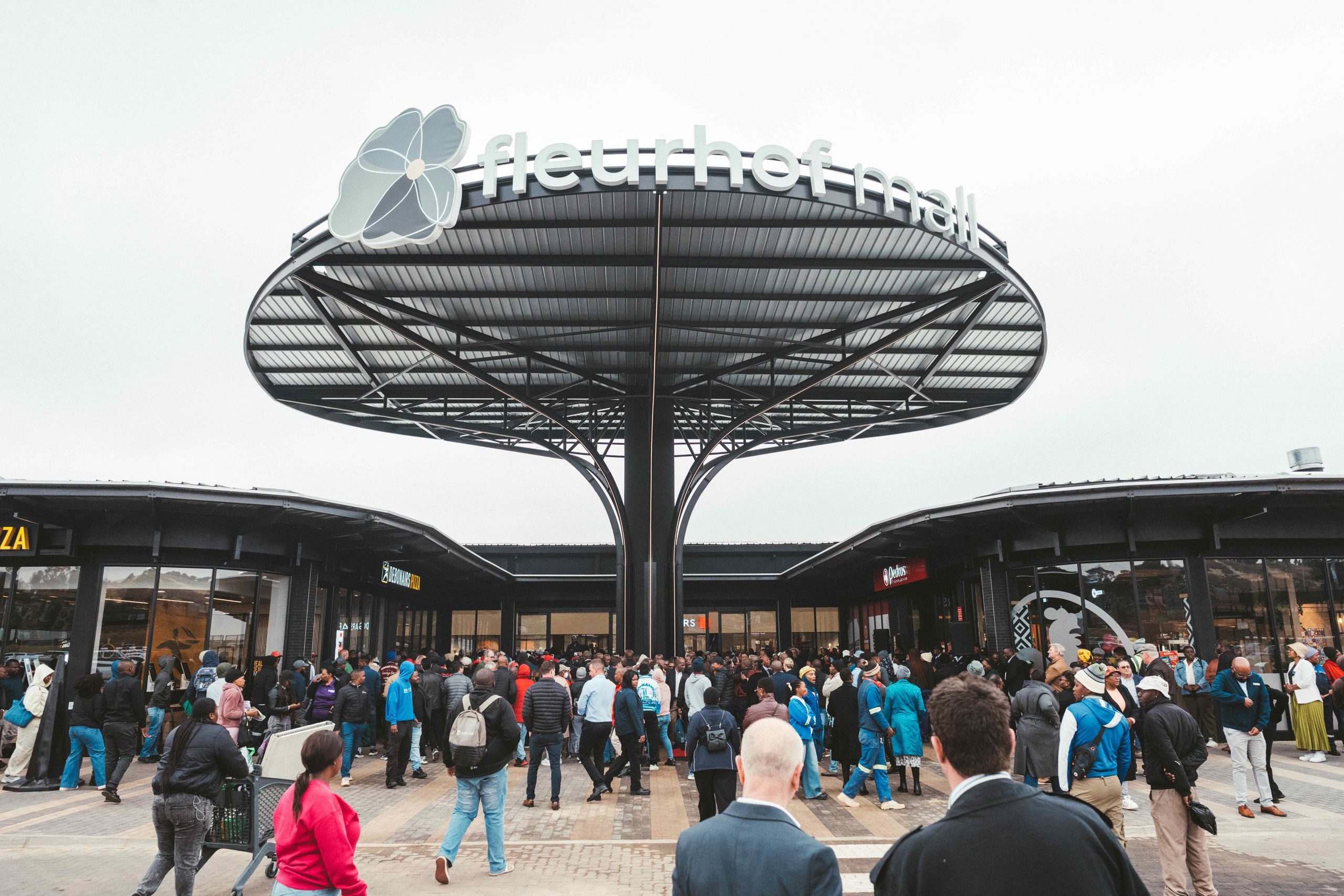
Every ribbon-cutting hides the same con. Malls don’t build township wealth; they drain it straight into Sandton and Stellenbosch balance sheets. Until we build factories instead of food courts, township upliftment remains a slogan, not an economy.
By Themba Khumalo
Drive through most townships and count the cranes. They are not building factories. They are building malls, glass-fronted, air-conditioned monuments to consumerism, dressed up in the language of “upliftment”, as if a big-brand retailer and a fried chicken franchise were ever going to rebuild a nation’s industrial spine.
I am tired of the ribbon-cutting photographs. Tired of beaming politicians standing next to a mall developer, calling it “economic inclusion” while the real economy, the one that makes things, ships things, and employs artisans and engineers, bleeds out in the background.
Somebody, somewhere, has to say plainly what this actually is: an extraction racket dressed in the bunting of township pride.
Here is the con, laid bare. These malls are not designed to keep money in the townships. They are designed to hoover it out. Every rand spent at the tills gets funnelled straight up into the accounts of listed property trusts and national retail chains headquartered in Sandton and Stellenbosch, then out again to shareholders who have never set foot in the community doing the spending.
It is not investment. It is a pipe with the tap running the wrong way.
Let us talk about the jobs, because that word gets thrown around like it settles the argument. A till operator’s job and a toolmaker’s job are not the same thing, and pretending otherwise is an insult to anyone who has ever tried to raise a family on retail wages.
Shelf-packing and security-guarding are precarious, low-paid, and disposable the moment footfall dips. Compare that with a factory floor, where a trained worker gains a skill that compounds, one that cannot be automated away by a self-checkout machine next January.
One kind of job builds a household over a generation. The other keeps a household treading water.
Now look at what actually flows through each. A mall imports finished goods from all over the world, sells them at a markup, and skims a fee. A manufacturing operation buys raw material locally, pays local wages up the chain, exports a finished product, and leaves genuine value behind at every link. One recipe grows a trade deficit. The other shrinks it. It is not a close call.
Retail malls keep something like a tenth of the money that passes through their doors inside the community. A working manufacturing base keeps the overwhelming majority. Any fund manager who tells you otherwise is either lying to you or has not done the sums.
So why do they keep building malls and not factories? Not because malls are more useful, but because they are safer for the people with the chequebooks. A mall backed by a twenty-year lease from a major retailer is about as close to a sure thing as institutional capital gets.
A factory means real machinery, real payback periods measured in years, not quarters, and real exposure to Eskom’s next crisis and Transnet’s next derailment.
Add decades of hollowed-out local manufacturing, and it is obvious why a developer would rather pour concrete for a food court than gamble on rebuilding a textile industry from nothing. The mall is not a solution to our problem. It is a symptom of our cowardice.
None of this is fate. It is a choice, repeated so often it now masquerades as inevitability. If we were serious about township economies, we would start with the demand that is already sitting there. Townships need school uniforms, workwear, furniture, building materials, food products, packaging, household goods, vehicle parts and countless other everyday products.
Instead of treating that demand as an invitation for outside companies to sell into the community, we should be asking how much of it could be produced by businesses based in those same communities.
That is where the alternative to another mall begins. A clothing manufacturer in a township could supply uniforms and workwear to schools, businesses and public institutions. A food-processing operation could buy agricultural produce, process and package it locally, and supply shops and households. Furniture makers, metal fabricators, packaging companies, bakeries, mechanics and small engineering firms could build businesses around needs that already exist rather than waiting for some distant market to appear.
The demand is already there. The money is already being spent. What is missing is the productive capacity to capture more of that spending through local ownership, local manufacturing and local skills.
That requires more than another business-incubator programme and a glossy launch event. It requires serviced industrial land, reliable electricity, water, transport and digital infrastructure, access to machinery and working capital, and development finance prepared to stay invested long enough for a manufacturing business to become competitive.
It means using public procurement to create markets for capable local producers, while requiring large retailers and other major buyers to open their supply chains to township manufacturers.
It means directing institutions such as the IDC and PIC towards productive industrial investment and clusters of businesses that can supply one another, employ skilled workers, and sell beyond their immediate communities.
The ambition should not be to build tiny factories that survive indefinitely on government favours. It should be to build businesses that can grow. A clothing manufacturer should be able to move from uniforms into larger contracts and eventually export. A food processor should be able to move from supplying one community to supplying retailers across the country.
A metal workshop should be able to invest in better machinery, train apprentices and become a supplier to construction, mining or manufacturing companies.
That is how an industrial base develops: one capable business becomes a customer for another, skills move from one workplace to the next, suppliers emerge around established firms, and money begins circulating through production rather than simply passing through a till.
Until that happens, spare me the speeches about township upliftment. A mall is not a factory. A cashier is not a toolmaker. A community that only ever gets to spend, never to make, is never being included in an economy; it is being sold an illusion.