

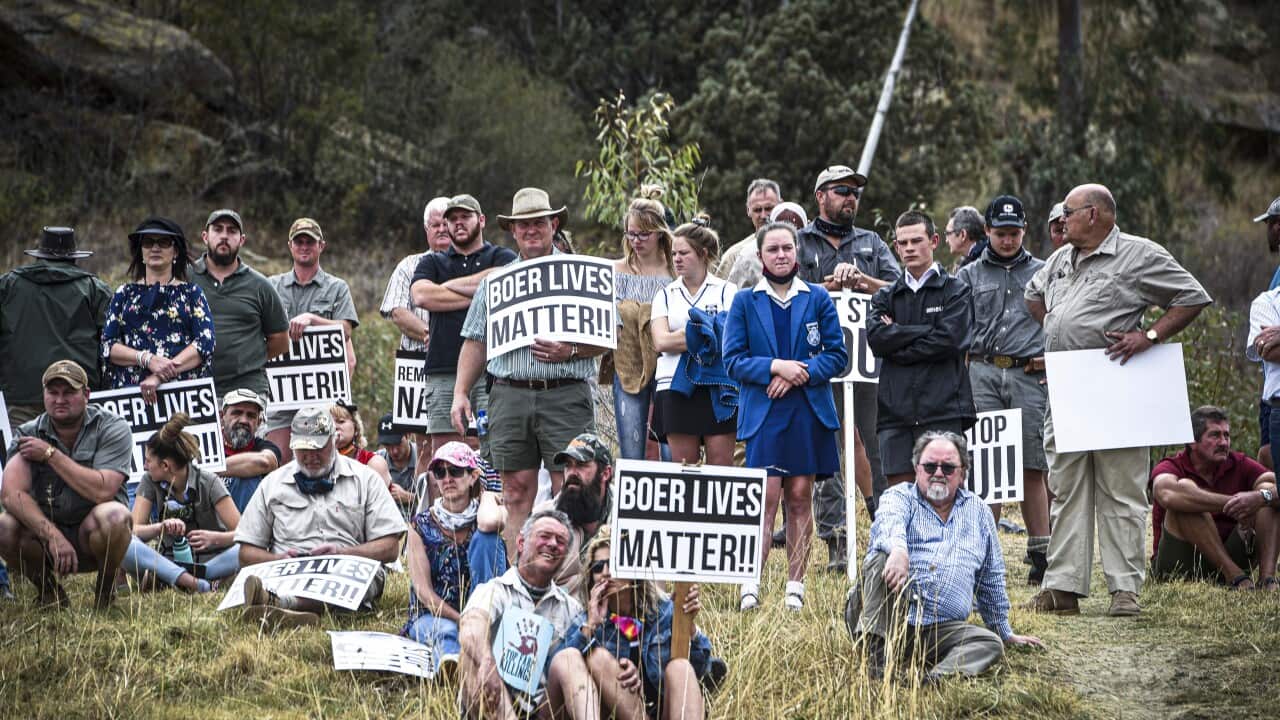
South Africa’s violent crime epidemic is real, vicious and devastating. So are farm murders. But neither proves that white South Africans are being ethnically cleansed. When the wider evidence is examined, the persecution narrative encounters something inconvenient: facts that refuse to co-operate.
By Themba Khumalo
Tucker Carlson sat down with a South African farmer, and the result was billed as a story that “will shock and sicken you”. The farmer is Leon Lotz, who says his father-in-law was murdered and his wife raped in front of their children.
If it happened as described, it is an atrocity, and no decent person would make light of it. But look at what the podcast does with the horror. It opens with a promise that “they” have told us ethnic cleansing is a racist conspiracy theory, and then offers one family’s agony as the rebuttal. Grief is called the only witness, and the audience is asked not to cross-examine it.
That is how propaganda works. It rarely needs to lie outright. It takes a real wound and hangs a false thesis on it, so that doubting the thesis feels like spitting on the victim. Whether Carlson believes the story or merely finds it profitable is immaterial, because the function is identical. The tragedy is a prop, and the host is the stagehand.
A single crime in a country with some 60 murders a day is made to carry the weight of “ethnic cleansing”, and no one thinks to ask where the other dead are buried.
Show this argument a statute, and it offers an anecdote. Show it a census, and it offers a feeling. Ask for the programme, the orders and the expulsions, and you get a farmhouse and a silence.
The statute books are not silent. We are told the ANC has passed “almost as many race-specific laws” as the apartheid state, though no count is offered, because none would survive contact with the record. Apartheid was an architecture, not a policy. The Population Registration Act sorted every citizen into a racial box. The Group Areas Act decided where you could live, the pass laws whether you could walk down a street, and the Immorality and Mixed Marriages Acts whom you could love.
The Bantu Homelands Citizenship Act stripped black South Africans of their citizenship in the country of their birth, and between 1960 and 1983 some 3.5 million of them were forcibly removed from their homes. The majority could not vote in a land that sat on top of them.
Name the equivalent law forbidding white South Africans to vote, to live where they please, to marry whom they like, or to hold a passport. You cannot, because it does not exist. What exists are redress measures, employment equity and Black Economic Empowerment, which you may think clumsy, as plenty of South African economists do. But a hiring target is not a pass law. Equating the two is like equating a parking fine with a prison sentence because the state is involved in both.
“A huge percentage of the white population has gone” does not survive a look at the census. Stats SA counted 4,434,697 white South Africans in 1996 and 4,504,252 in 2022. The number is roughly flat, and the share fell from 10.9% to 7.3% because the black population grew faster, not because anyone was herded onto ships. Plenty of whites have emigrated, as have plenty of black doctors and engineers, who somehow never feature in these tales of people who “left because of their skin colour”. The man who says everyone he has met confirms his thesis has usually met only people who flatter it.
The economy has not “collapsed” either. At the end of 1993, only about 37% of black African households had mains electricity, compared with nearly all white ones. Today roughly nine in ten households of every race are connected, so for tens of millions of families the choice was never between power and load-shedding but between load-shedding and candles.
Millions of houses have been built, and 26.5 million people receive a social grant. Unemployment above 30% is grim, and the Gini coefficient is among the worst on earth, an inheritance from the very system the speaker pretends to deplore. “Collapse” is a word for a building coming down, not for a country with a stubborn, ugly, and thoroughly familiar set of failures.
Eskom’s darkness was a scandal, but it was a scandal of looting, laid bare by the Zondo Commission, of the ruinous Medupi and Kusile overruns, and of new generation capacity put off for years. Its victims were the poor of every colour. It was never racism “switching sides”. The opinionista has mistaken a power station for a pogrom, and has not noticed that the lights have come back on. By Eskom’s own count, the country has now gone 476 consecutive days without load-shedding, and the grid met demand through the winter.
Localised cuts persist in parts of the country, and the utility is not out of the woods. But a country that was supposed to be sliding into the dark has spent the better part of two years climbing out of it, which is not what collapse looks like.
Julius Malema, the star witness, does not run the government. He leads the Economic Freedom Fighters, which took 9.5% of the vote in 2024, and the ANC expelled him in 2012. The ANC itself lost its majority in 2024, with 40% of the vote, and now governs in a coalition that includes the Democratic Alliance, the party most white voters back. The EFF is not in it. To describe Malema as “acting on behalf of the government run by the man sitting next to Donald Trump” is not a slip but a fabrication, and it is the load-bearing wall of the whole argument.
His Kill the Boer chant is odious to many, and the courts have been asked about it more than once. The Equality Court found it hate speech in 2011, in a case that ended in a 2012 settlement before any appeal was decided. In 2022, the Equality Court dismissed AfriForum’s later complaint over different performances, finding no causal link to farm attacks. The Supreme Court of Appeal upheld that in 2024, and the Constitutional Court refused leave in 2025. Nor has Malema walked free of consequences, as the speaker claims.
In August 2025, the Equality Court found that a separate speech, in which he told supporters not to be scared to kill, was hate speech, an exhortation to violence against white men, and made him and the EFF liable for the complainants’ costs. The EFF said it would appeal.
None of this makes him the president, as Ramaphosa pointed out to Trump’s face, to little effect.
The Oval Office ambush was built on props. The crosses lining a road were a symbolic memorial from a 2020 protest after a white farming couple were murdered, not burial sites. The photograph of body bags that Trump held up came from Reuters footage in Goma, in the Democratic Republic of Congo.
South Africa’s murder rate is among the highest in the world, around 58 killings a day in the latest quarters, though falling. Farm murders are a sliver of that. In 2023-24, the Institute for Security Studies counted 49 murders on farms against 27,621 nationally, about 0.2%, and AfriForum itself counted 29 in 2025. The victims include the workers and labourers who die in the same attacks and rarely get a podcast, and where motive has been examined, robbery is the usual driver.
Whether farmers are at greater risk than other South Africans is disputed, because no one knows how many people live on farms. What can be said is that no inquiry has found a campaign. “Ethnic cleansing” means the systematic removal of a group from a territory by force or terror, usually with state connivance. A 2017 government audit found white South Africans own 72% of individually owned farmland, a figure AfriForum disputes, and no one is marching them to the border.
Now look where the bodies actually fall. Over six days in late September, three mass shootings killed at least 39 people in townships near Durban, Johannesburg and Cape Town. Eight gunmen with AK-47s killed 17 in a bar in Wedela. Ten more died hours later in Lwandle. The Global Initiative Against Transnational Organised Crime recorded 45 mass killings between 1 January and 30 September, with at least 210 people killed and at least 79 wounded, and the most-cited motives are drugs, extortion, illegal mining and violence between minibus-taxi operators.
If a persecution were underway, it has an odd habit of killing the wrong people. The persecution story asks the world to mourn a few dozen farm deaths while 39 people, buried in a single week in townships whose residents are overwhelmingly black, never make the show.
None of this white persecution propaganda arrived by accident. For years AfriForum and its partners have carried a selective reading of farm-attack statistics to Washington and to friendly broadcasters. They count broadly, decline to set the figures beside the national rate, and let the raw numbers imply a campaign of racial killing that the research does not find. Western commentators repeat it without checking, because it tells them what they already wanted to hear.
A real national crisis was repackaged as a racial one, and anyone who keeps selling that story after seeing the figures is no longer mistaken, only invested.
The speaker adds that those who opposed apartheid were “implicated” and are hiding it. History says the reverse. Thatcher called the ANC “a typical terrorist organisation” in 1987. Reagan vetoed sanctions in 1986, and Congress overrode him. Mandela stayed on a US terrorism watch list until a law signed in 2008. They were on the wrong side and have been rebranding ever since.
As for anti-white racism being “the only institutional racism allowed in the Western world”, only someone who has never examined a sentencing table, a housing audit or a boardroom could write it. White South Africans make up under 8% of the economically active population, yet the Commission for Employment Equity finds they hold 57% of top management posts, about seven times their share. A group with that profile can be offended and inconvenienced, but it cannot credibly claim to be the victim of apartheid in reverse.
Some grievances are real. Equity rules can bite individual white applicants, and the courts hear those cases. Rural communities of every colour are failed by a state that cannot protect a farmhouse from eight armed men, or a township bar from eight more. A government that solves too few murders and lets its elite loot state-owned entities has failed its citizens of every race. That failure is documented, damning, and fixable, but it does not suit a story about racial conquest, so it gets buried under the one that does.
White persecution in South Africa is a fiction. There is no programme of racial targeting, no stripping of rights and no campaign of killing, and the country’s murder epidemic falls overwhelmingly on the black poor. What we have instead is a mournful tune with the facts left out, played to an audience that already knew the words.