

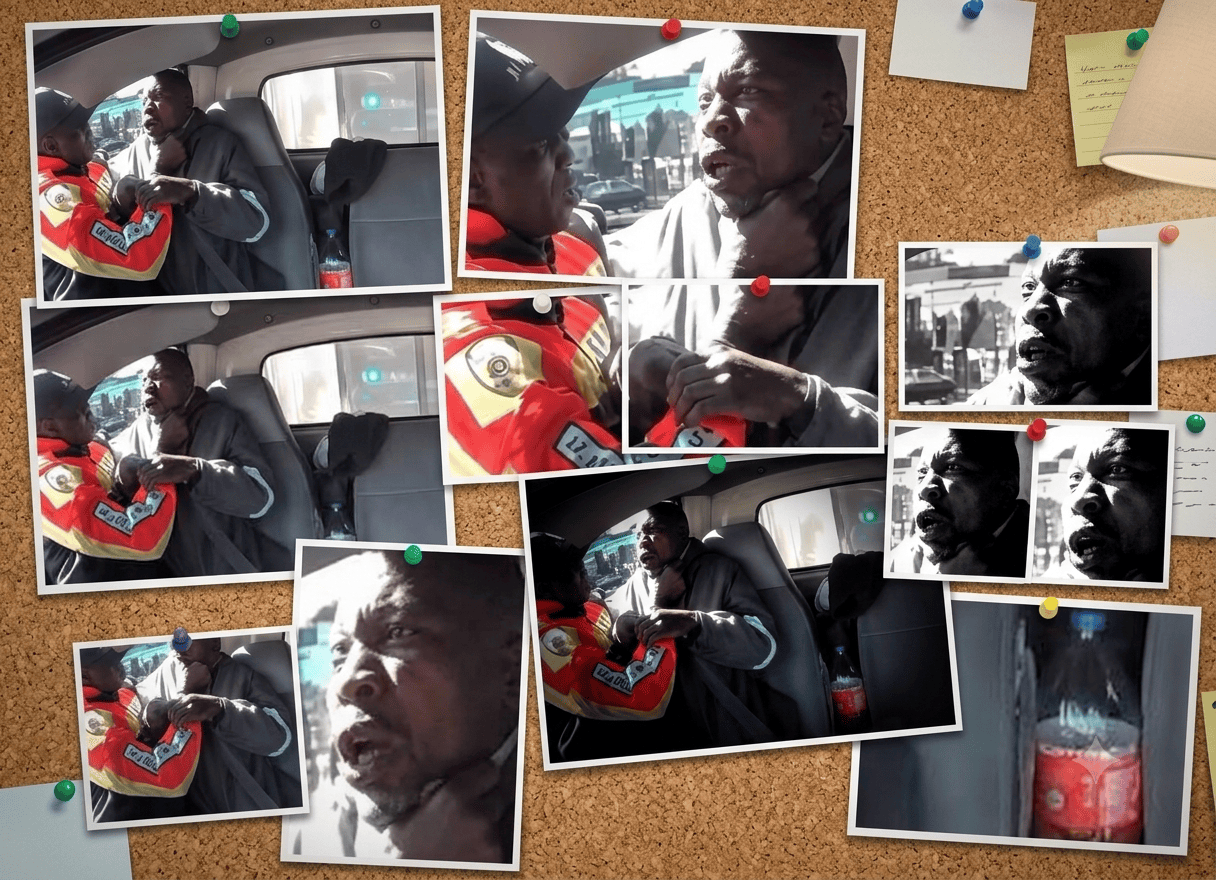
Some people should never be entrusted with public authority. A disturbing roadside confrontation involving a JMPD officer raises uncomfortable questions about temperament, accountability and the kind of personalities placed in positions of power. The wrong person in uniform can be as dangerous as any reckless driver.
By Themba Khumalo
There is a particular, pitiful species of ego that seems capable of surviving only beneath a neon-yellow high-visibility vest.
Give a man a uniform, a badge, a reflective jacket, a clipboard, and the authority to demand a driver’s licence before most people have finished their first cup of coffee, and you have all the ingredients for a breathtaking display of authority entirely detached from competence.
Few things inflate mediocrity faster than a sliver of power exercised over strangers.
Consider the latest roadside theatre courtesy of the Johannesburg Metropolitan Police Department.
A driver of a light delivery vehicle commits the cardinal sin of… using his brain. Signalled to pull over on a busy road, he performs the astonishingly reckless act of driving a few metres further to stop somewhere safe.
The audacity.
Imagine placing road safety above the immediate gratification of an officer whose self-esteem apparently expires the moment a motorist is not instantly stationary.
What follows, captured on a dashboard camera in glorious, indisputable detail, is a study in brittle machismo masquerading as law enforcement.
The officer marches to the driver’s window, not with the measured composure expected of a public servant, but with the simmering indignation of a toddler informed that the universe does not, in fact, revolve around him.
“Where is your licence? What is going on?” demands the self-appointed emperor of the asphalt.
The driver, making the fatal mistake of assuming reason still has a place in public life, smiles and explains that he was looking for a safe place to stop.
“Do you see me laughing?” the officer snarls, decorating the exchange with enough profanity to suggest that civility has become an arrestable offence.
Then comes the moment that exposes the entire performance for what it is.
The driver says four words.
“Talk to me nice.”
Not an insult. Not a threat. Not an act of defiance. A simple request to be addressed with the minimum standard of decency one might extend to a stranger.
The request proves too much.
The bully of an officer reaches through the open window, grabs the driver by the throat, and begins choking him.
Pause there for a moment.
A traffic officer entrusted with enforcing road safety abandons both traffic and safety because someone dared to ask for basic manners. It takes a very special kind of insecurity to mistake courtesy for insubordination.
“You are hurting me,” the driver gasps.
“Yes, I am hurting you,” replies the officer, helpfully removing any lingering doubt about intent.
There it is, stripped of bureaucratic varnish. No confusion. No misunderstanding. No split-second misjudgement. Just naked malice wearing reflective clothing.
One cannot help wondering how spectacularly fragile a man’s sense of self must be for a polite smile to register as provocation.
One imagines him standing before the mirror every morning, adjusting his cap with solemn ceremony, convincing himself that he is the last thin line between civilisation and chaos, only to be psychologically dismantled by a delivery driver requesting common courtesy.
Perhaps the police vest is not reflective after all. Perhaps it simply reflects the fantasy that absolute obedience is the same thing as respect.
As predictably as sunrise, the JMPD has responded with its familiar collection of sanitised corporate condolences.
The department has viewed the video “with serious concern”. Internal Affairs has been activated. The victim is encouraged to come forward. The public is reassured that abuse of authority is condemned in the strongest possible terms.
The bureaucratic hymnbook never changes.
The statements are polished. The concern is profound. The investigation is immediate. Accountability, meanwhile, always seems to be stuck somewhere in traffic.
All of which is wonderfully reassuring, except for one awkward detail. The evidence is already in the public domain.
It is not hidden inside a sealed docket or buried beneath months of forensic analysis. Millions have already watched a man being throttled because he requested to be spoken to politely. Sherlock Holmes is not required.
If an officer’s emotional stability is so catastrophically dependent on unquestioning obedience from ordinary motorists, perhaps the roadside is not where he belongs.
There are occupations involving considerably less human contact. Filing archives. Counting ceiling tiles. Guarding an empty warehouse or an abandoned parking lot. Anything that does not require the emotional resilience to survive hearing the words, “Talk to me nice.”
Until then, motorists should familiarise themselves with the revised rules of the road.
Signal early. Stop promptly. Keep both hands visible. Speak softly. Avoid eye contact.
Above all, never make the catastrophic mistake of expecting dignity from a man whose authority is so alarmingly flimsy that it collapses at the first hint of basic civility.
It may just cost you your breath.