

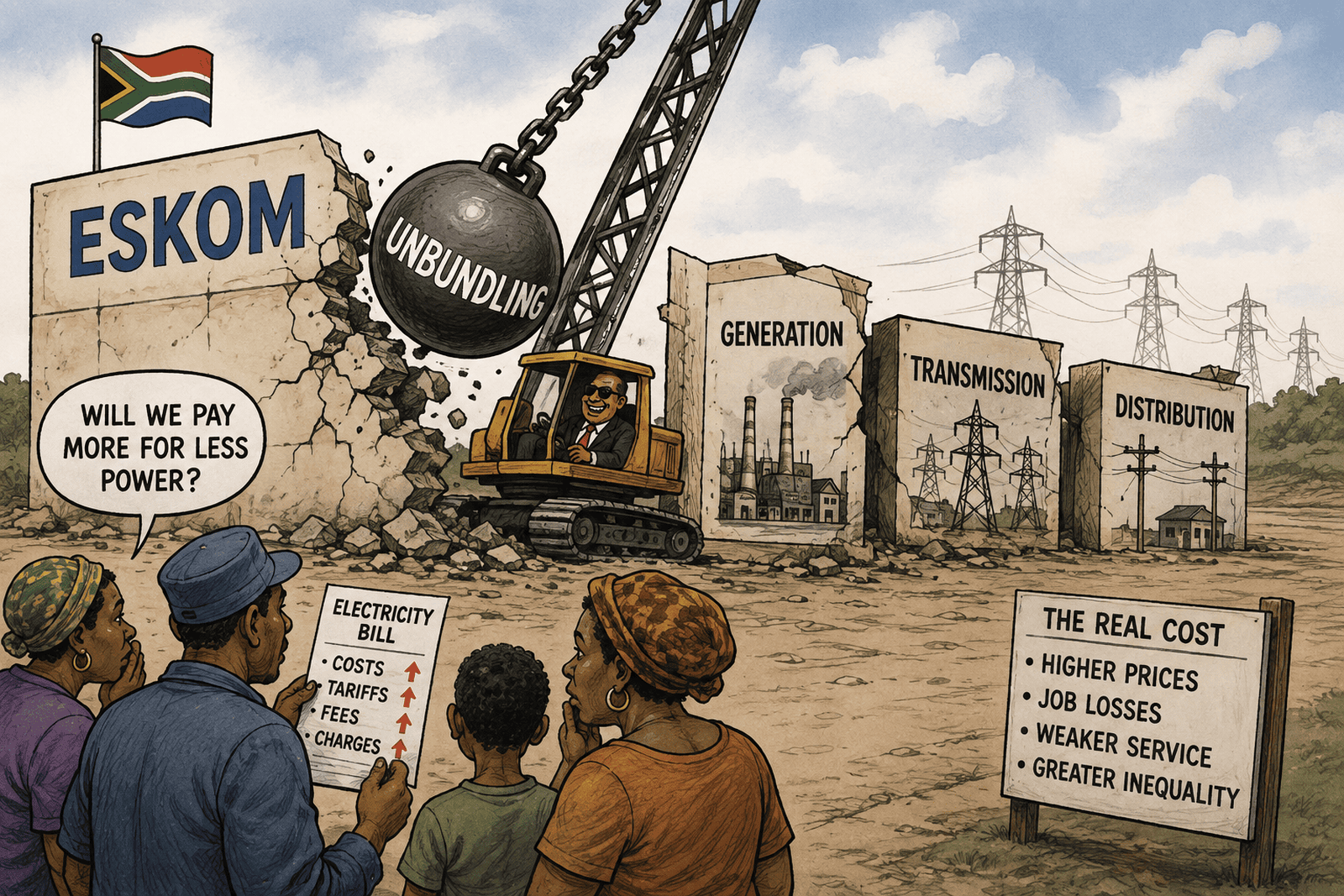
Reforming Eskom is unavoidable. But reform and dismantling are not the same thing. Once electricity becomes increasingly governed by competing commercial interests, accountability becomes harder to locate and affordability harder to guarantee. South Africa therefore faces a choice whose consequences extend well beyond Eskom itself.
By Themba Khumalo
There is something unsettling about the way Eskom’s impending unbundling is being discussed.
The language is polished, technical and reassuring: structural reform, market liberalisation, competitive trading platforms, and unbundled tariffs.
It makes the break-up of one of South Africa’s most important public institutions sound like an exercise in corporate housekeeping—a complicated machine being taken apart, reorganised and put back together more efficiently.
Yet beneath this polished corporate vernacular lies the most radical, high-stakes restructuring of South Africa’s economy in a generation.
The plan to carve the state utility into three distinct entities—Generation, Transmission, and Distribution—and hand operational control over to an independent Transmission System Operator (TSO) is being framed as an unavoidable technical evolution.
But strip away the PowerPoint slides, and the uncomfortable truth emerges: this unbundling is not just an engineering project. It is a profound political and social choice, and one that risks leaving working-class South Africans and power station workers paying the ultimate price.
Siphoning the Family Jewels
The fundamental flaw of the unbundling strategy lies in how it treats Eskom’s balance sheet. For decades, Eskom operated as an integrated system, using the stable, lucrative returns from its transmission infrastructure to cushion the immense costs of power generation and maintenance.
Under the new model, the high-value transmission network—assets worth roughly R100 billion—is being ring-fenced and effectively separated from the main business.
The National Transmission Company South Africa (NTCSA) and the independent TSO will act as the new, pristine highway for electricity, designed specifically to invite private Independent Power Producers (IPPs) to sell their power onto the grid.
On paper, opening the grid to private capital sounds logical. But what happens to the entity left behind?
The remaining core—GenerationCo—will be left holding Eskom’s most toxic assets: an ageing, breakdown-prone coal fleet, billions of rands in environmental remediation liabilities, and a mountain of historical debt. By siphoning off the most profitable, predictable segment of the utility, government is hollowing out the public enterprise.
It is a classic case of socialising the debts while commercialising the revenue streams. Without its high-performing transmission arm to subsidise the broader network, the remaining public utility will face perpetual financial insolvency, leaving taxpayers to endlessly bail out a dying shell or forcing the state to sell off what remains at bargain-basement prices.
The Cost of Electricity as a Commodity
For everyday households already battered by a relentless cost-of-living crisis, the unbundling process poses an immediate threat to the kitchen table.
In a traditional public utility model, electricity is treated—at least in theory—as a public good, essential for human dignity, public health, and social development. Price hikes are regulated to balance the provider’s operational needs with the socio-economic realities of the citizenry.
In a fully unbundled, multi-market system, power becomes a pure market commodity. Electricity will be traded on an exchange where prices fluctuate based on real-time supply and demand, and where private generators naturally demand profit margins on top of their operational costs.
Add to this the staggering cost of expanding the transmission grid—an estimated R440 billion to run new high-voltage lines across the country—and the mathematical reality becomes terrifyingly clear.
Who pays for these new transmission corridors? Who guarantees the profit margins of private energy developers?
The consumer does. Without ironclad state subsidies and explicit price caps, passing these structural costs directly onto end-users will accelerate energy poverty. Millions of township households and rural communities will be priced out of basic electricity, while energy-intensive industries like mining and smelting—the traditional backbones of local employment—face escalating operational costs that could trigger widespread retrenchments.
Labour, Insecurity, and the Backdoor Shift
It is entirely understandable why organised labour, led by trade unions like the National Union of Mineworkers (NUM) and NUMSA, has taken the fight to the courts. The union leadership understands the historical playbook of state utility unbundling better than most.
Across the globe, when public energy sectors are carved up to facilitate market liberalisation, workforce ‘rationalisation’ is never far behind.
As private players take over generation and distinct corporate entities assume control of transmission and distribution, the collective bargaining power built up over decades is fragmented. Workers, shifted amid complex corporate restructurings, face precarious contracts, threatened pension structures, and the very real prospect of retrenchment as new operators trim headcount to maximise margins.
Worse still is the human cost confronting the coal belt. The formal decommissioning of the coal-fired Komati Power Station in October 2022 served as a stark preview. Komati was meant to be the pilot project for a ‘Just Energy Transition’, yet the fallout devastated the surrounding community, as secondary economies collapsed and local contractors were left stranded long before alternative renewable jobs materialised.
Expecting workers across ageing stations like Duvha, Hendrina, or Tutuka to seamlessly transition into private green-energy roles without direct state ownership and guaranteed public investment is a corporate fantasy, not a social strategy.
A Crisis of Accountability
No one sensible argues that Eskom’s old, corrupt, and inefficient monopoly should have remained untouched. Load-shedding crippled our economy, and systemic reform was urgent. But there is a vast difference between reforming a public asset to serve its people and dismantling it to serve a market.
By delegating the future of electricity to market forces and independent operators, the government is quietly abdicating its primary constitutional responsibility: ensuring that all citizens have access to affordable, reliable energy.
If an unbundled system leads to skyrocketing tariffs, rolling blackouts driven by market volatility, and thousands of lost jobs, who will citizens hold accountable? The Ministry? The NERSA regulators? Or a collection of faceless corporate boards?
The legal battles that are about to play out in our courts are not a nuisance delaying progress; they are a necessary alarm bell.
Until the state can demonstrate a genuine social compact—one that guarantees affordable electricity for the poor, protects worker livelihoods, and retains democratic control over strategic assets—this unbundling will remain a dangerous gamble with South Africa’s social stability.