

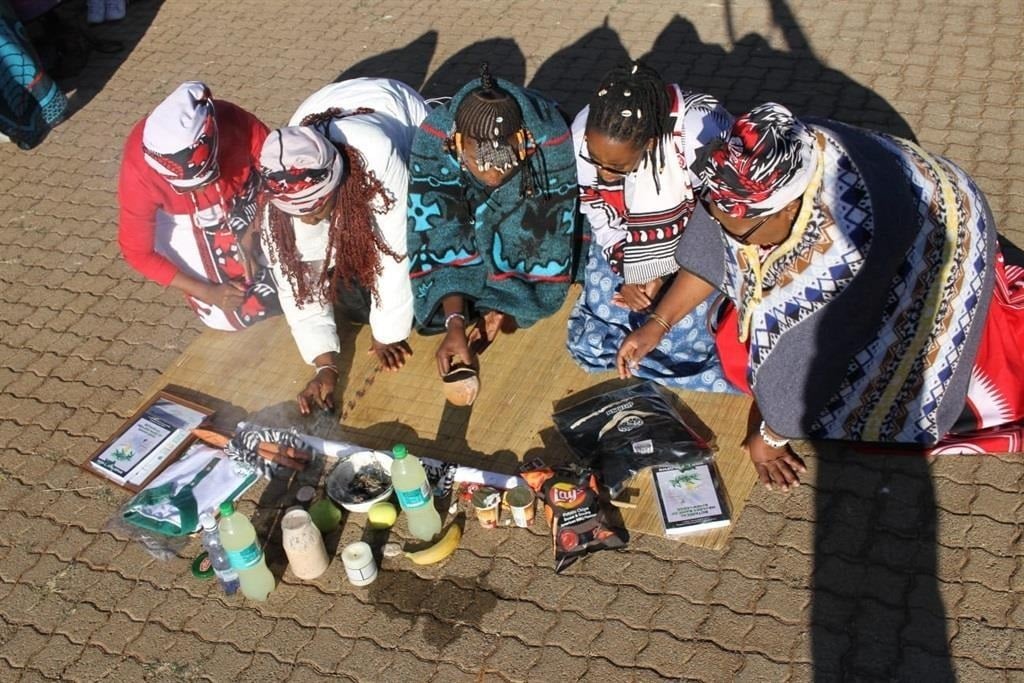
The government cannot claim to understand its people while treating indigenous healing as an administrative afterthought. It is a living part of the country’s social fabric, woven through culture, belief, health, knowledge, and livelihoods. Leaving it in a regulatory vacuum does not protect the practice; it leaves ordinary people dangerously exposed.
By Gogo Bathini Mbatha
There is a quiet, staggering fortune changing hands in the shadows of South Africa’s public administration — billions of rand moving through a vast sphere of indigenous healing and spiritual practice that touch the lives of millions, yet remain strangely peripheral to the machinery of the state.
It is the world of izinyanga and izangoma: traditional healers whose knowledge, practices and spiritual traditions remain woven into the lives of communities across the country.
For millions of South Africans, this is not some quaint relic from a distant past. It is part of how illness is understood, how grief is confronted, how families make sense of misfortune, how rituals are observed and how people seek help when conventional institutions have failed to answer the questions that trouble them.
And yet, when it comes to the business of governing this enormous and deeply personal sphere of life, the state seems to have developed a remarkable talent for looking the other way.
To date, there is no dedicated government department that traditional healers can point to and say, “This is where we belong.”
There is no clearly identifiable Minister whose portfolio is devoted to safeguarding the integrity, development, and regulation of indigenous healing. Instead, practitioners find themselves scattered across the administrative landscape, sometimes falling under the Department of Health, sometimes Traditional Affairs, and sometimes into the cracks between institutions that were never designed to deal with the full complexity of what traditional healing represents.
That is more than an administrative inconvenience. It is a failure to recognise the reality of the society being governed.
Traditional healing does not fit comfortably inside a single departmental box. It sits at the intersection of health, culture, spirituality, environmental stewardship, indigenous knowledge, and economic activity.
It raises questions about the protection of medicinal plants and traditional knowledge. It touches the health system when patients move between traditional and Western medicine. It intersects with policing and the courts when vulnerable people are defrauded or abused.
It is, in other words, much bigger than the narrow administrative category into which the state appears determined to squeeze it.
And that should matter.
Because where the state refuses to establish a proper home for something that millions of people already regard as part of their lives, the vacuum does not remain empty.
Someone always moves into it.
In this case, some of those who have moved in are genuine practitioners who have inherited knowledge through generations, understand the responsibilities attached to their calling, and regard healing as something far more serious than a commercial transaction.
But alongside them is another breed.
Amaqola…fraudsters who understand that desperation is a remarkably profitable commodity.
They know that people do not always seek traditional healers because they are curious. Sometimes they arrive carrying grief. Sometimes they are frightened. Sometimes they are ill. Sometimes a marriage is collapsing, a child is in trouble, a business is failing, or a family has suffered one misfortune after another and can no longer explain what is happening to them.
That is where the charlatan finds opportunity.
A vulnerable family may be told that the ancestors require R50,000 for a particular ritual. Another person may be told that a curse must be removed, but only after a series of increasingly expensive interventions. Someone else may be persuaded that failure to produce more money will bring catastrophic consequences upon their family.
The amounts can escalate while the fear deepens.
And when the money is gone, the victim is often left with nowhere to turn.
This is where the state’s absence becomes more than a bureaucratic embarrassment. It becomes dangerous.
A legitimate traditional healer who knows that someone is operating fraudulently should be able to report that conduct and expect the complaint to be taken seriously. Yet the practical realities of pursuing fraud can leave victims and witnesses trapped in a system that demands evidence, formal complaints and willing complainants from people who may already be frightened, ashamed or financially broken.
The person who has been told that more horror will be visited on them if they speak may not be eager to walk into a police station and announce that they have been defrauded.
The person who has spent their savings may not have the resources to pursue a lengthy dispute.
And the person who has been publicly humiliated by the experience may prefer silence to the prospect of explaining to strangers how they were persuaded to hand over their money.
Silence, however, is fertile ground for exploitation.
That is the great contradiction at the heart of this neglected sphere.
South Africa has a constitutional order that recognises traditional leadership and protects cultural and religious practices. It has laws and institutions dealing with health professionals, legal practitioners, financial services and countless other occupations where the public can be exposed to harm.
Yet indigenous healing remains caught in an uncomfortable halfway house: recognised enough to be part of the country’s social and cultural reality, but not sufficiently organised and regulated to give the public the protection it deserves.
The consequences are borne not by abstract institutions, but by human beings.
They are borne by the pensioner who spends money she cannot afford because she believes she is paying for healing.
By the parent who empties a bank account because someone has convinced him that his child’s suffering has a spiritual cause.
By the family that cannot distinguish between a respected practitioner and someone who has simply learned how to speak convincingly about ancestors.
And they are also borne by the honest healer.
Because every fraudster who exploits the vulnerable does more than steal money: he contaminates the reputation of practitioners who have spent years, sometimes generations, building trust within their communities.
The honest healer is forced to operate under the same cloud as the impostor.
That cannot be good for anybody.
Regulation, therefore, should not be understood as an attempt to sterilise indigenous healing or force it into the mould of Western medicine. Nor should it become another exercise in government imposing its language and institutions on traditions it does not fully understand.
It should begin with something much simpler: recognition that this world exists, that it matters and that the people who participate in it deserve both dignity and accountability.
A credible statutory framework could provide a register of practitioners, establish meaningful standards, create mechanisms for dealing with misconduct and fraud, protect legitimate indigenous knowledge, and give ordinary people somewhere to turn when something goes badly wrong.
It could also help separate the healer from the hustler.
That distinction matters enormously.
The state does not have to decide which person’s spiritual beliefs are true. It does not have to arbitrate between competing understandings of the supernatural. But it has every reason to intervene when deception, coercion, exploitation or financial abuse enters the picture.
That is the difference between regulating belief and protecting people.
And perhaps that is where the conversation needs to begin.
For too long, indigenous healing has been discussed either with romantic nostalgia or with dismissive suspicion. Both approaches miss the complicated human reality in the middle.
There are millions of people living in that middle.
They have one foot in a modern constitutional democracy and another in traditions that long predate the republic itself. They may visit a doctor in the morning and consult a traditional healer in the afternoon. They may use prescribed medication while observing ancestral rituals. They may move between different systems of understanding without experiencing any contradiction whatsoever.
The state should be mature enough to understand that complexity.
It should also be mature enough to understand the money involved.
Where there is a large population, a substantial flow of money, deeply held beliefs and vulnerable people, there will inevitably be people looking for ways to exploit the system.
Pretending otherwise does not protect tradition.
It protects the predator.
And perhaps the most revealing question is not why traditional healing has survived outside the comfortable boundaries of state administration.
It is why the state, after all these years, has still not properly decided what to do with something that millions of its citizens have never stopped believing matters.
This is not about choosing between science and tradition.
It is about choosing between accountability and a vacuum.
The sacred should not become a hiding place for the unscrupulous.
Nor should legitimate indigenous healing be left to carry the burden of an unregulated field while government departments pass the responsibility from one desk to another.
A country cannot claim to understand its people while refusing to understand one of the systems through which so many of them make sense of illness, suffering, family and life itself.
Billions may be changing hands quietly.
The human consequences are not quiet at all.
And until the state finally brings this enormous shadow into the light — with recognition, proper administration, credible regulation and respect for indigenous knowledge — the people most likely to prosper in the darkness will not necessarily be the healers.
They will be the predators.
Gogo Bathini Mbatha – Traditional Healer, Researcher, Spiritual Educator