

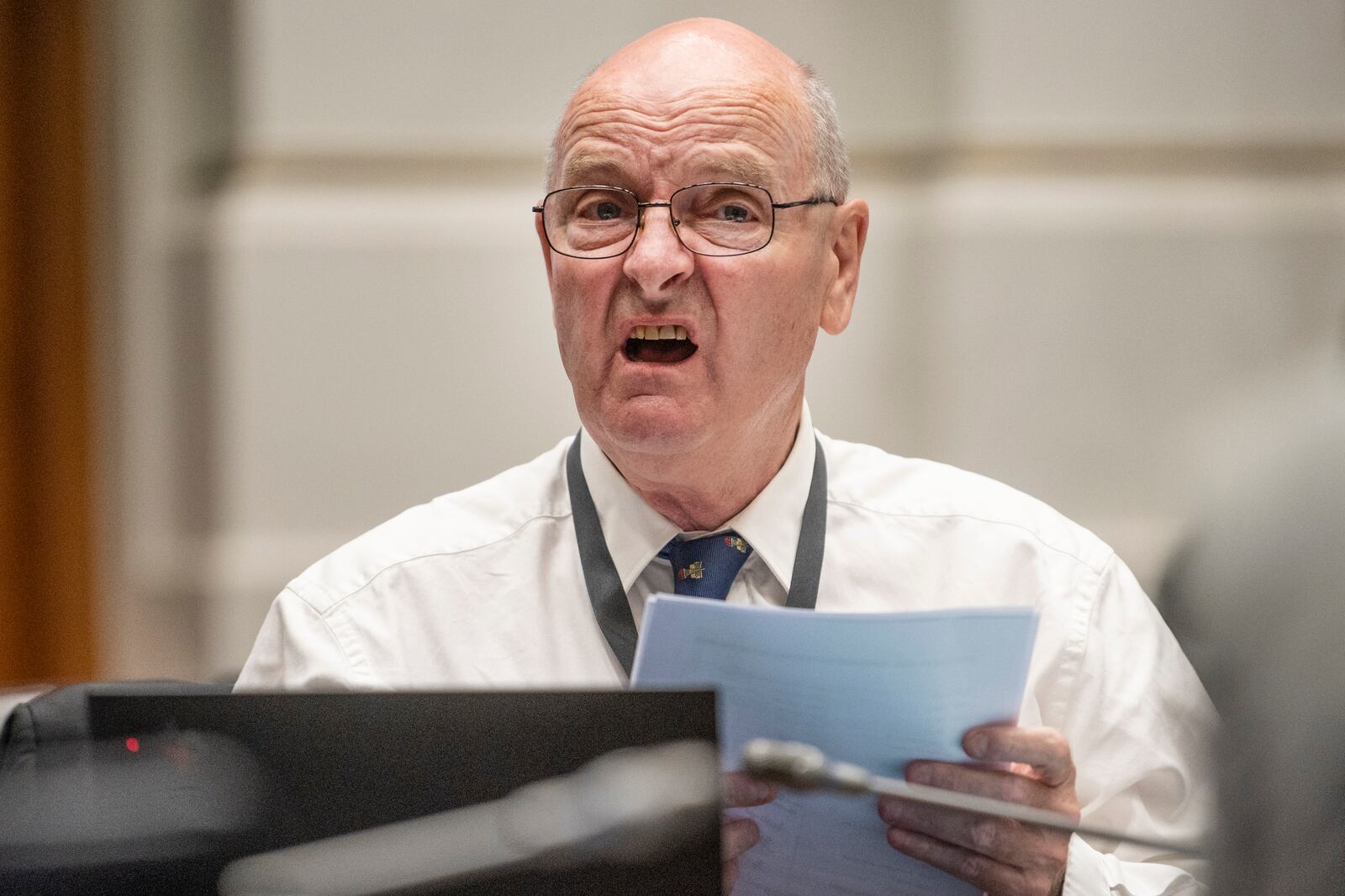
Reading the e-mail placed before the Madlanga Commission, you will find yourself asking one simple question: who exactly does Paul O’Sullivan think he is? His message is not simply the story of an extraordinary ultimatum. It is the story of what happens when a private citizen begins behaving as though the machinery of the South African state answers to him.
By Themba Khumalo
South Africa’s public square has long been littered with the burnt-out husks of state institutions, hollowed out by years of shameless plunder.
A populace battered by state capture, exhausted by systemic rot, and routinely betrayed by public servants who treat the national till as a personal fiefdom has every conceivable right to be furious.
Citizens are entirely justified in demanding answers. They are utterly right to insist that those who hold power be dragged to the light.
Yet a constitutional democracy rests on a foundational truth that becomes most critical precisely when public fury threatens to boil over: no individual, no matter how loudly they beat their own chest or wrap themselves in the mantle of civic righteousness, is above the law.
This brings South Africa to a deeply unsettling precipice. What happens when the man who purports to slay the dragon begins to adopt the very appetite and posture of the beast?
The unspooling saga of Paul O’Sullivan has forced into the open a debate far larger than one man’s swollen profile.
It raises alarming questions about the perils of unchecked private influence, the toxic lure of unaccountable power, and the precise moment a self-appointed champion of integrity begins acting as though the concept of accountability itself were his exclusive intellectual property.
The portrait that now emerges is not that of a disciplined investigator quietly doing the heavy lifting of justice. It is the spectacle of a man who has gleefully cast himself as a lone-ranger sheriff—striding into the saloon, barking demands, issuing decrees, and positioning himself as the ultimate arbiter of who is fit for public life and who belongs in the stocks.
The tragedy is not that Paul O’Sullivan appears to believe in accountability. It is that he increasingly appears to believe he owns it. In his world, institutions do not investigate unless he approves. Police officers do not deserve office unless he decrees it. Legitimacy is no longer conferred by law, but by Paul O’Sullivan.
Nowhere is this intoxicating hubris captured with quite such unvarnished clarity as in the e-mail O’Sullivan fired off to Brigadier Dineo Mokwele, now laid bare before the Madlanga Commission.
A single piece of correspondence can occasionally reveal more about a man’s character than years of carefully cultivated public image.
This e-mail is precisely such an artefact. It is not a mere inquiry; it is a terrifying window into an extraordinary delusion of grandeur—a private citizen addressing a serving police officer with all the imperial swagger of a colonial governor issuing a decree to an insubordinate clerk.
The contents are genuinely staggering.
Read it slowly. Not because it is legally sophisticated—it is not—but because it is psychologically revealing. A private citizen demands documents. A private citizen orders a Brigadier to resign. A private citizen instructs her to repay her salary. A private citizen gives her fourteen days to obey. A private citizen warns of consequences if she refuses.
There is not a sentence in that progression that does not reveal a man speaking as though the machinery of the South African state answers to him personally.
O’Sullivan, operating under the banner of his private outfit, Forensics for Justice, did not simply ask questions. He issued an ultimatum: hand over all documentation regarding your appointment, name your enablers, resign from the South African Police Service forthwith, and surrender every cent of salary you have ever drawn.
The prose itself was the most damning giveaway. It was not the crisp language of a citizen seeking transparency, nor the careful work of a professional investigator laying out facts. It was the imperious tone of a sovereign giving orders to a subject.
A fourteen-day deadline was slapped on the table. Absolute compliance was demanded. Vague, dark consequences were promised should she dare to demur.
Strip away the bombast, the self-congratulation and the faux legal language, and one absurd question remains: who, exactly, does Paul O’Sullivan think he is?
A citizen may well air grievances. An investigator may uncover evidence. A whistleblower may blow the whistle until they are blue in the face. But the authority to discipline, convict, dismiss, or cashier a public official belongs solely and exclusively to institutions established by law.
A constitutional republic cannot function if the loudest, most aggressive voice in the room is permitted to crown itself king. Righteous indignation does not confer statutory power. A formidable reputation is not an electoral mandate. And a personal grudge is not a constitutional office.
Yet the most chilling aspect of O’Sullivan’s missive was not its high-handed demands. It was the spiteful flourish at the tail end:
“Be wise, go back to BMW, and hope they will accept you…”
In that single, sneering sentence, the mask did not just slip—it was violently torn away. The investigator vanished, replaced entirely by the playground bully.
The so-called seeker of truth became the hanging judge, passing summary execution on a person’s career with a patronising smirk. It was a deeply revealing moment, demonstrating with brutal clarity that when accountability is divorced from humility, it metastasises into something profoundly ugly.
The most extraordinary sentence is not the threat. It is the boast. “Without it seeming like we are bragging…”
Few sentences in South African public life have so comprehensively dismantled themselves before reaching the full stop. What followed was not evidence. It was a trophy count. Two Commissioners. Twenty generals.
Read another way, the message was unmistakable: “Look what I have done to others. Decide carefully whether you wish to be next.”
It is perhaps the most hilariously ironic phrase in modern South African political discourse.
The message was not,“We follow the evidence wherever it leads.” The message was, “Look at my trophy wall. Look at the heads on my spikes. Do not cross me, or you will be next.”
And there lies the poison in the well.
The fight against corruption cannot be reduced to a hunter’s mantlepiece adorned with fallen officials. Justice is not measured by a body count. It is measured by the scrupulous fairness of the process, the rock-solid credibility of the evidence, and the unblemished integrity of the methods used to secure it.
Anyone who sets out to cleanse the stable must understand that the work requires ruthless self-discipline—because the line between holding power to account and becoming utterly drunk on one’s own authority is paper-thin.
South Africa has been taken down this garden path before. The nation has suffered a parade of politicians who thought the rules were for little people. It has endured bureaucrats who treated state departments as private estates. It has watched in horror as figures of all stripes confused public trust with personal entitlement.
The country cannot afford to recreate in private hands the very arrogance it has spent decades trying to uproot from public office.
The deeply unsettling question raised by O’Sullivan’s conduct—reflected equally in his combative parliamentary appearances, where he routinely treated legislative oversight with visible contempt—is whether the crusade against the abuse of power has produced a crusader consumed by the very vice he claims to abhor: unchecked, tyrannical ego.
A healthy democracy desperately needs brave journalists, meticulous investigators, and citizens who refuse to lie down. What it emphatically does not need is private individuals who set up shop as unelected, unanswerable institutions unto themselves.
The greatest threat to constitutional order is not merely the thief operating under cover of darkness. It is also the vigilante so thoroughly blinded by his own sense of divine mission that he comes to believe the law was written for everyone else.
The ultimate test of any true defender of justice is not how many opponents he can tear down in the court of public opinion. It is whether his own conduct can withstand the very scrutiny he so loudly inflicts upon others.
There is a peculiar danger in every democracy. It is not merely the politician who mistakes public office for private property. It is also the private citizen who mistakes public applause for public authority.
Paul O’Sullivan’s email was never simply about Brigadier Mokwele.
It was a declaration of self-belief.
It announced an arrogant view in which appointments require his approval, careers survive at his pleasure, and the machinery of the South African state is expected to tremble when he clears his throat.
That is not accountability.
It is megalomania dressed up as public service.
South Africa has buried enough political messiahs, enough untouchable strongmen and enough self-anointed saviours to recognise the warning signs. The Constitution did not replace one set of unelected authorities with another. It did not free the country from arbitrary power so that private individuals could reinvent it in their own image.
Nobody elected Paul O’Sullivan.
Nobody appointed him Commissioner of Police.
Nobody vested him with the authority to hire, fire, discipline or purge public servants by decree.
And yet there it was, in black and white before the Madlanga Commission: a private citizen issuing commands to a Brigadier as though the badge belonged to him.
It does not.
The badge belongs to the South African Police Service.
The authority belongs to the state.
And the moment any man—however celebrated, however connected or however convinced of his own righteousness—begins believing otherwise, he ceases to be a guardian of accountability.
He becomes exactly the kind of power South Africans have spent three decades trying to escape.