

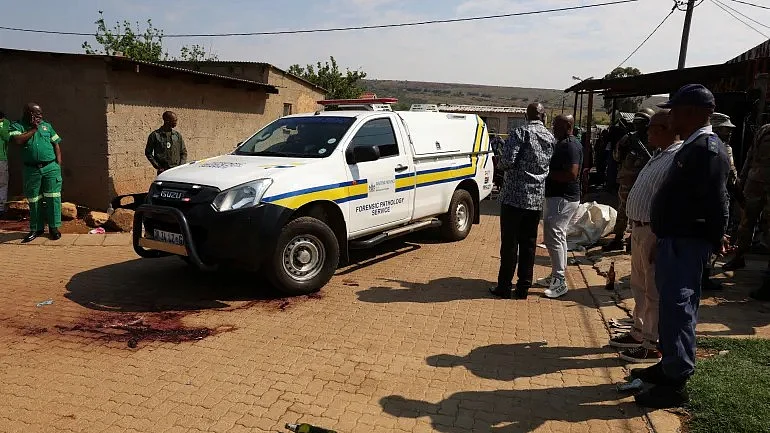
Phala Modise is concerned that the national conversation about murder has become increasingly divided by categories of victims. He argues that criminals do not care about those categories. Perhaps, he suggests, it is time to stop measuring the value of a life by the label attached to its victim.
By Phala Modise
I did not listen to President Cyril Ramaphosa’s speech because I did not need to. I could almost write the script myself: another solemn performance about the killing of women, another round of political hand-wringing and another opportunity to make innocent men feel as though they must answer for crimes they did not commit.
When government fails to protect its citizens, apparently the easiest thing to do is to find an entire sex to blame by association.
That is what increasingly troubles me about the way we talk about murder in South Africa. We have become remarkably selective about whose deaths demand our outrage, whose deaths deserve a name and whose deaths can be quietly absorbed into the daily statistics of a country that has become frighteningly accustomed to killing.
It started with AfriForum and Solidarity arguing that farm murders are targeted killings of white people and should be declared a priority crime. A few weeks ago, we were discovering the possibility of a serial killer targeting women, and suddenly the national conversation became feverish. We were angry, we demanded answers, and we asked men where they were when those women were killed.
But where were we when men were being killed?
Black men were being murdered long before we attached labels to particular categories of victims, and they are still being murdered every day, sometimes in terrifying numbers. Somewhere in KwaZulu-Natal, Gauteng and the Western Cape, families are left to bury sons, fathers, brothers and husbands while the rest of the country carries on with its business.
Have we become so desensitised to the killing of black men that the deaths of 10 men in a mass shooting in KwaZulu-Natal, 13 men in Gauteng and 8 men in the Western Cape do not make us stop and ask what the hell is happening to this country?
That is at least 31 men killed in three mass shootings, each one a son, father, brother, husband or friend whose family is now left to live with an absence that can never be filled. Have we reached a point where the blood of murdered men can be absorbed into the broader statistics of violent crime without provoking the same national urgency we summon when the victims belong to another category?
I am not suggesting for a moment that we should downplay femicide or the murder of women. Every woman who is murdered is a human being whose life mattered, whose family is left to carry an unbearable absence and whose killer must face justice. But taking femicide seriously cannot require us to look away when men are being slaughtered. Compassion should not come with a gender filter, and justice should not be rationed according to which victim fits most comfortably into the national conversation.
South Africa has a violent-crime problem, and that is the beginning and the end of the argument. Black men are among its most numerous victims, yet their deaths are too often swallowed by the broader statistics of violent crime. We should condemn the killing of South Africans without first deciding which victims deserve a louder funeral, a more fashionable label or a more politically useful outrage.
Sometimes the victim will be a white farmer. Sometimes it will be a woman. And somewhere in this country we all claim to love, men are being killed too. Should we not be concerned about the wanton killing of all South Africans by criminals, rather than elevating certain killings into a definitive national crisis while treating the killing of men as though it were simply part of the furniture?
It is true that, in most cases, the killings are committed by criminal men, but not all men are killers, and that should not be so difficult to understand.
Men are killed by women who hire criminals to do their dirty work for them, just as men are killed on farms by white farmers. Men are killed in townships, suburbs, taverns, taxis, homes and on the streets. Every one of those deaths should provoke outrage, every killer should be pursued, and every grieving family deserves the same seriousness from the state.
Our enemy is violent crime, not men in general. The fact that many violent crimes are committed by men does not make every man a potential killer, an accomplice or a suspect waiting to be identified. Most men go about their lives without harming anyone, while some men themselves become victims of the very violence we are discussing.
Treating every man as though he carries collective responsibility for the actions of criminals is not justice. It is an intellectually lazy way of dealing with a complicated problem.
We should be hunting criminals, dismantling criminal networks and demanding answers from a security and justice system that is failing to keep people safe, rather than turning an entire sex into a convenient suspect class.
The tragedy is that while we are busy arguing about men, women, farm murders, femicide and the labels attached to different forms of killing, criminals carry on doing what criminals do. They kill, they rob, and they terrorise, while families bury people they love and the rest of us argue over whose suffering deserves the greatest attention. A mother loses a son, a wife loses a husband, children lose a father, and somewhere another family receives the phone call or knock on the door that changes their lives forever.
The dead do not care whether the person who pulled the trigger was a man or a woman, and neither should the justice system. What should matter is who committed the crime, why it happened, whether it could have been prevented and whether the person responsible will be brought to justice.
But I am not making this argument from some comfortable distance. I am a man with a wife and three daughters, and when I speak about violence against women, I am not speaking from a distance or with indifference. The safety of the women in my family matters to me every single day. I want my wife and daughters to live in a country where they can walk the streets, go to work, come home safely and never have to wonder whether the person standing behind them is a threat. Their safety is my priority, and I know that instinct well.
But that concern does not mean I should be held responsible for the actions of men I have never met. When a woman is murdered, I want the killer found and brought to justice. I want the police to investigate, the state to do its job and families to receive answers. What I do not accept is being asked where I was, as though being a man makes me somehow accountable for another man’s crime. I am not responsible for a murderer simply because we share a sex.
Just as my wife and daughters deserve to be protected from violent men, the men who are themselves victims of violence deserve to be protected too. That is the point I am making: protecting women does not require us to ignore murdered men, and demanding justice for men does not diminish the lives of women.
Criminals do not need our help dividing us because they are already killing us. They do not care whether the victim is black or white, rich or poor, male or female, and they certainly do not care about the labels we invent after the blood has been spilt. While we argue about whose suffering deserves the loudest microphone, families across this country are receiving the knock on the door that no family ever wants to hear.
South Africa is a beautiful country, filled with beautiful men and women, and we should not allow criminals we do not know to turn us against one another while they continue to murder us.
Let us demand that the police do their work without fear or favour, and let us demand that every murder is investigated with urgency, that every victim matters and that every killer is pursued, regardless of the victim’s race, sex or circumstance.
We cannot keep counting some bodies loudly while allowing others to disappear into the background noise of violent crime. If we truly believe that every human life has value, then we must have the courage to say so even when the victim is a man.
Every South African life is a life of inherent dignity and worth. It is a life loved by someone, a life woven into a family and a community, and its sanctity should never be diminished by race, sex, status or circumstance.
God bless South Africa!
1 Comment
Well said Ntate Phala Modise! You have spoken for millions of men. Men would never dare have these conversations openly because they may face consequences they would regret for the rest of their lives. You have spoken well on their behalf. Statistics tell us that currently 60 human beings are violently killed in our country on a daily basis. Out of this number, 99,99% are African males. Just think about that for a while.