

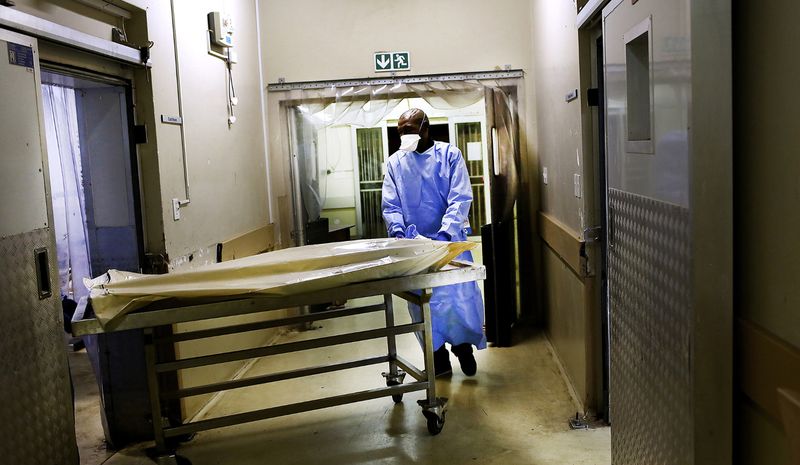
At Germiston’s forensic pathology service, grieving families are allegedly being asked for money to speed up post-mortem examinations that should cost them nothing. It is difficult to imagine a more revolting abuse of vulnerability: officials allegedly turning the agony of bereavement into an opportunity for extortion while the department responds with bureaucratic platitudes.
By Themba Khumalo
There is a special, unventilated room in hell reserved for those who look upon a grieving human being—someone crushed under the suffocating weight of a loved one’s death—and see nothing more than a paywall.
The report out of the Germiston Forensic Pathology Service is not just another story about public sector decay. It is a nauseating exposure of pure, unadulterated human rot.
Employees at a state mortuary—people tasked with handling the dead with basic human decency—have allegedly been standing between devastated families and the cold bodies of their mothers, fathers, and children, demanding cold, hard cash to “expedite” post-mortems.
Let that sink into your chest until it turns your stomach. On one side, a family shattered by death. On the other, someone staring at that grief and seeing an opportunity to make money. That is the obscene collision at the heart of this: grief on one side, greed on the other.
When you lose someone, time bends. You are in shock. You are trying to organise a funeral, comfort surviving children, hold your own cracking sanity together with both hands, and somehow navigate the staggering costs of burying your dead.
In the middle of this living nightmare, you go to a public facility to claim your relative. And there, standing behind a desk, is some low-level extortionist looking you dead in the eye, holding a corpse hostage, and essentially saying: Pay up, or let the post-mortem wait—and let the funeral wait with it.
It is predatory. It is slimy. It is a grotesque abuse of power that makes the skin crawl.
These are not criminal masterminds pulling off a sophisticated heist. These are parasitic bottom-feeders operating in the shadow of state authority, weaponising the tears of the broken for pocket change.
They know precisely what they are doing. They target people at their most defenceless, knowing that a weeping mother is not going to demand a supervisor, review departmental guidelines, or negotiate terms while her child lies on a stainless-steel slab down the hall.
They rely on the absolute desperation of families who will empty their last savings, borrow from loan sharks, or sell whatever they have left just to get their dead home for a dignified burial.
To prey on people at the absolute lowest point of their lives reveals a moral bankruptcy so profound it borders on the psychopathic.
How do these people go home at night? How do they sit down at the dinner table, buy groceries with money squeezed out of a weeping widow, and look their own children in the eye without flinching?
Yet, almost as infuriating as the extortion itself is the bureaucratic response from the Gauteng Department of Health.
Faced with a stomach-turning revelation that surfaced on social media, the department trotted out its standard, sanitised public relations script: We note the allegations with grave concern. Services are free. Please log a complaint with customer care.
Save us the sterile PR speak. “Grave concern” is an insulting posture when dealing with an atrocity this filthy.
Telling traumatised citizens to lodge formal administrative grievances against internal extortionists is institutional cowardice. Putting the burden of proof back onto grieving families—asking people who have just been emotionally mugged while trying to bury their dead to fill out paperwork, email quality assurance units, or call hotlines that barely function—is a cowardly attempt to manage a public relations headache rather than eradicate a disease.
The Gauteng Department of Health needs to get off its PR horse and move with merciless, uncompromising speed. An internal departmental “probe” that grinds slowly behind closed doors for months is not accountability; it is cover-up by delay, designed to let public outrage cool down until the news cycle moves on.
If the department wants anyone to believe it is not simply running damage control, the response must be immediate and severe.
This is no longer the time for carefully worded statements, bureaucratic rituals, or officials hiding behind procedures.
When grieving families can be shaken down for money to speed up post-mortem examinations, the rot has already penetrated far beyond a few rogue employees.
It raises the far more damning question of how long this has been happening, how many people have been victimised, who knew about it, who looked the other way, and who has been allowed to preside over a system in which the dead can apparently become bargaining chips.
The department therefore has no excuse for moving at the speed of bureaucracy. It must move at the speed of outrage.
Every person implicated must be identified, every official who enabled or ignored the abuse must be dragged into the investigation, and every state mortuary in Gauteng must be treated as a potential crime scene until proven otherwise.
The public does not need another press statement promising that allegations are being taken seriously. It needs to see the state finally take corruption seriously.
Suspensions at the Germiston facility must happen today, starting at the top. Extortion on this scale does not happen in a vacuum—it flourishes because leadership is either actively participating, profiting, or wilfully blind.
Stop treating criminal extortion as an internal HR squabble. Hand the files directly to the South African Police Service today, and launch undercover sting operations across every state mortuary in the province tonight.
Blast unmissable warnings across every waiting room desk declaring that every single service—from body storage to DNA analysis—is 100% free by law, and flood these facilities with independent integrity monitors so the burden of catching corrupt employees never again falls on a weeping citizen.
A civilised society cannot function when even death is subject to a shakedown. Every single employee who has ever taken a bribe to speed up a post-mortem examination is a vulture feeding on the grief of their own community. They should not just be fired—they should be named, shamed, and dragged through the criminal courts until they are locked away.
They deserve no union protection, no procedural stalling, no pity, and no second chances.