

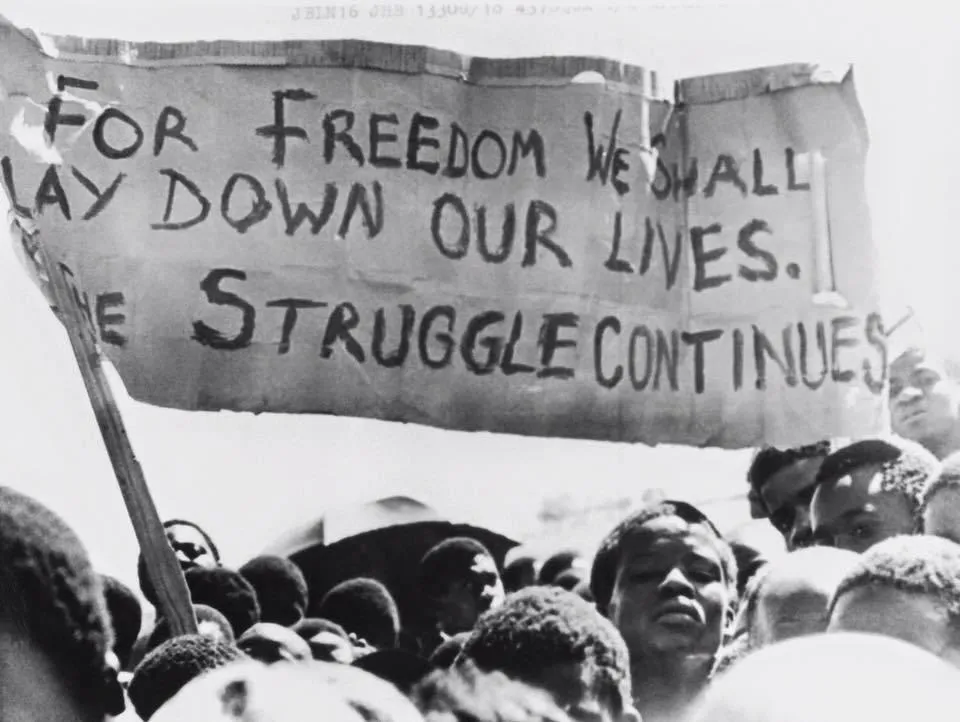
Gratitude has curdled into obedience, and old sacrifices are being used as a shield against present-day scrutiny. The struggle deserves reverence. The failed leaders hiding behind it deserve none. Separate the two, or keep mortgaging the country’s future to yesterday’s medals.
By Themba Khumalo
There is a particular kind of man in this country who wears 1976 the way other men wear cologne—applied liberally in the morning, so you smell him before he has said a word.
He does not enter a room so much as unveil himself in it, the struggle years trailing behind him like a cape he refuses to take off even indoors.
Ask him about his record in office, and he will hand you his record in exile. Ask him to account for a tender, and he will account for a detention. It is a magic trick, performed so often that half the country has forgotten it is a trick at all: yesterday, brandished hard enough, is supposed to make today disappear.
I want to be honest about where I stand before I take a hammer to that trick, because this is not an argument that can be made honestly from a place of contempt for the struggle itself. I have enormous respect for the men and women who surrendered the pleasures, the possibilities and the ordinary comforts of their youth to pursue the liberation of an oppressed people.
Some never lived to see the country they died imagining — they went into the ground believing that one day the law in this country would stop pricing a human life by the colour wrapped around it; that is not a small thing. It is not a thing I will cheapen for the sake of a clever sentence.
People from wildly different, often opposing political traditions endured prison, exile, banishment and violence — some paid with their lives — so that South Africa might eventually hold an election that meant something. That is part of this country’s moral bedrock, and anyone who denies it is either ignorant of history or lying about it on purpose.
But bedrock is not a throne. And this is where the trouble starts: the moment liberation history stops being a legacy we inherit and becomes a cudgel we are beaten with.
There is a breed of political personality now — and its numbers are swelling — who cannot survive a single conversation without first laying out his liberation résumé like a market trader spreading his wares on a blanket. Before his competence is examined, we are frog-marched back to 1985. Before his conduct is questioned, out comes the inventory: the arrests, the underground years, the comrades who never made it home, delivered with the solemnity of a eulogy and the strategic timing of a smokescreen.
The message underneath the message is always the same: history has excused me in advance. Whatever I have done since, take it up with the past.
Sit with that for a moment, because it is a genuinely extraordinary inversion. The very people who broke a system that ranked human beings by an accident of birth have, in some cases, built themselves a small hereditary peerage of their own — struggle credentials standing in for a coat of arms, sacrifice functioning as a title passed down not through blood but through repetition.
We are expected to defer because they were there, to admire because they suffered and, when the stench of wrongdoing becomes impossible to disguise, to hold our noses and look away because, after all, they were in the trenches, and who are we to judge a man from the safety of the peace he built for us?
Since when did suffering qualify anyone to lead?
Since when did surviving detention, or outsinging a stadium of comrades, become evidence that a man can run a municipality, administer a hospital, or keep his hands out of a public purse in the ruinously complicated South Africa of 2026? It never did. We have simply allowed nostalgia to perform a conjuring trick on our collective judgement and mistaken the smoke for the substance underneath it, because the smoke, at least, smells of something noble.
Here is the truth those men would rather you not examine too closely: courage and competence are not the same muscle, and exercising one does nothing whatsoever for the other. A man could have been fearless at twenty-five and be a catastrophe at sixty-five. He could have walked through fire once and decades later, be a hazard to everyone standing near him.
Liberation heroes are not saints whose biographies acquire supernatural immunity with age. They are human beings, with all the ordinary human talent for going rotten once the danger has passed and the perks have arrived.
And we have watched it happen in real time: institutions gutted, municipalities seizing up like unoiled engines, billions evaporating into an accounting fog, presided over by men whose political CVs would fill a shelf while their record in office would not fill an envelope.
So, let me ask the question properly, without flinching: what exactly are we supposed to do with the medal once the man wearing it has failed? Mount his incompetence in a glass cabinet because the frame around it once bore a struggle badge? Insist that a former political prisoner is somehow constitutionally incapable of greed, as though prison were an inoculation rather than simply a place some men come out of worse?
That is not reverence for liberation history. That is taxidermy — stuffing the corpse of a principle and propping it up in the hallway so no one notices it stopped breathing years ago.
The entire moral architecture of the struggle rested on one idea: that no person should hold unaccountable power over another. It was not fought so that yesterday’s activists could become today’s untouchables. It was not fought so that a new aristocracy could demand perpetual tribute from citizens whose only offence is having been born after the war ended.
A democracy cannot be run as an ancients’ cult. I can honour what a man did in 1985 without pretending that everything he does in 2026 is therefore beyond reproach.
These two positions are not in tension. They are, in fact, the entire architecture of accountability: remove one and the other collapses.
What riles me most is the slow, deliberate blurring of gratitude into obedience. Challenge a liberation veteran publicly, and the chorus arrives on cue, rehearsed to the syllable: do you know what this man sacrificed?
Yes, we know. We have always known. The question was never about yesterday — it is about what he is doing with today, this week, this tender, this budget.
A man’s history can explain him. It cannot indefinitely absolve him. If a former freedom fighter steals, the theft does not become struggle property, laundered clean by association. And the dead — the ones actually owed the reverence being borrowed here — cannot object when their names are conscripted to shield the living from a scrutiny they themselves would have demanded.
The country, meanwhile, has moved on, whether anyone is willing to admit it. The crises of 2026 are not the crises of 1986.
We now need people fluent in economics, in infrastructure, in digital systems, in institutional governance, in energy grids and public health logistics — not merely people who were brave four decades ago in a fight that, however righteous, taught them nothing whatsoever about running a power utility.
Courage without competence is not leadership. It is an expensive form of national self-harm: a pilot in the cockpit whose only qualification is that he once walked away from a different crash.
Which means we must stop disqualifying capable South Africans for the crime of lacking struggle credentials, while propping up exhausted relics for the accident of possessing them. There is a bitter irony in doing this in liberation’s own name. The struggle was meant to prise South African life open for everyone who came after — not reserve its leadership in perpetuity for whoever happened to be alive for one earlier chapter of it.
A South African born in 1996, competent, ethical, hungry to build something, should not have to queue behind mediocrity because she missed a war she was never given the choice to fight. Must every generation now produce a political birth certificate, proof of adequate suffering, before it is granted permission to lead?
Liberation was supposed to be an inspiration. It has, in too many hands, curdled into a qualifying exam nobody born after 1994 can ever sit. It should teach us what courage looks like — not exempt anyone from consequence, and certainly not become the excuse for hollowing out the very institutions it was fought to build.
There is something quietly insulting, too, in assuming that those who did not fight owe their political futures to those who did, as though democracy were a debt serviced in perpetuity by whichever generation happens to show up next at the counter.
Every generation has its own battlefield. Some fought apartheid with stones and songs and their own bodies. Others must now fight unemployment, decay, corruption and the slow, quiet rot of public trust — with spreadsheets, with policy, with the unglamorous discipline of simply doing the job properly. The country belongs to both in equal measure.
Struggle credentials are evidence of historical contribution. They are not evidence of competence, and they never were. Those who sacrificed deserve gratitude — not blind obedience. Those who fought for democracy deserve respect — not immunity from the very laws they helped write.
They earned, rightly, a place of honour in this country’s history. They did not acquire a deed of sale over its future, and no amount of struggle-song nostalgia will turn that deed into something that legally exists.
South Africa must finally separate the hero from the office, the sacrifice from the CV, the history from the job description. If the veteran is genuinely the best person for the job, appoint the veteran and let him prove it in the doing. If the newcomer is more capable, appoint the newcomer and let the results speak where the résumé cannot. That is not an insult to the struggle. It is the only sane, adult consequence of having actually won it.
The men and women who gave up their youth did not do so for this country to spend the next century on its knees, rummaging through a liberation archive for permission slips. They fought for a country where people would be judged by their character and their conduct — not their inheritance, not their surname, not the decade they happened to be born into.
So let us finally, without ceremony, retire the liberation past as some kind of divine appointment letter.
History deserves reverence. Leadership demands scrutiny. Nobody should be humiliated for a war they did not live through, and nobody — however loudly he sings, however long his list of arrests — should be worshipped forever for a chapter he closed decades ago and has been coasting on ever since.
This country does not need another museum. It has enough of those, curated by men who mistake the exhibit for themselves. What it needs, urgently and without further delay, are builders.