

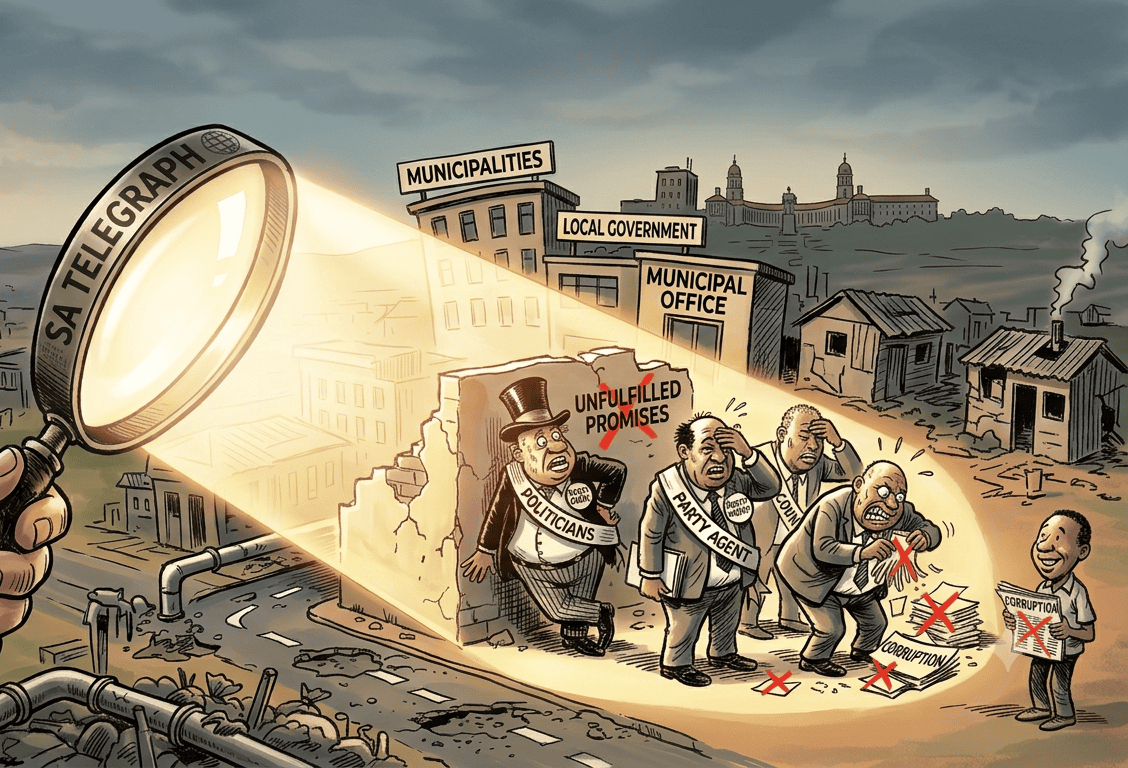
An informed vote is the only weapon capable of breaking the cycle of administrative decay. Ahead of the local elections in November, the SA Telegraph launches an extensive, in-depth series detailing municipal performance across the country, while putting political parties under a harsh spotlight to challenge their high-flown political rhetoric.
SA Telegraph Editorial
There is an old, comfortable illusion in politics that history is only made in capital cities, drafted by presidents and debated in Parliament.
We look to National Assembly benches and ministerial briefings for the trajectory of our country, believing that the grand project of building South Africa belongs entirely to the lofty echelons of national governance.
But the true state of our republic is not measured by the marble of the Union Buildings or the speeches delivered under parliamentary television lights.
It is measured at the doorstep.
It is found in the flickering streetlights of our major metros, the dry taps and potholed roads of our townships, the muddy roads of our rural and agricultural hubs, and the continuous, exhausting struggle of the ordinary citizen to secure the absolute basics of life.
Local government is where the state meets the human being. When local government fails, the constitutional promise of dignity dissolves directly into the dirt.
For too long, our municipal spaces have been treated by political formations as mere transactional chessboards—the ultimate prize for patronage, tender distribution, and endless coalition musical chairs.
While council chambers degenerate into shouting matches and executive mayors are shuffled in and out through short-sighted motions of no confidence, the administrative spine of our municipalities is left paralysed.
We see the result in the numbers, but we feel it in our daily lives. Massive debts to utilities like Eskom and Rand Water are not just abstract items on a balance sheet; they are the reasons small businesses collapse in the dark, and families carry buckets to private water tankers.
When forty per cent of a city’s clean water leaks into subterranean soil before reaching a single household, it is an engineering catastrophe masquerading as an accounting problem.
When watchdogs flag systemic corruption inside supply chain departments, it means money meant for tarred roads and functional substations is being pocketed by the politically connected.
Democracy is a fragile thing when it cannot deliver clean water, functioning sanitation, and safe streets.
If citizens lose faith in the local council, they lose faith in the democratic project itself.
On 4 November, South Africans will head to the polls for the local government elections. This is not a secondary ballot. It is the most critical democratic milestone on our horizon, and voters must use it to demand basic competence from those who seek to govern.
The SA Telegraph believes that an informed vote is the only weapon capable of breaking the cycle of administrative decay.
We refuse to let the upcoming campaigns dissolve into vague political slogans, hollow manifestos, and theatrical finger-pointing.
This publication is embarking on an extensive, uncompromising series dissecting the operational and financial realities of South Africa’s major metros and most troubled municipalities.
We will open the books, verify the figures, and look directly at the structural failures and plastic fixes holding our communities back.
Crucially, we will shine an aggressive spotlight on the political parties themselves. We will interrogate their track records, hold their governing coalitions accountable for the state of their respective councils, and demand clear, concrete engineering and financial plans rather than rhetorical promises.
The road to November begins now. It is time to look past the political noise, focus on the infrastructure under our feet, and map out the true anatomy of local governance.