

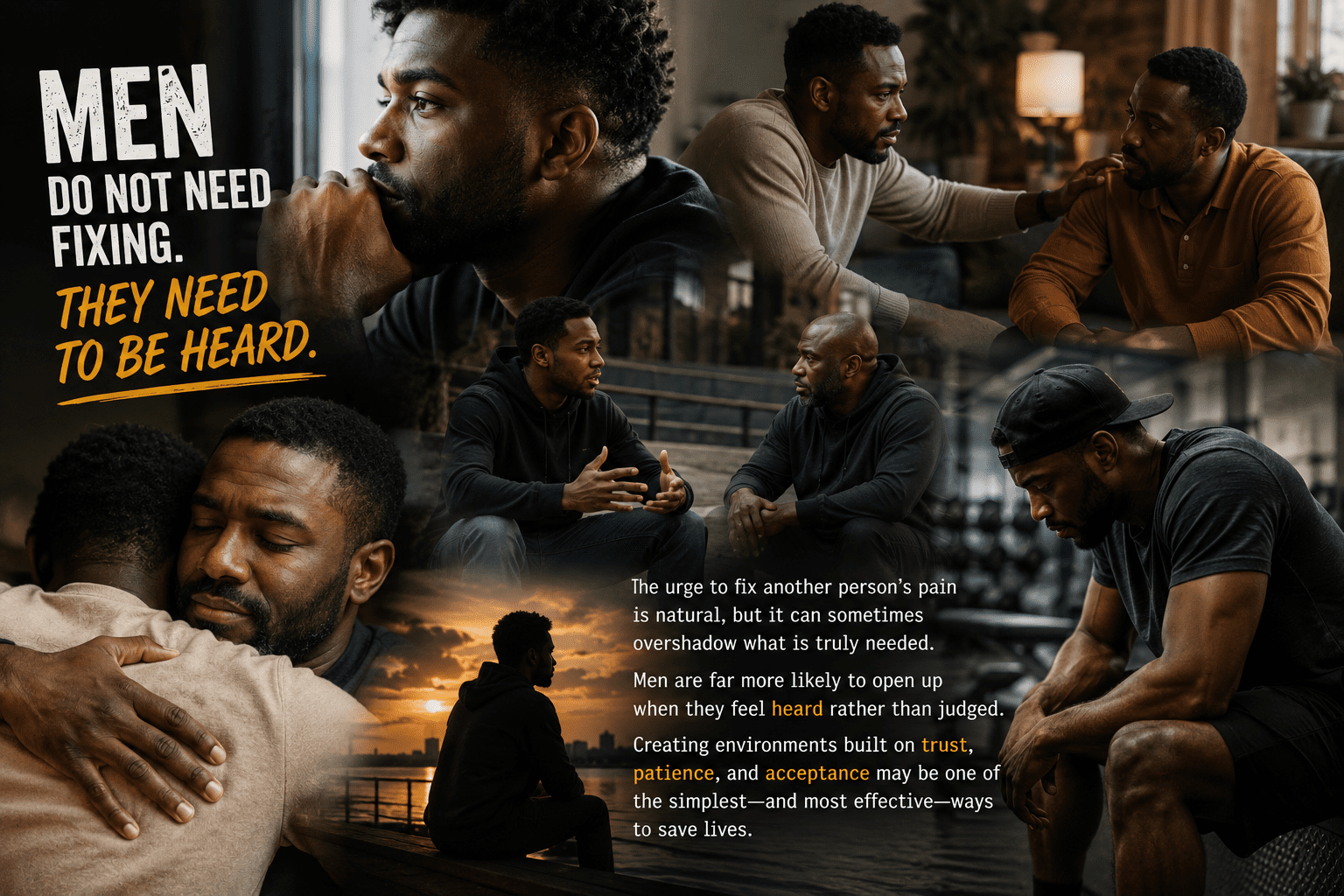
The urge to fix another person’s pain is natural, but it can sometimes overshadow what is truly needed. Men are far more likely to open up when they feel heard rather than judged. Creating environments built on trust, patience, and acceptance may be one of the simplest—and most effective—ways to save lives.

By Halima Layeni
Support does not require complexity. It requires presence, patience, and the willingness to listen without judgment, dismissal, or the urge to immediately fix.
It requires creating space where honesty is not punished or minimised.
In conversations around men’s mental health, this kind of support is often the missing piece. Many men do not struggle in silence because they have nothing to say, but because they have learned that saying it may not be met with understanding.
Over time, silence can become a form of protection rather than absence. If speaking leads to ridicule, minimisation, or discomfort in others, not speaking begins to feel safer.
When men do express emotional distress, it is often subtle. It may come out in indirect language, humour, irritability, withdrawal, or changes in behaviour rather than direct statements like “I am struggling.”
These expressions are not signs of emotional absence. They are signs of emotional caution. This is why presence matters. Not performance, not advice, not solutions offered too quickly, but genuine presence.
Being willing to sit with someone’s experience without rushing to correct it communicates something powerful: that their emotions are safe to exist in the room.
Patience also matters. Many men test the environment before they fully open up. A brief comment might carry more weight than it appears on the surface. A small disclosure may be an attempt to gauge whether deeper honesty will be met with respect or discomfort.
When those early signals are dismissed, the door often closes again. Listening without judgment is equally important.
Too often, men are met with comparisons, minimisation, or immediate reframing of their experience. While often well-intentioned, this can unintentionally reinforce the idea that their emotions need to be justified in order to be valid.
And the urge to fix, while natural, can sometimes interrupt what is actually needed: to be heard. Not every expression of pain requires an immediate solution. Sometimes it requires acknowledgment first, before anything else can be addressed.
Creating space where honesty is not punished or minimised changes everything. It allows men to move from guarded expression to genuine communication. It builds trust over time, not through grand interventions, but through consistent emotional safety.
When men experience that kind of environment, they are more likely to speak earlier, more openly, and more honestly. And early honesty is often what prevents deeper crisis later.
Support, at its core, is not about doing more. It is about being different in how we respond. And that difference can save lives.
Halima Layeni is a Speaker | Global Voice For Men’s Mental Health & Policy Reform | Author of Dear Man | Executive Director, Life After Abuse Foundation | Mental Health Coach For Professionals.