

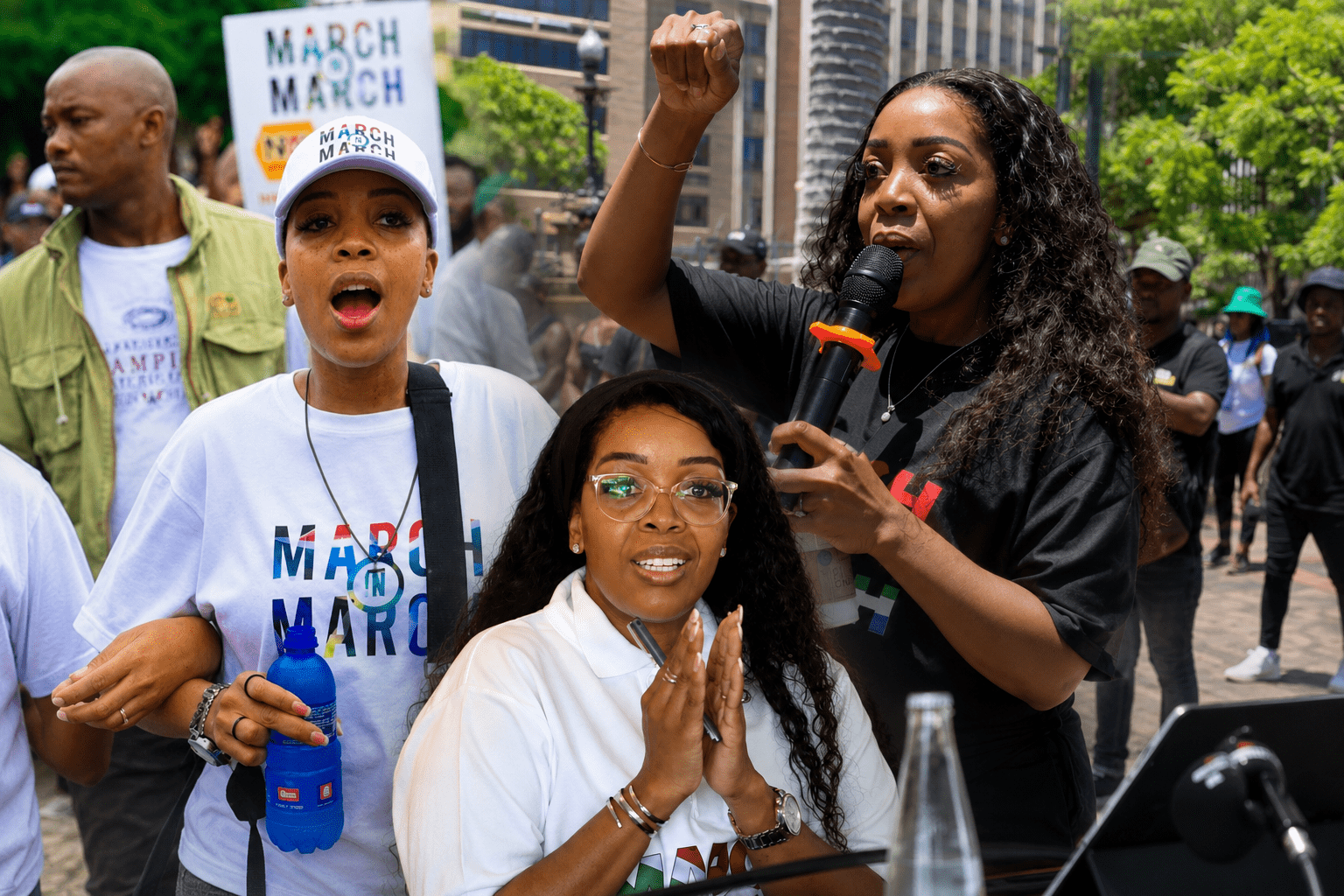
When a prominent civic leader demands that the law bend to raw prejudice, identity alone becomes an unpardonable offence. The thin line between legitimate immigration debate and unadulterated hatred vanishes.
By Themba Khumalo
There is a distinct and dangerous line in public discourse between arguing for rigorous immigration enforcement and descending into raw, unadulterated prejudice.
It is the line that separates a legitimate discussion around immigration challenges from a witch-hunt.
During the nationwide public consultation roadshow managed by the Department of Home Affairs regarding the future of the Zimbabwean Exemption Permit (ZEP) and the Lesotho Exemption Permit (LEP), Jacinta Ngobese-Zuma—the founder and leader of the anti-illegal migrants movement March and March—did not merely cross that line. She obliterated it, exposing a chilling undercurrent of systemic malice that should sound urgent alarm bells across South Africa.
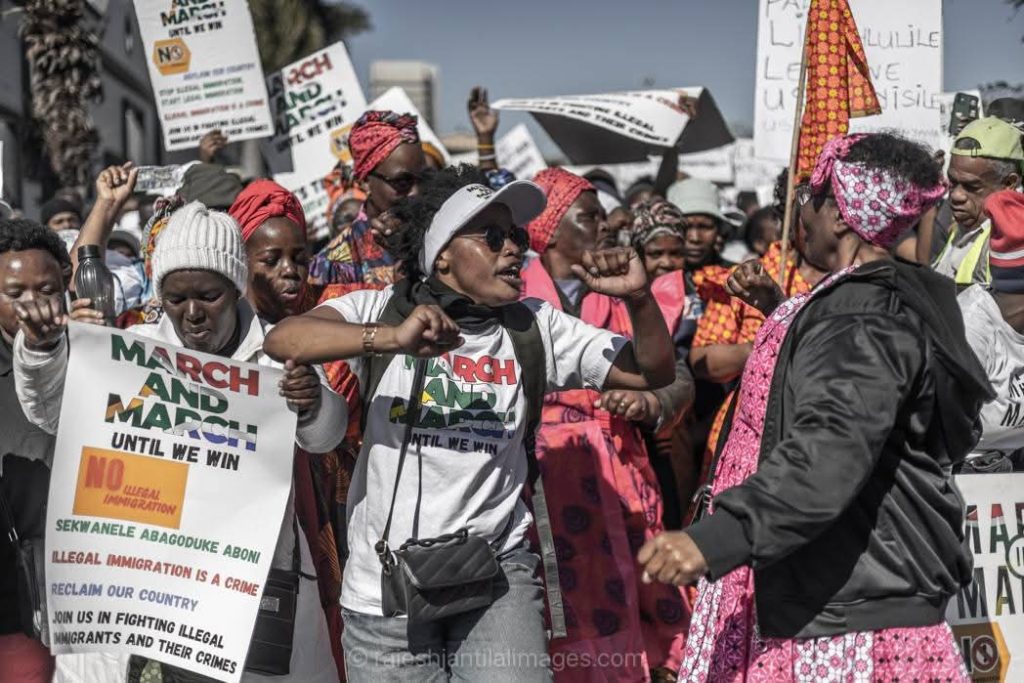
These consultations were legally mandated by the courts to ensure compliance with the Promotion of Administrative Justice Act (PAJA), following previous successful legal challenges by civil society groups.
However, instead of serving as a robust, legally structured democratic forum, the platform was hijacked to unleash an unmasked torrent of hostility.
To listen to Jacinta’s submission to the chairperson is to witness a disturbing shift in the anatomy of local xenophobia.
For years, groups like March and March have couched their activism in the respectable language of law and order, framing their campaigns around civic advocacy and the socio-economic immigration challenges facing South African infrastructure.
These are concerns many citizens share.
What Jacinta unleashes is something entirely different: a deeply personalised, psychologically charged tirade targeted explicitly and exclusively at Zimbabwean nationals, irrespective of their legal status.
Ripping Open the Anatomy of Rage
Using a sharp scalpel to dissect Jacinta’s words reveals a terrifying rhetoric that goes far beyond the technicalities of immigration challenges.
She explicitly dismissed the legal framework of the discussion, stating: “We are dealing with a psychological issue more than we are dealing with a legal issue.”
In doing so, the March and March leader attempted to pathologise an entire nationality.
Her assertion that “psychologically, Zimbabweans do not think that they are Zimbabweans” but “are convinced that they are South Africans” is a sinister attempt to strip a group of people of their agency, intelligence, and dignity.
This is not the language of a civic activist demanding better immigration control. This is the language of deep-seated disdain.
Jacinta did not stop at accusing Zimbabweans of legal overreach; she weaponised generalised cultural stereotypes, claiming that Zimbabweans look down on South Africans for being “drunks” and being “uneducated.”
By creating this fictitious, insulting dichotomy, she sought to stoke the fires of native resentment, transforming a bureaucratic review into a deeply personal ethnic war.
The Erasure of Legality
The most alarming aspect of this tirade is the absolute refusal to acknowledge the concept of legal immigration, culminating in a chilling admission of absolute rejection.
When the chairperson commendably interjected to inject sanity into the proceedings—correcting her by noting that ZEP holders are, by definition, legally residing and complying with South African law—Jacinta aggressively doubled down.
She turned her fury onto the state itself, declaring: “No, Chair, we’re not going to take back our words because you, as a department, want to legalise ZEPs. We don’t want them. We’ve never wanted them. It was your call as a department, not ours as South Africans.”

This is a pivotal, dangerous moment in the national discourse. By rewriting the definition of legality to suit her prejudice, Jacinta effectively argues that even when a foreign national follows all applicable laws, registers with the state, pays taxes, and holds valid documentation, they are still illegitimate.
The declaration that “We don’t want them. We’ve never wanted them” strips away the veneer of legal critique.
It signals that no matter how perfectly a Zimbabwean complies with South African law, their very existence within the borders is viewed as an offence. The subtext here is brutal and absolute: it is not your documentation that is the problem; it is your identity.
When the leader of an influential, highly mobilised citizen movement begins to echo the sentiment that a specific nationality is inherently unwanted regardless of the law, it lays the psychological groundwork for the justification of expulsion, segregation, and violence.
It signals to her followers that legal protections do not matter if the mob decides a presence is unwelcome.
The Hypocrisy of Denial
This unmasked hostility exposes a glaring, irreconcilable contradiction at the heart of March and March.
When pressed in public forums or facing media scrutiny, Jacinta routinely denies accusations of being xenophobic, hiding behind the shield of constitutional patriotism, public safety, and the rule of law.
Yet, it becomes entirely impossible to believe those denials when she retreats into tirades of this nature.
You cannot claim to merely oppose illegal immigration while simultaneously launching an all-out assault on legally documented residents simply because of where they were born.
When you stand before a government panel and announce that an entire population is collectively unwanted, the mask slips completely.
It proves that the “law and order” rhetoric is nothing more than a palatable front for deep-seated national chauvinism.
The denial of xenophobia rings hollow when the actual vocabulary being deployed dances so violently close to it.
Masking Hate as Legalism
Further in the transcript from the audio of the consultation, a paragraph directly outlines the dangerous endgame of this rhetoric.
Jacinta laid bare her true objectives when she addressed the panel, stating, “We don’t want you in our country. We just want the laws to enable us to—to reiterate that. Because currently, you guys having ZEPs makes you believe that we want you to still be in our country.”
This specific quote is a chilling manifestation of hatred dancing in plain sight.
It reveals that the legislative processes and the law itself are not being treated as instruments of justice or governance. Instead, they are being weaponised as tools to validate raw, exclusionary prejudice.
By demanding that the state strip away the ZEPs solely to send a message of total rejection, she is calling for the legal system to bow to public malice.
This statement strips away any lingering doubt regarding her intent. It is an open decree that the presence of an entire group of human beings is intolerable, and it demands that the state codify this intolerance into law.
The Myth of the Monolith
Jacinta openly admitted to her bigotry, stating without shame: “I am going to generalise because I am talking about Zimbabweans here in the majority.”
By treating millions of individual human beings—teachers, nurses, domestic workers, entrepreneurs, and children—as a single, malicious monolith, she commits the foundational sin of xenophobia.
She reduces human lives to a singular “other” that must be purged.
Her metaphor of “spilt milk” that cannot be put back into the carton is a telling slip; it frames human migration not as a complex social reality to be managed, but as a domestic mess to be cleaned up and discarded.
A Stark Warning for the Republic
We must look clearly at what is happening here. March and March is not a political party bound by formal electoral oversight, but a grassroots civic pressure group capable of mobilising immense street-level disruption.
When public participation forums, meant to uphold constitutional democracy, are hijacked to mainstream raw ethnic hatred, the fabric of our society begins to fray.
Jacinta’s words are a symptom of a darker, more volatile societal anger that is looking for a convenient scapegoat.
If we allow this specific hatred against Zimbabweans to be normalised under the guise of “citizen frustration” or “community advocacy,” we open a door that cannot easily be closed.

It is entirely permissible to demand that the state manage immigration challenges properly and fairly.
It is, however, completely unacceptable to demand the erasure of a specific group of people based on pure malice.
The alarm bells are ringing loudly.
If South Africa does not confront this toxic rhetoric with absolute moral clarity, the country risks losing its own humanity in the process.